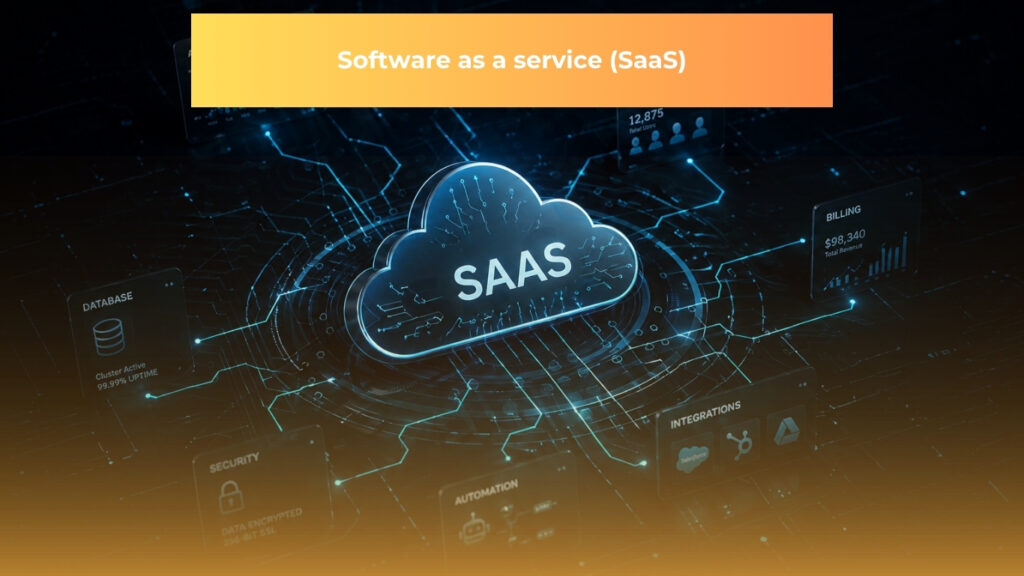
SaaS (Software as a Service) is not simply any kind of software; it is a specific delivery and licensing model for software.
Most of the software running modern businesses no longer lives on the machines where people use it. Email, accounting, customer records, project boards, payroll: these systems sit on servers owned by their vendors and reach the user through a browser tab.
By 2026, the global SaaS market exceeds 300 billion USD in annual revenue, with growth still running in double digits.
The term gets used loosely. Vendors apply it to anything that requires a login. Buyers use it interchangeably with “cloud” or “online.”
What Counts as SaaS
Browser access alone does not make something SaaS
A web interface is necessary but not sufficient. Plenty of products run in browsers without qualifying as SaaS.
A bank portal lets customers check balances; the underlying core banking system is licensed software running on the bank’s own infrastructure. A hotel chain’s booking site connects to property management software the chain installed itself. The browser is the access layer, not the delivery model.
The defining question is who owns and operates the running instance of the software. If the customer does, the product is on-premise software with a web interface. If the vendor does, and the customer pays for ongoing access rather than ownership, the product is SaaS.
The three conditions that define SaaS
The U.S. National Institute of Standards and Technology (NIST SP 800-145) specifies that SaaS gives the consumer the capability to use applications running on a cloud infrastructure operated by the provider, with the consumer controlling neither the infrastructure nor the application configuration beyond user-specific settings.
Three conditions follow:
- The vendor hosts and operates the software. The customer never installs it, never patches it, and cannot access the underlying servers, operating system, or database.
- The customer pays for ongoing access. Whether billed monthly, annually, or by usage, the relationship is access-for-fee. Stop paying and access ends.
- The same software instance serves many customers simultaneously. This is multi-tenancy: one codebase, one running system, many tenants whose data is logically separated.
A product hosted by the vendor but sold as a perpetual license is hosted software. A product running multi-tenant but sold once is licensed cloud software. Only the combination produces SaaS.
Why subscription changes everything about ownership
Subscription is often described as a payment mechanism. Its consequences run deeper than that.
Under a perpetual license, the software belongs to the customer once paid for. The vendor’s incentive ends at the sale; future revenue depends on selling upgrades, a separate transaction. Under SaaS, revenue continues only if the customer continues to use the product. The vendor’s incentive structure inverts.
Every feature decision, every support interaction, every uptime commitment exists in the shadow of next month’s renewal. Software improves continuously. Support responds quickly because cancellation is one click away. Pricing compounds because what the customer is buying is an ongoing service.
Tool, platform, application, and where SaaS sits
These words get used interchangeably in casual conversation, and the imprecision causes real confusion when buyers compare options.
An application is software that performs a defined set of functions for an end user. A spreadsheet program is an application. A CRM is an application. A platform is software that other software runs on top of, providing shared infrastructure such as authentication, data storage, APIs, and developer tools. Salesforce is both an application (the CRM product) and a platform (the underlying environment that allows third parties to build extensions).
A tool is the loosest term, usually referring to an application focused on a narrow task.
SaaS is a delivery model, a way of making software available, not a description of what the software does. An application can be sold as SaaS or as a perpetual license. A platform can be SaaS or self-hosted. What the software does belongs to a separate dimension.
How SaaS differs from on-premise software
On-premise software is installed on infrastructure controlled by the buyer. The buyer owns the license, runs the database, applies patches, and bears full responsibility for uptime, security, and disaster recovery.
The cost profile is heavy upfront:
- License fees and hardware
- Implementation services
- An internal team to operate the system
- Ongoing maintenance, typically 18 to 22 percent of the license fee per year for major enterprise systems
SaaS inverts this cost profile. There is no license to buy, no hardware to provision, no installation project. Cost arrives as a recurring subscription that includes hosting, security, support, and upgrades.
On-premise is not obsolete. It remains common in regulated industries with strict data residency requirements, in environments with poor connectivity, and in organizations whose customizations would be impossible on a multi-tenant platform. The choice is about which trade-offs the buyer is willing to accept.
Whether ChatGPT and Claude qualify as SaaS
When a business pays for ChatGPT Enterprise or Claude for Work and uses the web interface, the product behaves as SaaS in every meaningful respect. The vendor hosts the model and the application, the buyer pays a recurring subscription, and the same infrastructure serves many customers concurrently.
The picture shifts at the API layer. When a developer pays Anthropic or OpenAI for API access measured in tokens, the relationship is closer to infrastructure-as-a-service or platform-as-a-service. The buyer is consuming a capability to build into their own product.
The same model can reach users as:
- SaaS (a finished chat application)
- A platform (an API that developers build on)
- Embedded in another product (a CRM that adds an AI assistant powered by Claude or GPT)
Why SaaS is mostly a B2B story
Consumer subscriptions are large. Netflix, Spotify, and iCloud satisfy the technical conditions of SaaS. In industry conversation, however, SaaS almost always refers to business software, and the reason is economic.
Business buyers pay more, churn less, and embed software into operational workflows that resist replacement. A consumer cancels Spotify on a whim. A 500 person company does not cancel its HR system on a whim because thousands of records, integrations, and processes depe nd on it.
The unit economics that make SaaS attractive to investors, recurring revenue with high retention and expanding contracts, exist most reliably in the business segment.
How SaaS Became the Default
Software before the login screen
Until the late 1990s, business software arrived on physical media and ran on hardware the business owned. Acquiring a system meant buying servers, installing the application, configuring it to local processes, training staff, and maintaining everything in perpetuity. Implementation projects for major enterprise systems ran for one or two years and frequently failed.
The dominant vendors of the era, Oracle, SAP, Siebel, and Baan, sold software through large contracts, long cycles, and dedicated services teams. This model worked for the largest companies because they had IT departments capable of running it. A 50 person firm could not afford a six figure license plus the hardware and consulting needed to deploy it.
Why the PC era almost killed shared software
The 1960s introduced time-sharing, the first commercial arrangement in which multiple users connected to a central machine and paid for compute time. The personal computer ended that line of development.
Through the 1980s and 1990s, software shifted decisively onto local machines. Word processors, spreadsheets, accounting packages, and design tools all became products customers bought, installed, and ran on their own hardware. Networks were slow. Bandwidth was scarce. Browsers did not yet exist. Two decades of momentum built around a delivery model that the next decade would unwind.
Application Service Providers, the failed precursor
In the late 1990s, a category of vendor called Application Service Providers (ASPs) attempted something close to SaaS. ASPs hosted commercial software and delivered it to customers over the internet for a subscription fee. The promise: no installation, predictable cost, vendor-managed operations.
The execution failed. Most ASPs hosted single-tenant instances, meaning each customer got a dedicated copy of the software on dedicated infrastructure. The economics resembled hosting more than software, with thin margins and limited scalability. The applications were not designed for browser delivery, so the user experience was poor. Most ASPs failed in the dot com collapse.
The lesson the next generation absorbed: hosting existing software was not enough. The software itself had to be built for the model.
How Salesforce rewrote the rulebook in 1999
Marc Benioff founded Salesforce in 1999 with a deliberate rejection of the ASP approach. The company built its CRM application from the ground up to be multi-tenant, browser-delivered, and subscription-priced. The slogan, “No Software,” was a marketing statement aimed at Siebel, but it captured a real architectural difference.
Multi-tenancy was the technical breakthrough. By running one instance of the application serving many customers simultaneously, Salesforce spread infrastructure costs across the customer base, pushed updates to everyone at once, and reached margins that ASPs could not.
By the mid 2000s, Salesforce had demonstrated that a SaaS company could reach hundreds of millions in revenue. By 2010, it was clear the model would not stay confined to CRM. The architectural template Salesforce established became the default for new business software.
Why Adobe and Microsoft abandoned the boxed model
The transitions of Adobe and Microsoft are instructive because both companies had built dominant businesses on perpetual licensing and had every reason to defend it.
Adobe announced in 2013 that Creative Suite, its flagship design software, would no longer be sold as a perpetual license. The product became Creative Cloud, a subscription service. The reaction was furious. Customers signed petitions; long-time users felt expropriated.
Within three years the financial picture had changed completely. Subscription revenue exceeded what perpetual licenses had ever produced, customer lifetime value rose, and the company gained the ability to ship features continuously. By 2020, Adobe was one of the most consistently growing software companies in the world.
Microsoft followed a more gradual path with Office 365 (later Microsoft 365), launched in 2011. The company maintained perpetual licenses while making the subscription product more attractive on every dimension: cloud storage, collaboration features, mobile apps, security tooling. By the mid 2020s, the subscription product had become the primary version of Office.
From delivery model to economic foundation
By the mid 2010s, SaaS had moved past being a category and become the default mode for new software. Y Combinator and the major venture firms financed almost exclusively SaaS startups. Public market investors awarded the highest multiples to SaaS companies with strong retention metrics.
New business software is built as SaaS unless there is a specific reason not to. The exceptions, regulated industries, sovereign data requirements, edge environments, do exist, but they are exceptions to a default that holds across every other context.
Companies That Built the Industry
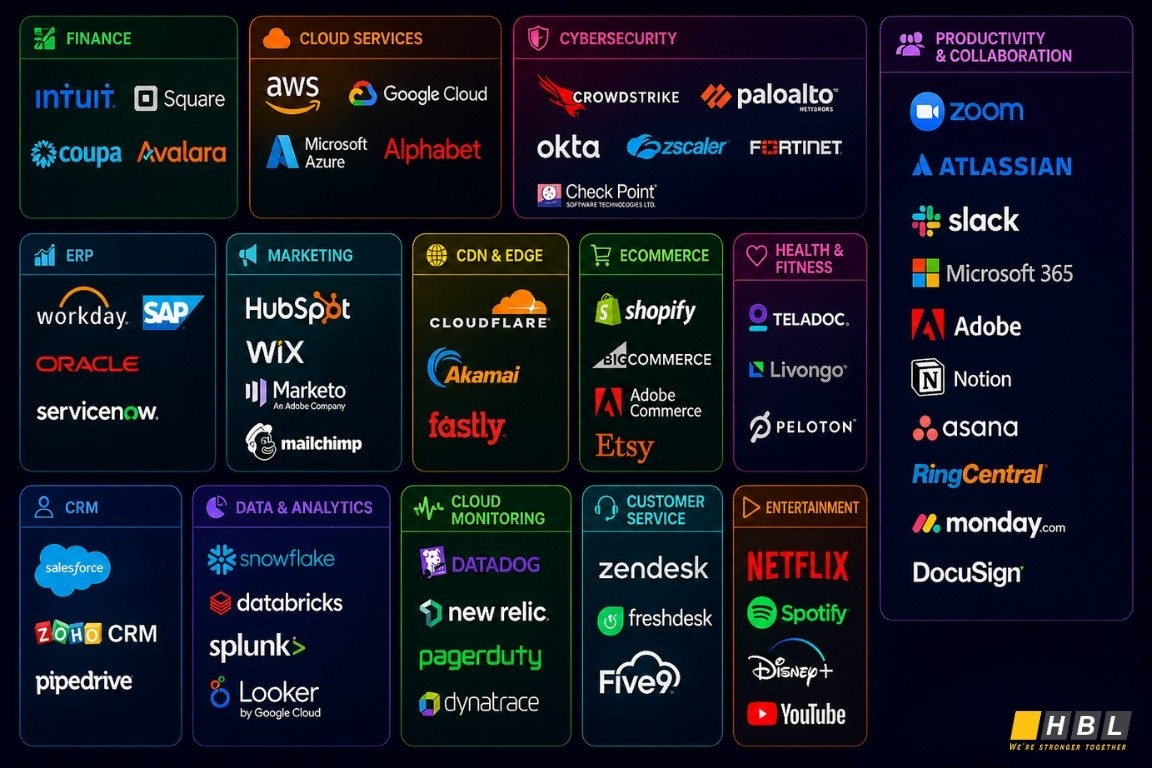
Why Salesforce gets the credit
Several companies were experimenting with browser-delivered software in the late 1990s. Concur, NetSuite, and a handful of smaller vendors all predated or paralleled Salesforce. The reason Salesforce gets credit for founding modern SaaS is the combination of architectural commitment, commercial discipline, and longevity.
- Architectural commitment: multi-tenancy from day one
- Commercial discipline: relentless focus on subscription metrics: annual recurring revenue, net retention, contract length
- Longevity: scaling past 30 billion USD in revenue without abandoning the model that started it
Other companies illustrated pieces of the SaaS playbook. Salesforce executed all of them simultaneously.
How Microsoft turned Office into recurring revenue
Office is the most installed software in history. Converting it to subscription was a high stakes operation that few companies could have survived. Microsoft’s approach was patient and bundled.
Microsoft 365 combines the Office applications with Exchange (email), SharePoint and OneDrive (storage and collaboration), Teams (communication), and security tooling. Each component on its own would face strong competition. Combined, they form a stack that is difficult to leave once a company has standardized on it.
Office became infrastructure rather than a product, deeply embedded in how organizations operate.
What Adobe gained by killing perpetual licenses
The 2013 transition cost Adobe goodwill in the short term. The long term gains were substantial enough that the move is now studied as one of the most successful subscription transitions in software history.
Three things changed:
- Revenue predictability raised the company’s stock multiple and reduced volatility under perpetual licensing
- Piracy fell sharply, because subscription licenses tied to authenticated accounts are harder to crack
- The product roadmap accelerated, because shipping features continuously is easier than packaging them for biennial releases
Customers usually adapt to subscription pricing within two or three years. The financial benefits of recurring revenue typically outweigh the transition costs.
Why Oracle and SAP took so long to commit
The two largest enterprise software vendors of the pre-SaaS era moved slowly into the model and only began serious commitments in the 2010s. The reason: the size of the business they were defending.
Oracle and SAP sold massive perpetual license deals to large enterprises and earned recurring maintenance revenue at high margins. Moving to SaaS meant cannibalizing this business. By the time the transitions began in earnest, smaller cloud-native competitors had captured significant segments:
- Workday took share from SAP in HR
- NetSuite (acquired by Oracle) took share in mid-market ERP
- Salesforce took share in CRM, sales, and service
Oracle Cloud and SAP S/4HANA Cloud are now real businesses generating significant revenue. The companies spent the better part of a decade catching up to a model their customers had already chosen.
The second generation that brought SaaS to everyone
Salesforce, Workday, and NetSuite built SaaS for enterprises. The second generation pushed it down market and into new categories.
Atlassian (Jira and Confluence) demonstrated that developer tools could be sold without a sales team, using a low-friction self-service model that scaled from individual developers to large engineering organizations.
Slack made workplace messaging spread inside companies through bottom-up adoption.
Zoom, propelled by the COVID-19 pandemic, became the default video conferencing tool for hundreds of millions of users.
HubSpot built a marketing and sales platform competing with Salesforce in the small and mid-market segment.
Notion, Canva, and Figma extended the category into design, documentation, and creative work.
Two patterns connect this generation:
- They distributed primarily through the product itself, not enterprise sales motions
- They prioritized user experience to a degree that earlier enterprise software had not
Inside a SaaS Product
Multi-tenancy
Multi-tenancy is the architectural decision that makes SaaS economically viable. A single instance of the application, running on shared infrastructure, serves all customers. Each customer (each tenant) sees only its own data and configuration. The vendor maintains one codebase, runs one set of servers, and ships one set of updates.
The alternative, single tenancy, gives each customer a dedicated copy of the software. Single tenancy offers stronger isolation and easier customization, at the cost of higher operational complexity and weaker margins.
The technical work that multi-tenancy requires is substantial:
- Data must be partitioned so no tenant can access another’s information, even by accident
- Performance must remain consistent so one large tenant does not slow the system for everyone
- Configuration must be flexible enough that each tenant can tailor the product without modifying shared code
Companies that solve these problems well achieve gross margins above 75 percent, which is part of why public market investors value SaaS so highly.
The technical components every SaaS needs
A functioning SaaS product requires several systems working together, most of which the end user never sees.
- Authentication and identity management handle who is allowed to log in and what they can do once inside, typically supporting single sign-on, multi-factor authentication, and integration with identity providers like Okta or Microsoft Entra
- Billing and subscription management tracks who pays what, when, and for which features; companies like Stripe have built large businesses solely around this layer
- Application logic is the actual product, the code performing the work the customer pays for
- Data storage holds customer data with partitioning and durability guarantees that multi-tenancy requires
- Infrastructure, almost always cloud-based, runs everything; AWS, Microsoft Azure, and Google Cloud Platform host the majority of the SaaS industry
The visible product is a thin layer on top of considerable engineering depth.
The customer journey from signup to renewal
The lifecycle of a SaaS customer divides into stages that vendors track closely because each stage corresponds to specific revenue risk.
- Acquisition: the prospect signs up; minutes for self-service products, months for enterprise deals
- Onboarding: the customer configures the product and begins using it. The first 30 to 90 days predict long-term retention more reliably than any other variable
- Activation: the moment the customer completes a key workflow or invites team members, signaling genuine product use
- Engagement: the steady state of regular use, monitored through daily and monthly active users, feature adoption, and support volume
- Expansion: the customer adds users, upgrades plans, or adopts additional products from the same vendor
- Renewal: the periodic decision to continue, usually annual
Vendors instrument every stage. The metrics that emerge, activation rate, time-to-value, net revenue retention, churn rate, predict future revenue more accurately than current sales numbers do.
Integrations, APIs, and the surrounding ecosystem
No SaaS product runs in isolation. The average mid-size company in 2026 uses more than 100 distinct SaaS applications, and they need to share data. APIs (application programming interfaces) are the standard mechanism, letting systems read and write data programmatically.
Some SaaS vendors go beyond APIs and build full platforms. Salesforce’s AppExchange, Atlassian’s Marketplace, and Shopify’s App Store let third party developers build and sell applications that extend the host product. Platform models produce stronger lock-in because customers depend on the integrated ecosystem rather than the host product alone.
Integration platforms like Zapier, Make, and Workato let non-technical users connect SaaS applications without writing code. Their existence is evidence of how fragmented the typical SaaS stack has become.
SaaS by Industry
Horizontal versus vertical SaaS
Horizontal SaaS sells to customers across industries by solving a problem that exists everywhere. CRM, accounting, email, project management, and HR are horizontal categories. A company in manufacturing and a company in law both need to manage payroll.
Vertical SaaS specializes in a single industry, building features and workflows that match how that industry actually operates. The bet is that depth beats breadth. A construction company will derive more value from a tool built specifically for construction than from a horizontal project management product.
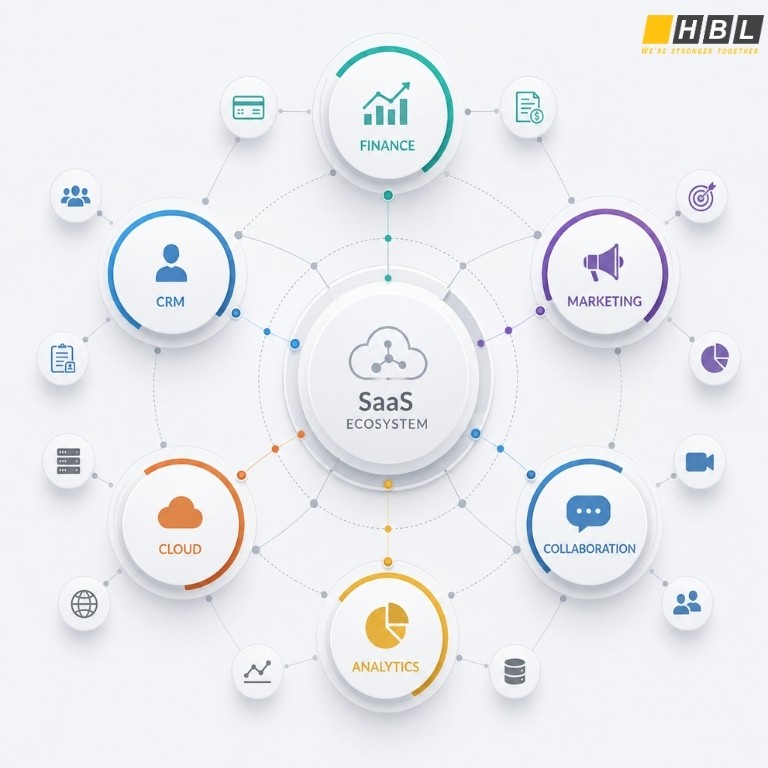
The vertical SaaS thesis has played out more successfully than many investors initially expected. Procore (construction), Toast (restaurants), Veeva (life sciences), and Clio (legal) have reached billions in valuation by serving industries that horizontal vendors found awkward to address.
Healthcare: Epic and Veeva
Epic Systems is the dominant electronic health record vendor in the United States. Most large hospital systems run on Epic. The implementations are heavyweight and the contracts large.
Veeva Systems serves life sciences companies (pharma, biotech, medical devices) with a CRM, regulatory document management, and clinical trial tools. Veeva’s depth in life sciences workflows has made it the standard in an industry that horizontal CRM vendors could not serve adequately.
Healthcare is not one market. It is a collection of specialized markets each requiring deep domain knowledge to serve.
Education: Canvas and Coursera
Canvas, by Instructure, is a learning management system used by universities and schools to manage courses, assignments, and grading. Coursera partners with universities to deliver courses to learners directly and sells enterprise versions to companies for employee training.
Both qualify as SaaS, though they monetize differently. Canvas earns through institutional contracts, Coursera through a mix of consumer subscriptions and enterprise deals. The education market has been slower to consolidate around SaaS because public sector procurement is slow and budgets are constrained.
Real estate and construction: Procore and CoStar
Procore makes construction management software for general contractors and owners to track projects, documents, and field operations. Construction has unusual workflows around drawings, RFIs, submittals, and safety compliance that require dedicated features.
CoStar provides data and analytics on commercial property markets through a subscription that real estate professionals consider essential. Once a contractor’s processes run on Procore, switching costs are high. Once a brokerage relies on CoStar data, alternatives feel inadequate.
E-commerce: Shopify and Klaviyo
Shopify provides the storefront, checkout, and back-office systems that let merchants run online stores, handling payments, inventory, shipping integration, and tax compliance. Klaviyo focuses on email and SMS marketing for e-commerce, with deep integration into Shopify and other commerce platforms.
A typical Shopify merchant might use 15 to 20 connected applications, and the integrations between them are part of the value proposition.
Finance: Stripe, Brex, Ramp
Stripe processes online payments for businesses ranging from individual creators to public companies. The documentation, dashboards, fraud tools, billing systems, and developer platform that accompany the payment rails are SaaS in every sense.
Brex and Ramp are corporate card and expense management products that combine card issuance with software for tracking and controlling spend. Both replaced a category that historically required separate banks, expense systems, and accounting integrations.
Financial services SaaS demonstrates how the category extends beyond traditional software into products that move money. The software wraps the financial activity and produces most of the differentiation.
Human resources: Workday and Rippling
Workday built a cloud-native HR and finance platform aimed at large enterprises, taking significant market share from SAP and Oracle in the late 2000s and 2010s.
Rippling is a newer entrant, integrating HR, IT, and finance into a single system that handles employees end to end, from hiring through payroll through laptop provisioning. Rippling’s bet is that a unified platform built around employees can replace several separate systems. Workday defined the category one way. Rippling redefined it.
Legal: Clio and Westlaw
Clio is the leading practice management system for small and mid-size law firms, handling case management, time tracking, billing, and client communications. Thomson Reuters Westlaw is a legal research database that has been delivered as a subscription service for decades.
Legal is a slower-moving industry technologically. The trend is now firmly toward cloud-delivered tools, accelerated by remote work and the integration of AI into legal workflows.
Hospitality: Toast
Toast provides a point-of-sale system for restaurants combined with payments processing, online ordering, payroll, and team management. A restaurant that adopts Toast for the POS often ends up using it for payroll and online ordering too, because integration reduces friction and bundling reduces total cost.
Restaurant operations, with their tableside ordering, kitchen routing, tipping calculations, and complex labor rules, demand specialization that a generic POS cannot provide.
Why Businesses Choose SaaS
Monthly payments versus large upfront purchases
The financial argument for SaaS is the conversion of capital expenditure into operating expenditure. A perpetual license requires a large purchase amortized over several years; the cash hits the budget upfront. A SaaS subscription is paid as the service is consumed, matching cost to usage and freeing capital for other purposes.
The financial benefit of SaaS is not always lower total cost. It is predictability, lower commitment, and the absence of upfront capital lockup. For many companies, especially smaller ones, those factors matter more than nominal lifetime cost.
Continuous updates
Under perpetual licensing, software improved in versioned releases. Customers received a new major version every year or two and decided whether to upgrade, often deferring for years to avoid disruption. Under SaaS, the vendor pushes updates continuously. There is no version to defer.
A vendor that ships an unwelcome change cannot easily be rejected. The customer’s recourse is feedback, support escalation, or leaving for a competitor. Most customers accept the trade because the cumulative pace of improvement is faster than what versioned releases delivered.
Scalability
A growing business using on-premise software hits hardware limits. Adding users means provisioning more servers, scaling databases, and managing capacity. Under SaaS, the vendor handles all of this. A company can grow from 10 to 1,000 users on the same product without thinking about infrastructure.
The constraints that used to slow growth, IT capacity, hardware procurement cycles, software deployment timelines, mostly disappear.
Remote access
The COVID-19 pandemic forced an abrupt shift to remote work in 2020. Companies running on cloud-based SaaS continued operating with minimal disruption. Companies running on-premise systems, where access required being on the corporate network, struggled.
The pandemic compressed several years of cloud migration into several months and ended any remaining debate about whether SaaS belonged in serious enterprise environments. Hybrid and remote work patterns persisted. SaaS is now a baseline expectation for new business software.
>> Cloud Migration in Australia: What Businesses Need to Know in 2026
Recurring revenue
Recurring revenue changes how software companies behave. A vendor whose revenue depends on next month’s subscription invests in customer success, builds support organizations sized to the customer base, and treats churn as a strategic priority.
For customers, this is mostly beneficial. The vendor’s incentives align with the customer’s continued satisfaction. The risk is that pricing power, once established, can be used to raise prices on captive customers. The same dynamic that makes SaaS vendors responsive also makes them difficult to leave.
Challenges of Saas
SaaS sprawl and the subscription pile-up
Most companies do not know how many SaaS applications they use. Studies by SaaS management vendors consistently find that the actual number, discovered through expense audits and identity provider logs, exceeds what IT believes by a factor of two or three. A 1,000 person company commonly runs more than 200 distinct SaaS applications.
The cost: duplicated tools, unused subscriptions, and integration debt. Subscriptions purchased on individual credit cards never make it onto the centralized inventory. The result is significant waste, often estimated at 20 to 30 percent of total SaaS spend.
Shadow IT
Self-service SaaS purchasing lets employees adopt tools without approval. A team that needs a new capability can sign up for a product and start using it within minutes, without involving IT, security, or procurement.
The phenomenon is known as shadow IT, and it is structural rather than accidental. The same friction that traditional IT procurement removed (long approval processes, lengthy deployments) was also the friction that prevented unauthorized tool adoption. SaaS made buying software easy, and that ease cuts both ways.
Data security and compliance pressure
Storing data with a third party requires trust that the third party will protect it. Most enterprise-grade SaaS products carry:
- SOC 2 Type II reports
- ISO 27001 certifications
- Industry-specific attestations: HIPAA for healthcare, PCI-DSS for payments, GDPR for European data
The compliance burden falls partly on the customer. Regulators hold the data controller (the customer) responsible for protecting personal data, regardless of who processes it. Companies in regulated industries spend significant effort vetting SaaS vendors, negotiating data processing agreements, and tracking subprocessor relationships.
Vendor lock-in and switching costs
Lock-in is rarely a single dramatic problem. It is the accumulation of small dependencies that eventually become impossible to disentangle. A company adopts a CRM, builds workflows around it, integrates other systems with it, trains employees on it, and accumulates years of historical data inside it. The cost of leaving grows with use.
Vendors design products to maximize this. Proprietary data formats, custom features, and platform ecosystems all increase switching costs. Some degree of lock-in is the price of using SaaS at all.
Customer churn and what drives it
Churn, the rate at which customers stop paying, is the single most watched metric in SaaS. A small change in monthly churn compounds dramatically over time:
- 2 percent monthly churn = approximately 22 percent of customers lost per year
- 5 percent monthly churn = approximately 46 percent of customers lost per year
Churn has two main drivers:
- Failed activation: customers who never reached the product’s core value during onboarding
- Degraded fit: customers whose needs evolved away from the product over time
Most SaaS companies invest heavily in both because the alternative is a leaky bucket that no amount of new sales can fill.
Renewal price escalation
Subscription prices rarely stay flat. Vendors raise prices at renewal, typically by 5 to 15 percent annually, citing inflation, new features, or platform investment. Customers absorb the increases because the alternative, switching, is more expensive than the price hike.
Some companies negotiate multi-year contracts with capped increases as a defense. Others accept the escalations as an ongoing cost. The dynamic is one reason why SaaS management has emerged as its own category, with tools and consultancies dedicated to optimizing subscription portfolios.
How SaaS Companies Charge
Per-seat pricing
Per-seat pricing, charging a fixed amount per user per month, is the dominant model in SaaS. It is simple to understand, predictable for the customer, and scales naturally with the size of the buyer’s organization.
The model works well when each user derives similar value and uses it actively. It works poorly when usage is uneven. A company with 200 employees might pay for 200 seats of a tool that only 60 employees actually use. Vendors increasingly offer usage-based or hybrid pricing as alternatives, particularly for products where usage varies significantly across users.
Usage-based pricing
Usage-based pricing charges according to how much the customer uses the product: API calls, transactions processed, gigabytes stored, messages sent. The model aligns cost with value more precisely and lowers the barrier to entry for small customers.
The challenge for vendors is revenue predictability. Most usage-based SaaS companies blend the model with platform fees or minimum commitments to recover some predictability. Stripe, Twilio, and Snowflake all use variants of usage-based pricing successfully.
Freemium versus free trial
Freemium offers a limited version of the product permanently free, hoping users will upgrade to paid plans. Free trials offer the full product for a limited period, typically 14 or 30 days, after which the user must subscribe.
- Freemium works for products with low marginal cost per user and viral characteristics. Slack, Notion, and Dropbox all grew through freemium.
- Free trials work for products where the cost of supporting free users would be prohibitive, or where core value requires genuine commitment.
The choice depends on product economics and the customer behavior the vendor is trying to encourage.
Tiered plans and annual contracts
Almost all SaaS products offer multiple pricing tiers: a basic plan for small customers, a mid-tier for growing customers, and an enterprise plan for large customers with custom requirements. Tiering lets vendors capture customers across a wide range of sizes and expand revenue as customers grow.
Annual contracts are common for everything except the smallest customers. Vendors prefer them because they reduce churn and improve cash flow. The compromise is usually a discount, often 10 to 20 percent, in exchange for annual commitment.
Product-led growth as a pricing strategy
Product-led growth (PLG) is a distribution strategy in which the product itself drives acquisition, conversion, and expansion. Customers find the product, sign up self-service, and begin using it before any salesperson is involved.
Companies that have executed PLG well, including Atlassian, Slack, Figma, and Notion, often grow faster and at lower customer acquisition cost than companies relying on traditional sales-led models. Most successful PLG companies eventually layer enterprise sales on top of the self-service motion to capture the largest accounts.
Where SaaS Is Heading
Vertical SaaS pulling ahead
Investment data through the mid-2020s shows venture capital flowing increasingly toward vertical SaaS rather than horizontal categories. Most major horizontal categories (CRM, HR, accounting, marketing) now have entrenched leaders, and new entrants face high competitive costs. Vertical categories often have no dominant SaaS leader yet, and the deep workflows specific to each industry create defensible positions.
The next generation of large SaaS companies will likely come from vertical specialization in industries still underserved by existing software, including agriculture, logistics, public sector, and skilled trades.
Enterprise consolidation
Large enterprises, having accumulated hundreds of overlapping SaaS subscriptions over the past decade, are now consolidating. CFOs and CIOs are auditing their stacks, eliminating duplicates, and standardizing on platforms that cover multiple categories.
The trend favors vendors that can credibly serve multiple needs (Microsoft, Salesforce, ServiceNow) at the expense of point solutions that solve one problem well but do not extend. This is partly a reaction to the spending excess of 2020 to 2022, and partly a structural shift toward platforms over best-of-breed approaches.
Platform business models
The most valuable SaaS companies are increasingly operating as platforms rather than standalone products. Salesforce derives a substantial portion of its revenue from the AppExchange ecosystem. Shopify monetizes its app store and payments rails alongside the core platform. Atlassian’s marketplace generates significant third party revenue.
The platform model produces stronger lock-in, higher revenue per customer, and competitive advantages that are difficult to replicate.
From growth-at-all-costs to efficient growth
Public market sentiment toward SaaS shifted sharply in 2022. The previous decade had rewarded growth at any cost; companies could lose money indefinitely if they grew quickly enough. The shift in interest rates and investor expectations changed this.
Now public SaaS companies are evaluated on efficient growth, measured through metrics like the Rule of 40 (revenue growth plus operating margin should sum to at least 40 percent) and net revenue retention. The era of unprofitable hypergrowth is over for most companies.
Market size and forecast to 2035
The global SaaS market exceeds 300 billion USD in 2026 and continues to grow at approximately 13 to 18 percent annually. Forecasts to 2035 suggest the market will reach somewhere between 800 billion and 1.2 trillion USD, depending on assumptions about emerging market adoption, AI integration, and the boundary between SaaS and adjacent categories.
The growth drivers are well understood:
- Continued enterprise migration from on-premise systems
- Expansion into emerging markets
- Vertical specialization opening new categories
- AI capabilities embedded into existing SaaS products, increasing their value and pricing power
Common Questions
SaaS versus a normal application
A normal application is software that performs functions. SaaS is a way of delivering software. The same application can be sold as SaaS or as a perpetual license. The defining property of SaaS is the combination of vendor hosting, subscription pricing, and multi-tenant architecture. An application without those properties is software. With them, it is SaaS.
Whether SaaS is only for businesses
Technically no. Netflix, Spotify, and most streaming services qualify as SaaS by the operational definition. In industry usage, however, SaaS almost always refers to business software because that is where the economics of the model produce the most distinctive results. When someone says they work in SaaS, they almost certainly mean B2B software.
How to tell if a product is actually SaaS
Three questions decide it:
- Does the vendor host the software, with the customer never installing or maintaining it?
- Does the customer pay an ongoing subscription rather than a one-time license?
- Does the same instance of the software serve many customers simultaneously?
Three yes answers identify SaaS. Anything less is a related but different category: hosted software, licensed cloud software, or single-tenant managed services.
SaaS versus cloud software
Cloud software is a broader term that includes infrastructure-as-a-service (IaaS), platform-as-a-service (PaaS), and software-as-a-service (SaaS). All SaaS is cloud software. AWS EC2, which provides virtual machines, is cloud software but not SaaS. The customer still installs and operates whatever runs on those machines.
The distinction matters in technical procurement and contracts. For casual usage, the terms get conflated.
What happens to your data if a provider shuts down
If a vendor goes out of business or discontinues a product, customer data may become inaccessible. Reputable vendors include data export provisions in their contracts and provide notice periods before shutdown. Smaller vendors and free products offer fewer guarantees.
Customers managing critical data on SaaS products should:
- Maintain regular exports of important data
- Evaluate vendor financial health for mission-critical systems
- Understand what their contracts require in shutdown scenarios
The risk is not theoretical. Several SaaS startups shut down each year, and customers occasionally lose access to data on short notice.
Why SaaS prices creep up annually
Vendors raise prices because they can. Switching costs make customers reluctant to leave over single-digit price increases. Vendors cite inflation, new features, infrastructure costs, and platform investment, all of which are real to varying degrees, but the underlying reason is pricing power.
Customers who want to limit increases can:
- Negotiate contracts with capped escalations
- Choose multi-year agreements at locked rates
- Maintain credible alternatives so that switching threats carry weight
Self-hosted security myths
The intuition that self-hosted software is more secure than SaaS is widespread and usually wrong. SaaS vendors operating at scale invest more in security than most individual companies can afford. They employ dedicated security teams, run continuous monitoring, maintain compliance certifications, and patch vulnerabilities centrally.
The exceptions are real but specific. Highly regulated organizations, government agencies, and companies with extreme data sensitivity sometimes have legitimate reasons to keep systems on-premise. For most companies, SaaS is more secure than what they would build themselves, not less. The discomfort of trusting a third party is real, but the alternative is rarely safer in practice.
Read more:
– 7 Best Workflow Automation Software: Which Type Fits Your Business
– Software Development Life Cycle Phases: Step-by-Step Guide
– Team Software Process (TSP) and Personal Software Process (PSP)