
Cloud migration in Australia is accelerating at a pace that makes it a strategic business priority rather than an optional technology upgrade. Public cloud spending in Australia is projected to rise from A$12.2 billion in 2022 to A$22.4 billion in 2026, an 83 percent increase, according to IDC research commissioned by Microsoft. That growth is driven by infrastructure cost pressure, a maturing regulatory environment, and the emergence of AI workloads that older systems simply cannot support.
Why Australian Businesses Are Moving to the Cloud
The primary technical obstacle pushing organisations toward cloud migration in Australia is legacy infrastructure. Legacy systems are older on-premise (meaning physically housed within the organisation’s own premises) IT infrastructure built before cloud computing became commercially viable, typically from the early 2000s. These systems are expensive to maintain, require specialist staff to operate, and cannot support modern workloads such as AI-driven analytics or real-time data processing at scale.
The financial model of cloud infrastructure differs fundamentally from what traditional environments require.
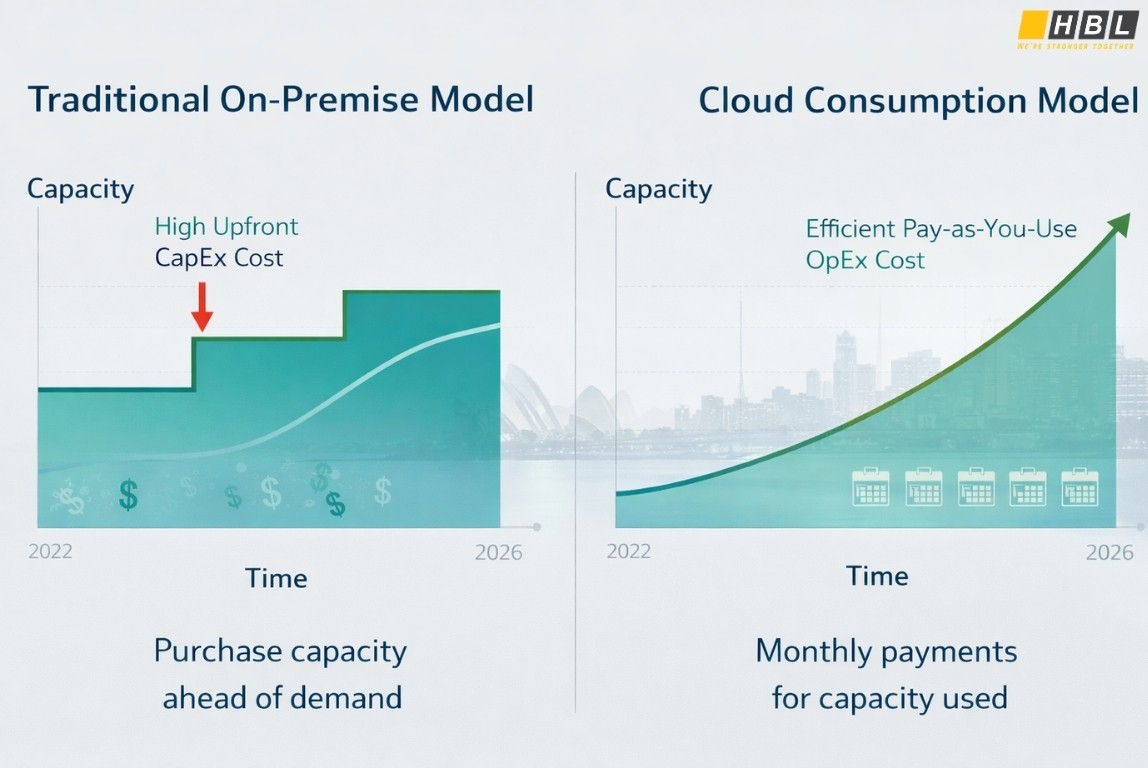
CapEx (Capital Expenditure) means purchasing and owning physical hardware upfront, with costs incurred regardless of how much capacity is actually used.
OpEx (Operational Expenditure) means paying for computing resources as they are consumed.
Moving to the cloud converts IT costs from CapEx to OpEx, removing the recurring burden of hardware refresh cycles.
Data residency, the legal requirement that certain sensitive data must remain stored within Australian geographic borders, was previously a barrier for some organisations.
AWS (Amazon Web Services), Microsoft Azure, and Google Cloud now operate local cloud regions in Sydney, Melbourne, and Brisbane, resolving this concern without introducing performance trade-offs.
The regulatory signal from government reinforces all of the above. The Australian Government’s Whole-of-Government Cloud Computing Policy takes effect on 1 July 2026, requiring all Australian Public Service agencies to adopt cloud for new digital initiatives and decommission legacy systems. For private sector organisations, this confirms that cloud infrastructure is now a structural baseline.
The Four Cloud Migration Strategies
Every cloud migration begins with an assessment. This is a structured review of existing systems, application dependencies (meaning how different software relies on other software to function), data sensitivity, and workload performance requirements. Skipping this step is the most common cause of budget overruns and extended timelines, and organisations that attempt to move systems without mapping dependencies consistently encounter downtime and unexpected costs.
Once the assessment is complete, organisations apply one of four recognised strategies to each workload, defined as a discrete computing task or application running on a server, ranging from a payroll system to a customer database.
Rehost (Lift and Shift): The workload moves to the cloud with no code changes. This is the fastest option and suits stable applications that do not require cloud-native features.
Replatform: Targeted technical adjustments are made so the application performs better in a cloud environment, without a full rebuild. A common example is switching from a self-managed database to a fully managed cloud database service.
Refactor: The application is redesigned from the ground up to use cloud-native capabilities such as serverless computing (where the cloud provider manages all server operations automatically) or containerisation (packaging software to run consistently across different environments). This takes the most time but delivers the highest long-term performance gains.
Repurchase: The existing application is retired and replaced with a commercially available cloud-based subscription service, such as replacing a locally hosted CRM (Customer Relationship Management) system with Salesforce or Microsoft 365.
Most Australian enterprises apply a mixed-strategy approach, assigning different strategies to different workloads based on each system’s criticality and migration risk.
Benefits and Challenges of Cloud Migration for Australian Organisations

Scalability is the most immediate operational benefit cloud migration in Australia delivers. Cloud infrastructure lets organisations increase or decrease computing resources in direct response to demand, without purchasing additional hardware. A retail business can process significantly higher transaction volumes during peak trading periods without having provisioned additional server capacity in advance.
Security is a documented advantage that deserves careful attention. Major cloud providers invest in security infrastructure at a scale that no individual Australian business can replicate internally. The ACSC (Australian Cyber Security Centre) has published cloud security guidelines that align directly with the capabilities built into major provider platforms, giving organisations a recognised framework for evaluating their cloud security posture.
One of the most significant benefits of adopting cloud for innovation in Australia is that cloud infrastructure is the technical prerequisite for deploying Generative AI (AI systems that produce text, code, or data outputs based on learned patterns) and advanced analytics at scale. Organisations running on legacy infrastructure cannot access these capabilities without first completing their cloud migration.
>> The Ultimate AI Agent Development Guide
Cloud platforms also provide geographically distributed backup and disaster recovery (automated systems that restore operations after a failure, breach, or data loss) services that on-premise data centres cannot replicate at comparable cost or speed.
The challenges are equally concrete. Australia faces a significant shortage of experienced cloud architects and engineers, a finding documented in ADAPT research on the state of the Australian technology workforce. This shortage extends migration timelines, increases dependence on third-party managed service providers, and reduces an organisation’s ability to execute complex migrations using internal staff.
Cost sprawl is a persistent risk in cloud environments. Without structured cost governance, cloud spending rises unpredictably through unused provisioned resources or undisclosed data transfer fees. FinOps (Financial Operations for cloud) is the discipline that applies financial accountability to cloud resource usage by assigning spending ownership and optimising provisioned capacity. AWS Cost Explorer and Azure Cost Management are examples of tools organisations use to identify wasteful spending before it compounds into a material budget problem.
Cloud Migration Compliance in Australia
Cloud migration compliance in Australia in 2026 is a legal obligation shaped by federal privacy legislation, sector-specific regulatory standards, and a regulator that is actively pursuing enforcement action. Treating compliance as an afterthought during migration exposes organisations to penalties that Australian courts have now demonstrated they are prepared to impose.
The primary federal law governing personal information is the Privacy Act 1988, administered by the OAIC (Office of the Australian Information Commissioner). Beneath the Act sit 13 Australian Privacy Principles (APPs) that define specific obligations around data collection, storage, use, disclosure, consent, and security. These obligations apply to most Australian organisations and to foreign entities processing personal data about individuals in Australia.
The Privacy and Other Legislation Amendment Act 2024 received Royal Assent on 10 December 2024 and introduced changes directly relevant to cloud migration. Under APP 8 (Australian Privacy Principle 8, which governs cross-border data disclosure), organisations remain legally liable for how personal data is handled after it is transferred to an overseas cloud provider or SaaS (Software as a Service) platform.
Contracts with vendors are no longer sufficient to demonstrate compliance. Organisations must have real-time visibility into where their data actually flows, because liability follows the data, not the contract.
APRA (the Australian Prudential Regulation Authority) regulates banks, insurers, and superannuation funds. Its CPS 234 standard (Information Security) and CPS 230 standard (Operational Risk Management, in effect from 2024) require APRA-regulated entities to classify data by sensitivity, vet the information security practices of all third-party cloud vendors, and notify APRA within 72 hours of any material security breach.
The key frameworks applicable to most organisations are:
- Privacy Act 1988 and the 13 APPs: Applies to most Australian organisations and to foreign entities that process personal data about individuals in Australia.
- APRA CPS 234 and CPS 230: Mandatory for financial institutions, insurers, and superannuation funds. Requires data classification, third-party vendor vetting, and breach notification within 72 hours.
- Australian Government Hosting Certification Framework: Sets minimum security standards for cloud-hosted government data across federal agencies.
- Whole-of-Government Cloud Computing Policy (effective 1 July 2026): Requires all Australian Public Service agencies to adopt cloud for new digital initiatives and decommission legacy systems.
- OAIC Regulatory Priorities 2025 to 2026: The regulator is actively scrutinising cloud-related practices in healthcare, financial services, and AI-adjacent technologies.
In October 2025, the Federal Court ordered Australian Clinical Labs to pay AUD 5.8 million following a 2022 cyberattack that exposed the personal data of more than 223,000 individuals. This is the first civil penalty issued under the Privacy Act. The decision confirms that Australian organisations cannot rely on third-party providers to absorb legal responsibility for data breaches that occur within their cloud environments.
Where Cloud Migration Is Already Delivering Results in Australia
Banking and financial services provide the clearest evidence of what cloud migration in Australia delivers at scale.
CommBank completed the migration of its full data platform to AWS in May 2025, working with AWS and HCLTech to transfer:
- Over 61,000 data pipelines
- 10 petabytes of data
- Across 200 source systems
The bank now runs over 2,000 AI models making approximately 55 million automated decisions daily, a level of AI deployment that was not achievable on its previous on-premise infrastructure.
Healthcare and government have demonstrated that cloud migration can be completed safely for highly sensitive workloads.
eHealth NSW migrated its most critical clinical applications to AWS, enabling secure cross-state sharing of patient records and supporting telehealth services across remote regions where physical infrastructure is limited. The migration demonstrates that scale and data sensitivity are not barriers to cloud adoption when the assessment and compliance groundwork is done correctly.
Mining operations illustrate a different set of use cases.
Australian mining companies use cloud-enabled IoT (Internet of Things, meaning internet-connected sensors and devices) networks to monitor remote machinery across geographically isolated sites. Processing large seismic and geological datasets in real time requires computing capacity that on-site servers cannot provide, and cloud platforms remove that infrastructure bottleneck. Retail organisations similarly scale computing capacity dynamically during peak periods, processing transaction data at volumes and speeds that legacy systems cannot match.
About HBLAB
HBLAB is a Vietnam-headquartered technology partner with a global presence across Australia, Singapore, Japan, and South Korea, delivering enterprise-grade cloud migration and modernisation services to organisations at every stage of their digital journey.

With 10+ years of experience in custom digital solutions and AI expertise dating back to 2017, HBLAB now integrates Professional AI Procedures across every phase of migration and modernisation. From initial dependency assessment through to post-migration optimisation, these AI-driven workflows significantly reduce delivery timelines while ensuring every roadmap is precisely tailored to your organisation’s systems, compliance obligations, and business objectives.
Backed by a team of 700+ IT professionals, CMMI Level 3 certification for process excellence, and enterprise-grade security safeguards, HBLAB brings the rigour that Australian compliance requirements demand. Flexible engagement models including offshore, onsite, dedicated teams, and BOT (Build-Operate-Transfer) give clients full control over workflows and delivery, at up to 30% cost efficiency compared to local market rates.
CONTACT US FOR A FREE CONSULTATION
Frequently Asked Questions
1. What is cloud migration and why does it matter for Australian businesses in 2026?
Cloud migration is the process of moving an organisation’s data, applications, and IT systems from on-premise infrastructure to cloud-based platforms. In 2026, it matters because the Australian Government’s Whole-of-Government Cloud Computing Policy takes effect on 1 July, legacy infrastructure can no longer support AI or real-time workloads, and regulators are actively enforcing data compliance obligations.
2. How long does a cloud migration typically take?
Timelines vary significantly depending on the complexity of your existing systems, the number of application dependencies, and the migration strategies applied to each workload. Simple rehosting projects can be completed in weeks. Refactoring enterprise applications can take 12 to 24 months. Providers that incorporate Professional AI Procedures into the assessment and planning phases can compress these timelines considerably.
3. What is the biggest risk of cloud migration for Australian businesses?
Skipping the dependency mapping assessment before migration begins. Organisations that move workloads without fully understanding how their systems interconnect consistently encounter unplanned downtime, budget overruns, and compliance gaps.
4. How much does cloud migration cost?
There is no fixed figure. Costs depend on the number of workloads being migrated, the strategies applied, the complexity of your compliance obligations, and whether you use internal staff or an external partner. The shift from CapEx to OpEx means upfront hardware costs are replaced by ongoing consumption-based spending. Without a FinOps governance framework in place, cloud costs can grow unpredictably after migration.
5. Does my data have to leave Australia when I move to the cloud?
Not necessarily. AWS, Microsoft Azure, and Google Cloud all operate local cloud regions in Sydney, Melbourne, and Brisbane. Organisations with data residency obligations can keep sensitive data within Australian borders while still accessing full cloud capabilities.
Read more:
– AI-Driven Business Transformation: What It Actually Means and How to Execute It
– Legacy Systems: What They Are, Why They Persist, and What to Do About Them