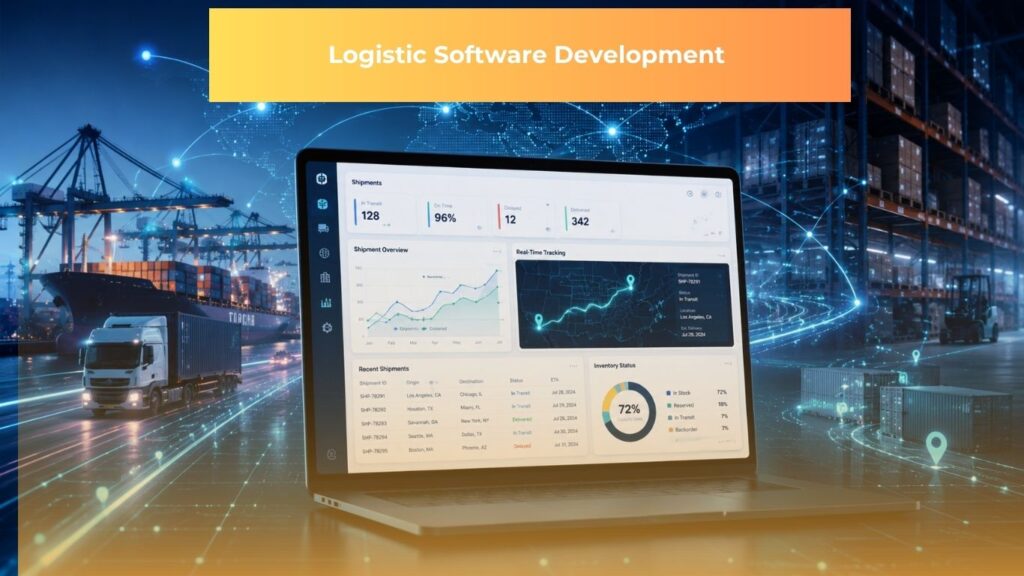
Logistic software development services fit when dispatch logic, carrier contracts, cold chain checks, warehouse layouts, billing rules, or customer portals need process specific design. They also give product owners more control over data ownership, user experience, integrations, and release priorities.
The global logistics software market was estimated at approximately $17.47 billion in 2026 and is projected to reach $31.74 billion by 2034, at a CAGR of 7.75% (Fortune Business Insights).
As cloud based deployment reaches about 64% to 66% of the market, logistic software development services increasingly focus on cloud based logistics platform design, ERP integration, API first architecture, real time tracking, and analytics for daily decisions.
What Is Logistics Software?
Logistics software is a digital system used to plan, manage, track, and optimize the movement of goods, vehicles, inventory, orders, and delivery information across the supply chain. It helps logistics teams replace manual coordination with real time data, automated workflows, and centralized visibility across transportation, warehousing, fleet operations, and customer delivery.
For a 3PL provider, logistics software may manage shipment planning, carrier assignment, warehouse inventory, proof of delivery, and customer reporting. For an e commerce business, it may connect online orders with fulfillment centers, delivery partners, return workflows, and customer notifications. For a manufacturer, it may support inbound materials, finished goods distribution, supplier coordination, and freight cost control.
The core value of logistics software is operational control. Instead of relying on disconnected spreadsheets, emails, phone calls, and legacy tools, companies can monitor orders, stock levels, vehicles, delivery status, exceptions, and performance metrics in one connected system. This becomes critical as shipment volume grows, delivery windows tighten, and customers expect accurate, real time updates.
Common logistics software categories include:
- transportation management systems
- warehouse management systems
- fleet management software
- order management systems
- freight management platforms
- supply chain visibility tools
When these systems are built around company specific workflows, logistics software becomes more than a tracking tool. It becomes the operating layer that connects people, assets, partners, and data across the full logistics process.
What Logistic Software Development Services Actually Cover
Logistic software development services cover the design, engineering, integration, testing, deployment, and support of digital systems used to manage freight, warehouses, fleets, orders, and supply chain visibility. A logistic software development services partner builds logistics software around the operating model of a 3PL, carrier, retailer, manufacturer, freight broker, or logistics startup.
For buyers, logistic software development services sit between packaged platforms and internal engineering. Off the shelf tools work when workflows are standard and the business can adapt to the product.
The Core Types of Logistics Software
Development teams build logistics software across transportation, warehousing, fleet operations, orders, and visibility. Logistic software development services adapt these systems to shipment volume, asset ownership, service commitments, and data maturity, so the product supports how the business moves, stores, tracks, and bills.
Transportation Management System
A transportation management system, or TMS, plans, executes, tracks, and analyzes freight across carriers, rates, lanes, and service levels. TMS holds the leading software type share at about 27% to 36% of the logistics software market (Business Research Insights, 2026). Logistic software development services for TMS projects cover shipment planning, carrier tendering, route optimization, rate engines, freight audit, invoicing, and carrier APIs.
Warehouse Management System
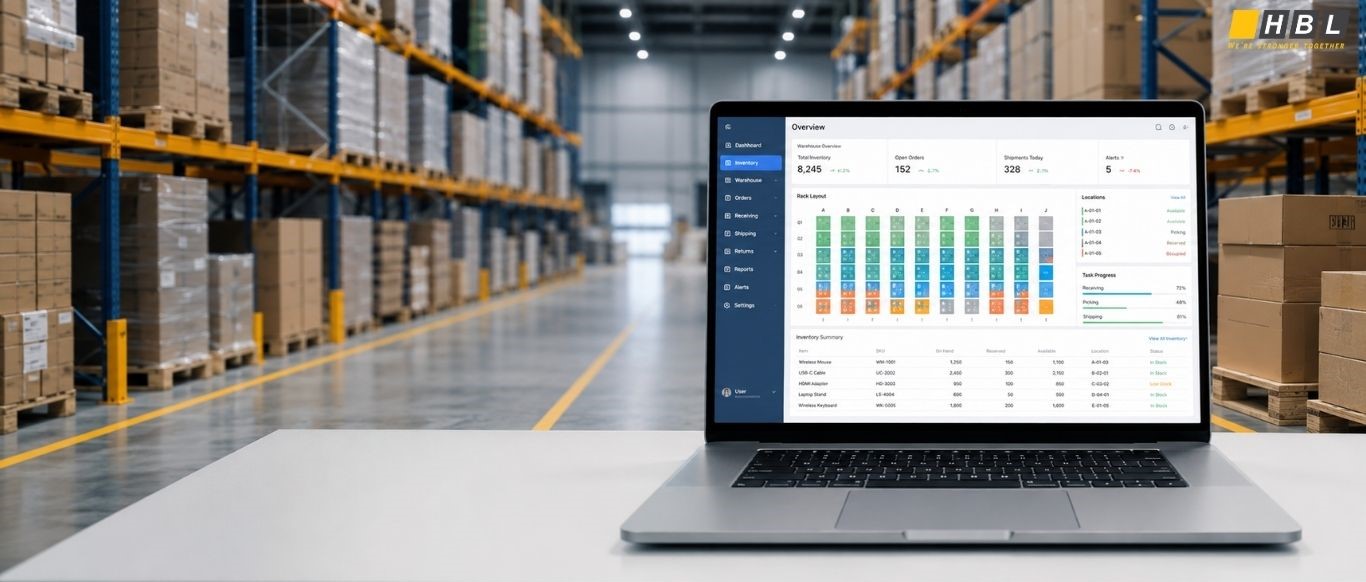
A warehouse management system, or WMS, controls receiving, putaway, picking, packing, inventory counts, returns, and dispatch. US e commerce sales reached $1.19 trillion in 2024, up 8.1% year over year, raising pressure on fulfillment accuracy (US Census Bureau, 2025). Logistic software development services for WMS platforms include barcode scanning, slotting logic, inventory reservation, labor dashboards, and ERP integration.
Fleet Management Software
Fleet management software supports vehicles, drivers, fuel, maintenance, safety records, schedules, and proof of delivery. AI driven route optimization can reduce fleet management costs by up to 20% and cut rerouting times by 90% in relevant use cases (HERE Technologies, 2024). Logistic software development services in fleet projects build driver apps, telematics ingestion, geofencing, maintenance alerts, real time dispatch, and customer notifications.
Order management systems connect orders with inventory, fulfillment rules, delivery options, invoicing, and customer communication. They matter for retailers, manufacturers, distributors, and 3PL providers managing orders across marketplaces and warehouses. Logistic software development services for order management cover orchestration, delivery promises, status sync, exception handling, customer portals, and finance links.
Supply Chain Visibility Platforms
Supply chain visibility platforms trace shipments, inventory, documents, milestones, and exceptions across carriers, suppliers, and customers. Visibility and tracking software is the fastest growing sub segment for the 2026 to 2035 forecast period, while last mile delivery and reverse logistics is the fastest growing application segment. Logistic software development services focus on predictive ETA, IoT sensor integration, event streaming, exception dashboards, and role based access.

Modern logistics platforms are expected to ship with these capabilities:
- Real time status for shipments, vehicles, inventory, and orders.
- System connectivity across ERP, WMS, TMS, carrier, marketplace, and customer systems.
- Exception management, alerts, audit trails, and configurable rules.
- Operational analytics for cost, service, throughput, fleet use, and delivery accuracy.
- Data protection through access control, encryption, monitoring, and backups.
Our Case Study
Microservices Based Logistics Software Reconstruction for a Eyewear Retailer
A major eyewear retail enterprise needed to reconstruct its sales, warehouse management, and inventory management system to support a complex retail logistics model involving manufacturers, logistics centers, stores, and end customers. The project shows how logistic software development services can modernize distributed inventory operations while improving the connection between supply, store allocation, purchase flows, and returns.
The client’s supply chain involved both domestic eyewear manufacturers and overseas eyewear manufacturers, with products moving through multiple logistics centers before reaching retail stores. Each store needed accurate stock availability, while the wider business needed better control over inventory allocation, warehouse coordination, sales flow, and return handling. As the number of stores, suppliers, and product movements increased, the existing system architecture needed a more scalable foundation.
HBLAB supported the reconstruction of the system using a microservices based architecture. Instead of relying on a tightly coupled legacy structure, the rebuilt system was designed around smaller service components that could manage specific business functions such as inventory allocation, logistics center coordination, store distribution, sales flow, and stock updates. This approach gave the client a more flexible foundation for future enhancement and easier system maintenance.
A central focus of the project was inventory allocation, also known as stock reservation. In retail logistics, this process determines which available stock should be assigned to stores, orders, or fulfillment needs. For the eyewear retailer, allocation needed to account for inventory across logistics centers, store demand, purchase activity, and return flows. By rebuilding this logic within the system, the client could improve visibility into stock movement from logistics centers to stores.
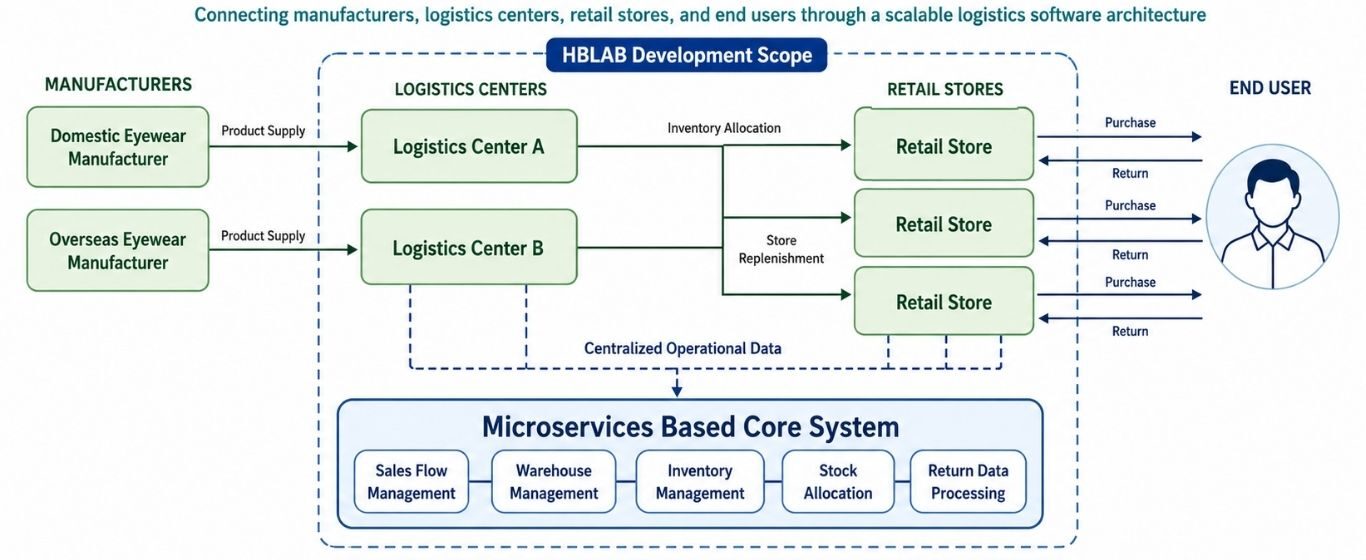
The reconstructed logistics software connected several operational flows:
- Products supplied by domestic and overseas eyewear manufacturers.
- Inventory movement through Logistics Center A and Logistics Center B.
- Stock allocation from logistics centers to multiple retail stores.
- Customer purchase activity at the store level.
- Return handling from end users back into the retail operation.
- Centralized sales, warehouse, and inventory data through the microservice system.
DOWNLOAD OUR IN-DEPTH CASE STUDIES
For HBLAB, the main responsibility covered the sales flow and inventory management area, especially the operational layer between logistics centers and stores. This included supporting the flow of goods, stock allocation, and inventory related data needed for store operations. The project reflects a common requirement in logistic software development services: rebuilding core operational systems without separating software design from real supply chain workflows.
From a business perspective, the project created a stronger digital foundation for retail logistics management. The client could manage inventory across multiple locations, support store level operations, and handle purchase and return activity through a more structured system. For logistics companies, 3PL providers, retailers, and manufacturers, this type of reconstruction shows how custom logistics software can improve control over distributed operations when off the shelf systems cannot fully match existing workflows.
The case also highlights why a logistics software development company needs both engineering capability and domain understanding. Retail inventory systems must account for physical movement, stock status, store demand, warehouse operations, customer transactions, and reverse logistics. When these flows are rebuilt through microservices, the system can scale more effectively while giving operations teams clearer visibility into the movement of goods across the supply chain.
The Technology Stack for Logistics Software Development
Modern logistics software development combines cloud infrastructure, API first architecture, data pipelines, AI models, IoT streams, and security controls to turn physical movement into digital workflows. Logistic software development services apply these technologies to predictive ETA, demand forecasting, automated dispatch, cold chain monitoring, warehouse planning, and customer self service portals.
AI and machine learning create value when logistics decisions repeat at high volume. Predictive analytics can estimate delays, detect inventory risk, forecast demand, and recommend carrier choices. Agentic dispatch adds task specific AI agents that monitor orders, capacity, driver availability, route constraints, and service level rules. Gartner forecasts that 40% of enterprise applications will feature task specific AI agents by the end of 2026, up from under 5% in 2025. Logistic software development services translate this trend into AI powered dispatch, exception triage, and automated updates.
IoT sensor integration supports real time tracking for vehicles, pallets, containers, temperature controlled shipments, and high value inventory. More than 80% of logistics companies plan to integrate IoT for real time tracking and inventory optimization. Logistic software development services connect telematics APIs, RFID readers, barcode systems, GPS feeds, temperature sensors, and event streaming pipelines so teams can act on live movement and condition data.
Blockchain traceability fits cases where several parties need a shared record of custody, origin, handling condition, or compliance events. Food logistics, pharmaceuticals, luxury goods, spare parts, and cross border trade can benefit from tamper resistant audit trails. In logistic software development services, blockchain components often support traceability while the main application still uses conventional cloud databases, dashboards, and reporting for speed.
>> Developing a Blockchain: Step by Step Guide
Cloud native SaaS architecture shapes how platforms scale, update, and connect with customers. SaaS logistics software was valued at $13.1 billion in 2026 and is forecast to reach $28.09 billion by 2035 at 8% CAGR (Source: Business Research Insights). Logistic software development services for SaaS logistics platforms often use containerized services, managed databases, message queues, API gateways, observability tools, and modular web and mobile applications.
How the Logistics Software Development Process Works
The logistics software development process moves from operational discovery to architecture design, agile delivery, integration, testing, launch, and ongoing improvement. Logistic software development services work best when the provider maps how freight, inventory, orders, vehicles, documents, exceptions, and users move through the business before the engineering team writes production code.
Discovery
Discovery starts with workshops, process mapping, data review, user interviews, and current system analysis. The team defines the product scope, such as 3PL software, freight management, WMS modernization, fleet dispatch, last mile delivery, or a SaaS logistics platform. In 2025, 78% of global logistics operators used cloud platforms and AI analytics, cutting delivery errors by 32% (SNS Insider, 2026). Logistic software development services should turn similar benchmarks into measurable goals, such as fewer delivery errors, faster order cycles, or higher warehouse throughput.
Architecture design
Architecture design turns the target workflow into modules, data models, integration points, security boundaries, and deployment choices. Logistic software development services often need ERP integration, carrier APIs, WMS and TMS connectors, payment or invoicing systems, mapping services, mobile applications, and analytics pipelines. Logistic software development services need API first architecture because logistics operations depend on systems owned by carriers, marketplaces, suppliers, brokers, and enterprise customers.
Agile delivery
Agile delivery breaks the roadmap into release cycles that start with workflows able to reduce operational pain quickly. Engineers build core modules, integrate third party services, add role based access, encrypt sensitive data, and set up logging, monitoring, and audit trails. Logistic software development services should include security and compliance work during delivery, especially where GDPR, customer data, location data, financial records, or regulated goods are involved.
QA and testing
QA and testing must reflect logistics conditions rather than only ideal software paths. Test coverage should include scan failures, carrier API outages, duplicate orders, delayed GPS pings, partial deliveries, split shipments, inventory mismatches, route changes, mobile offline use, and permission errors. Logistic software development services should also cover post launch maintenance, cloud monitoring, performance tuning, new integrations, AI model retraining, and feature releases based on actual user behavior.
Cost Factors and ROI in Logistic Software Development Services
Cost in logistic software development services depends on product scope, feature complexity, integration depth, data quality, compliance requirements, team composition, and post launch support. An MVP for one workflow costs less than an enterprise platform that connects multiple warehouses, carriers, customer portals, mobile apps, analytics layers, and AI modules.
Scope sets the first cost boundary because a freight quoting tool differs greatly from a full TMS with rate management, dispatch, tracking, billing, and customer dashboards. Complexity rises when the product needs route optimization, predictive analytics, IoT sensor integration, dynamic pricing, custom document handling, or AI powered dispatch. Logistic software development services can also become more expensive when legacy ERP, carrier, WMS, TMS, accounting, and marketplace systems use inconsistent data formats.
The ROI case should compare total cost of ownership with measurable operating returns. A logistic software development services budget should include cloud hosting, support, security updates, data storage, third party API fees, model monitoring, and product evolution. Logistic software development services should tie cost to lower fleet spend, fewer missed deliveries, faster warehouse cycle time, higher delivery accuracy, lower support volume, and better asset use. AI driven route optimization can reduce fleet management costs by up to 20% in relevant contexts.
Enterprise grade platforms cost more because they need scalability, security, permissions, auditability, uptime planning, compliance controls, and heavier integration testing. Cloud based deployment accounts for about 64% to 66% of the 2025 market, so many budgets include recurring cloud and DevOps expenses rather than only initial build spend (Fortune Business Insights; Precedence Research, 2026). Logistic software development services should separate MVP cost, scale up cost, support cost, and change request cost so leaders can compare build versus buy options realistically.
What to Look for in a Logistics Software Development Company
A logistics software development company should show domain knowledge, integration experience, transparent engineering practices, security maturity, agile delivery discipline, and clear support terms. Logistic software development services require more than general application development because freight, warehouse, fleet, order, and visibility workflows create operational dependencies that generic software teams often miss.

Domain depth matters because a provider that understands 3PL software, freight management, last mile delivery, WMS workflows, TMS logic, carrier tendering, proof of delivery, and returns can ask better scoping questions. The company should explain data movement across ERP, carrier APIs, customer portals, warehouse scanners, driver apps, telematics, and analytics systems. Asia Pacific is forecast as the fastest growing region at about 11% CAGR through 2033, driven by e commerce growth in China, India, and Japan (Precedence Research, 2026). Logistic software development services with regional operating knowledge can support these buyers.
The competitive market has two broad tiers. Oracle, SAP, and Manhattan Associates collectively hold about 49% of the global SaaS logistics software market, giving enterprise buyers mature suites with wide feature coverage. Specialist firms offering logistic software development services serve buyers needing proprietary workflows, legacy modernization, customer facing platforms, or integration flexibility.
A strong vendor should provide evidence across several areas:
- Logistics specific case work across 3PL, e commerce fulfillment, manufacturing distribution, freight brokerage, or fleet operations.
- Clear technology explanation covering architecture choices, cloud model, data strategy, and testing approach.
- Integration experience with ERP, WMS, TMS, carrier APIs, maps, payment systems, and analytics tools.
- Security maturity through access control, encryption standards, monitoring, backup planning, and relevant certifications.
- Support terms covering release governance, service levels, escalation paths, and knowledge transfer before contract signing.
Midmarket and growth stage logistics companies often choose specialist partners for product fit, speed, and integration flexibility without the cost profile of a major enterprise suite. A logistics software development company can reduce project risk by keeping operations, IT, finance, and leadership aligned around scope, priorities, acceptance criteria, and ROI metrics.
Frequently Asked Questions
What do logistic software development services include?
Logistic software development services include discovery, product design, custom software development, cloud architecture, API integration, security engineering, testing, deployment, and support for logistics operations. Typical systems include TMS, WMS, fleet management software, order management systems, freight management platforms, supply chain visibility tools, driver mobile apps, customer portals, and analytics dashboards.
How long does logistics software development take?
Logistics software development can take a few months for an MVP and longer for an enterprise grade platform with many integrations. Timeline depends on scope, data quality, workflow complexity, mobile needs, ERP integration, carrier API availability, compliance requirements, and testing depth. Logistic software development services should define release phases, and each phase should connect directly to operational value.
Should a logistics company build custom software or buy an existing platform?
A logistics company should buy existing software when standard TMS, WMS, or fleet workflows fit its operations with limited configuration. It should consider logistic software development services, and compare them with packaged platforms, when proprietary workflows, customer experience, pricing logic, integrations, data ownership, or platform differentiation matter. The build versus buy decision should compare total cost of ownership, launch speed, operational fit, and long term change needs.
Is cloud based logistics software better than on premise deployment?
Cloud based logistics software is often better for companies that need faster scaling, remote access, continuous updates, easier API integration, and lower infrastructure management. On premise deployment may suit organizations with strict data control, legacy constraints, or regulatory requirements. Logistic software development services should assess security and document deployment tradeoffs, uptime, compliance, integration, and cost before selecting a deployment model.
Read more:
– 7 Best Workflow Automation Software: Which Type Fits Your Business
– Software Development Life Cycle Phases: Step-by-Step Guide
– AI Enterprise Solutions Failure: Why Organizations Invest More and Get Less