Most vendor comparisons for business process automation services still run through the same checklist: uptime, integration options, cost per transaction, service-level response times. That checklist assumes automation follows fixed rules, and agentic AI breaks that assumption by letting an agent interpret a situation, choose an action, and adjust its own approach without a human writing out every branch in advance.
What a Business Process Automation Service Actually Covers

Before comparing any two providers, it helps to be specific about what a business process automation service actually is, since the term gets applied loosely enough to cover almost anything with automation in the name.
A business process automation service is a combination of work a provider takes on so a company does not have to build and run that capability internally. Depending on the provider, business process automation services can include:
- Process assessment: mapping the current workflow and identifying where rules are stable and where exceptions cluster.
- Technology implementation: building the automation itself, which today usually pairs robotic process automation with AI in business services in one deployment.
- System integration: connecting the automation to the platforms that already hold the data, such as a CRM, an ERP, or a ticketing system.
- Governance design: defining who approves what, and what an agent is allowed to decide on its own.
- Ongoing operation: monitoring results, handling exceptions, and adjusting the automation as the process or the business changes.
Coverage varies by provider. Some stop at implementation and hand the finished automation back to the client’s team, others operate it indefinitely as a managed service. That range is exactly why the delivery model, in-house build, platform license, or managed service, matters as much as which vendor’s technology looks most capable in a demo.
Why Vendor Evaluation Criteria Need to Change
Business process automation, often shortened to BPA, is the use of software to carry out repeatable business tasks that would otherwise require a person: routing an invoice for approval, updating a customer record, sorting a support ticket into the right queue. Most BPA deployments still combine robotic process automation and AI in business services this way: RPA executes the repeatable steps, and AI handles the parts that involve reading or classifying information.
For most of the last decade, this automation was rule-based. A developer defined a set of conditions in advance, and the software executed those conditions exactly, every time. If a case fell outside the rules, the system stopped and handed it to a person.
That rule-based nature is why the traditional vendor checklist looks the way it does. Every one of these criteria assumes a predictable system that either executes correctly or stops and waits:
- Uptime measures whether the system keeps running.
- Integration options measure whether it connects to existing software.
- Cost per transaction measures the price of each rule-based action.
- Service-level response times measure how quickly a human gets involved when the rules run out.
Artificial intelligence changed part of that picture over the past several years, mostly by helping the system read unstructured input: a scanned invoice, a customer’s free-text message, a photo of a damaged product. AI classified, extracted, and predicted, but a human or a rule still decided what to do with that information.
Agentic AI removes that separation. An agent built on a large language model can look at a situation, decide what action serves the goal, take that action, and check the result against what it expected, adjusting its next step if the outcome falls short. It behaves less like a script and more like a junior employee working through a task.
That difference changes what buyers need to evaluate. A checklist built for predictable systems tells you whether a provider’s automation runs reliably. It tells you almost nothing about what happens when the automation itself makes a judgment call, independent of any human or fixed rule.
That question, who is accountable when an agent decides something on its own, is now central to choosing a business process automation service. It did not exist as a real evaluation criterion five years ago, and it is the reason business process automation services now need a different comparison method than a feature checklist.
Agentic AI Versus Traditional Process Automation
Robotic process automation and AI have been used together for years, usually with RPA handling structured, repetitive steps and AI models handling classification or data extraction inside that fixed sequence.
Agentic AI works differently. Instead of following one linear path, an agent runs a loop with four steps:
- Reason about the goal it has been given, such as resolving a customer’s refund request.
- Act, gathering information or taking a step toward that goal.
- Reflect, comparing the result against what it expected.
- Re-plan if the result falls short, choosing a different action rather than simply stopping.
A concrete example makes the difference clear. Traditional automation routes a support ticket to a queue based on a keyword in the subject line. An agentic system reads the full message, checks the customer’s order history, decides whether the situation matches a known resolution, drafts or issues that resolution, and escalates to a person only if its own confidence in the outcome is low.
This capability is genuinely useful, because most real business processes are full of exceptions that used to require a person to intervene. It also introduces a risk that traditional robotic process automation and AI pairings never carried: an agent that can decide how to respond to a customer can also decide incorrectly, and it can repeat that mistake at a scale no single employee ever could.
Human-in-the-Loop and Human-on-the-Loop Governance
Because agentic systems make their own decisions within a task, providers now describe how much autonomy an agent has using one of two governance models. Understanding both is necessary before comparing any two vendors, since the same underlying AI model can be deployed under either one with very different risk and speed outcomes.
When each model applies
Human-in-the-loop governance means the agent pauses at a defined checkpoint and waits for a person to approve the action before it proceeds. Every significant step requires sign-off.
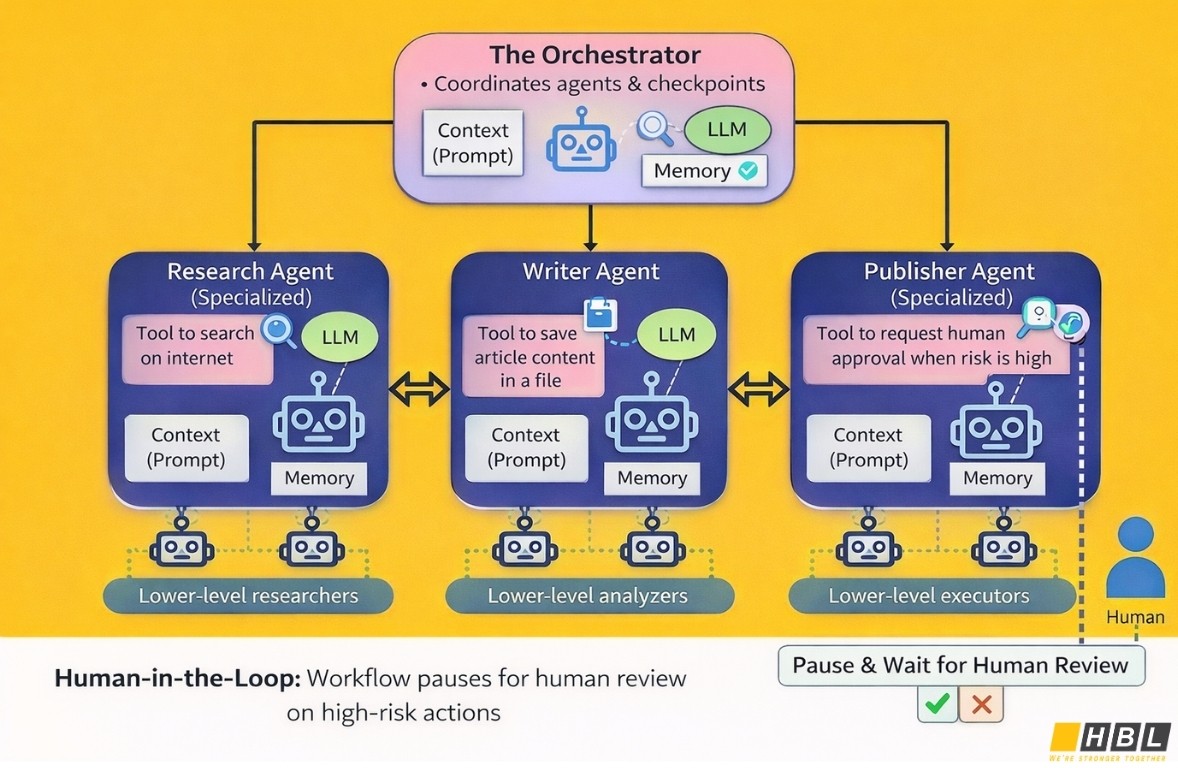
This model suits high-stakes actions where a mistake is costly or hard to reverse, such as issuing a large refund, changing a customer’s account details, or approving a contract term. The trade-off is speed: because a person sits in the critical path, much of the time saving that agentic automation offers gets absorbed by the approval step itself.
Human-on-the-loop governance means the agent acts on its own within boundaries a person has already defined. A person monitors results and handles exceptions after the fact.
This model suits high-volume, lower-risk work, such as drafting a first reply to a routine support ticket or routing a request to the right team. The agent moves at its own pace, and a person reviews the output afterward.
Why this is now a vendor question
Which governance model a provider defaults to used to be an internal engineering decision, invisible to the client. It now determines what the buying company is actually responsible for once the automation is live, which makes it worth asking before signing.
Analysts have raised concerns about this exact gap: a widely cited estimate suggests that roughly 40 percent of agentic AI projects may be shelved because ownership and governance were never made explicit before launch, independent of how well the underlying model performed.
Separate research on enterprise pilots has found that automation built through an experienced delivery partner reaches full production roughly twice as often as automation built entirely in-house, largely because the partner has already worked through governance questions that a first-time internal team tends to discover only after something goes wrong.
Comparing Build, License, and Managed Service
Underneath the governance question, the original delivery decision behind any business process automation services engagement still exists, and it is worth defining plainly for anyone comparing options for the first time.
An in-house build means the company’s own developers or automation specialists design, code, and maintain the automation, including any agentic components. This gives the company the most direct control, since any part of the logic can be changed internally, but it also requires developers who can maintain that logic, and now the governance rules around it, for years after launch.
A platform license means the company pays to use a vendor’s automation software, typically with pre-built templates, connectors, and configuration tools rather than custom code. The internal team still needs enough skill to configure workflows correctly and to set governance boundaries within whatever options the platform provides.
A managed service means an external provider designs, builds, and operates the automation, including its governance model, while the client supplies business requirements, process knowledge, and approvals. Control is shared under the terms of the service agreement, which makes the wording of that agreement more important than in the other two models.
| Model | Control | Talent required | Governance ownership |
|---|---|---|---|
| In-house build | Highest, limited by internal expertise | Ongoing developer and AI maintenance skills | Fully internal, including agent oversight |
| Platform license | Bounded by vendor configuration options | Configuration and monitoring skills | Split between internal team and platform defaults |
| Managed service | Shared, defined by the service agreement | Supplied by the provider | Should be explicit in the contract, not assumed |
Which model fits depends mainly on the process itself, not on which option looks most modern:
- A stable, well-documented process with strong internal engineering capacity can still justify an in-house build.
- A standardized, predictable workflow often suits a platform license, where cost is easier to forecast.
- A process with frequent, consequential exceptions, which is exactly where agentic AI adds the most value, tends to favor a managed business process automation service.
Whichever model is chosen, the agreement should state plainly who owns the agent’s decisions instead of leaving that question to be assumed later.
Applying This to Customer Service Automation
Customer service is where this governance question stops being theoretical, because the customer experiences the agent’s decision directly, in real time. A refund workflow shows concretely how business process automation can improve customer service in practice.
Consider a refund request. Traditional rule-based automation routes it to a queue based on order value, and a person makes the actual decision. An agentic system can instead read the customer’s message, check the order history, decide whether the request meets policy, and issue the refund without a person in the loop at all.
This is often the clearest and most concrete answer to how business process automation can improve customer service: faster response, consistent handling, and availability outside business hours.
It is also the point where an incorrect judgment reaches the customer immediately, with no queue and no reviewer standing between the agent and the outcome.
This is where human-on-the-loop governance earns its place in customer-facing work specifically. The agent can act within a clearly defined policy boundary, such as an approved refund amount or a set of pre-authorized responses, while a person reviews flagged exceptions and unusual patterns afterward rather than approving every case. A chatbot that repeats itself, or a refund approved outside policy, damages customer trust in a way that a delayed internal report never does. Judging a customer-facing agent purely by its accuracy on routine cases misses the point in any business process automation service built around agentic AI. The cases that matter most are the ones where it acts outside the boundary it was given, and how quickly a human notices and corrects that.
Questions to Ask Before Signing
Before signing an agreement for business process automation services, a short set of questions, answered ahead of time, tends to reveal more about a provider than any feature comparison.
- Does the automation operate under human-in-the-loop or human-on-the-loop supervision, and who made that decision?
- What triggers escalation to a person, and how is that threshold set and adjusted over time?
- What audit trail exists for the agent’s decisions, not only for the data it touched?
- What service-level agreement applies to response time and accuracy, and what happens when the agent gets a customer-facing decision wrong?
- Who owns the outcome when the agent, rather than a person, made the call?
For managed customer service automation, HBLAB works through these governance questions before scoping the workflow itself, since a well-designed process built on an unclear governance model tends to fail in ways that only surface once it is already handling live customers. How business process automation can improve customer service depends on how clearly that governance was defined before launch.