A programming paradigm is a foundational approach to structuring code. Procedural programming, the dominant style before OOP, structures programs as sequences of instructions that act on separate data.
As software projects grew larger during the 1980s, this approach created maintenance difficulties because changes in one function frequently caused unexpected failures elsewhere in the program. Any oop programming language addresses this problem by isolating data within objects rather than scattering it across global variables. OOP was developed to address these limitations directly.
The concept first appeared in Simula, a language created in Norway between 1961 and 1967 by Ole-Johan Dahl and Kristen Nygaard.
Alan Kay later formalized the term “object-oriented programming” while building Smalltalk at Xerox PARC in the 1970s.
What Are Object-Oriented (OOP) Programming Languages?
An OOP programming language is any language that supports the object-oriented paradigm through built-in constructs for classes and objects. Some languages are classified as pure OOP languages, meaning every piece of code must be written within a class or object structure. Others are multi-paradigm languages, supporting OOP alongside procedural or functional programming.
The distinction matters when choosing a language for a specific project. A pure OOP language enforces strict object-oriented design from the start, while a multi-paradigm language gives developers the flexibility to mix approaches.
Pure OOP leaning: Java, C#, Ruby
Multi-paradigm: Python, C++, JavaScript, PHP
What qualifies a language as object-oriented is the presence of core mechanisms: the ability to define classes as blueprints, create objects as instances of those classes, and apply the four pillars of OOP.
Main Components in OOP
Four structural components form the foundation of every OOP language. To understand each clearly, consider a single scenario: a Car class representing different vehicles in a software system.
A class is a blueprint that defines the structure and behavior its objects will share. The Car class specifies what every car object will contain and what operations it can perform. The class itself is not a car — it is the specification from which individual car objects are created.
An object is a specific instance of a class. One car object might represent a red sedan with a specific license plate, while another represents a blue truck. Every object built from the same class shares the same structure but maintains its own separate state.
A method is a function defined within a class that describes what objects of that class can do. In the Car class, methods would include actions like accelerate, brake, and turn. When a car object calls the accelerate method, it changes its own internal speed value.
An attribute is a variable stored within an object that holds a specific piece of data. In the Car class, attributes would include color, speed, fuelLevel, and licensePlate. Attributes represent the current state of an object at any given moment during execution.
The 4 Core Properties of OOP
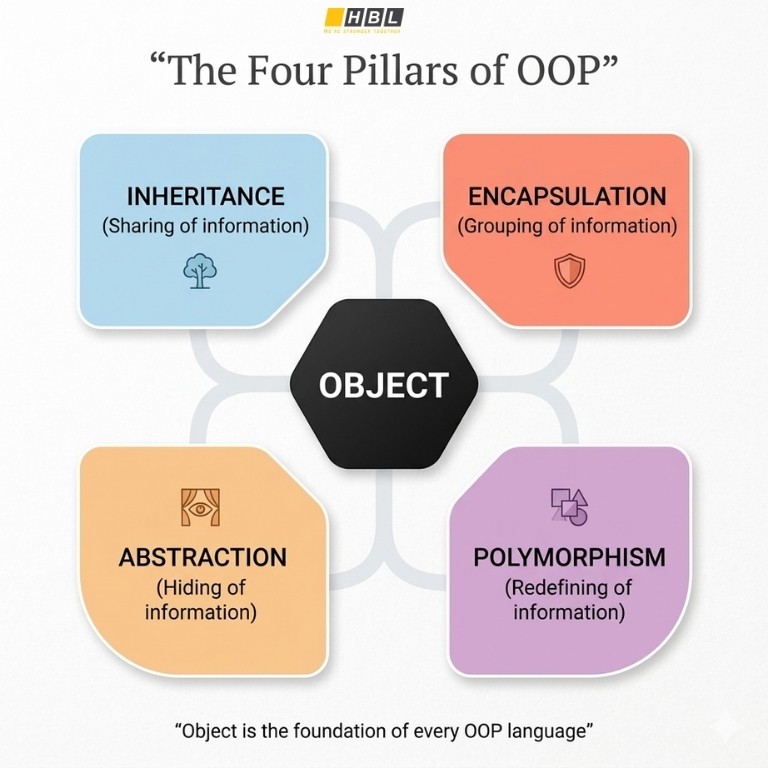
Four core properties define what separates an OOP language from other programming approaches. Every OOP language implements these four pillars, though syntax and mechanisms vary.
Encapsulation
Encapsulation is the practice of bundling an object’s data and methods into a single unit, then restricting direct access to the object’s internal state. An object’s attributes are marked as private or protected, and external code can only modify them through public methods. This prevents other parts of a program from changing an object’s data in unexpected ways, reducing bugs and simplifying maintenance.
Abstraction
Abstraction hides complex implementation details and exposes only the essential features of an object. A database connection object, for example, exposes a connect method and a query method while concealing the underlying network protocols, authentication processes, and error handling. Abstraction lets developers work with complex systems through simple, well-defined interfaces.
Inheritance
Inheritance allows a new class to derive properties and methods from an existing class. The derived class, called a subclass, inherits the structure of the parent and can extend or override it with additional behavior. In the Car scenario, an ElectricCar subclass could inherit color and speed from the Car class while adding a new batteryLevel attribute and a charge method. Inheritance reduces code duplication because common functionality is written once and reused across all subclasses.
Polymorphism
Polymorphism means “many forms” and refers to the ability of different objects to respond to the same method call in their own way. A Car class might define a refuel method, and then the ElectricCar and GasCar subclasses each implement it differently: one charges a battery, the other fills a gas tank. This allows a program to call refuel on any car object without needing to know its specific type, enabling flexible, extensible code.
Why Should We Learn OOP?
Learning OOP provides tangible career advantages. The majority of enterprise systems, mobile applications, and web platforms are built using an OOP language. Java, C++, C#, and Python consistently rank among the top ten most popular programming languages worldwide. JavaScript, another OOP language, is used by an estimated 28 million developers globally.
Major companies like Google, Amazon, Microsoft, and Netflix rely on OOP architectures to manage systems serving millions of users simultaneously. Employers consistently list proficiency in at least one OOP language as a requirement for backend, frontend, and full-stack development roles.
Code reusability is another practical benefit. Developers write a class once and create as many objects from it as needed. Inheritance allows teams to extend existing classes without rewriting shared logic, shortening development time and reducing the chance of introducing errors.
The Drawbacks of OOP
OOP introduces specific challenges that can affect project efficiency and code quality, particularly when applied without careful consideration of project scope.
- Steep learning curve: Abstract concepts like encapsulation and polymorphism can be difficult for beginners who are used to linear, step-by-step logic.
- Performance overhead: OOP programs tend to consume more memory and execute more slowly than equivalent procedural programs due to object memory allocation and method call indirection.
- Unnecessary complexity in small projects: Simple scripts or short programs rarely benefit from the full structure of classes, inheritance hierarchies, or polymorphic behavior.
- Tight coupling risk: When classes depend heavily on each other’s internal structure, changes cascade through the system, undermining the modularity OOP is designed to provide.
- Difficulty in testing: Deep inheritance hierarchies and hidden internal state can make testing difficult, often requiring specialized frameworks and significant overhead.
Top OOP Programming Languages
Selecting the best OOP language depends on the type of software you intend to build and the industry you want to enter.
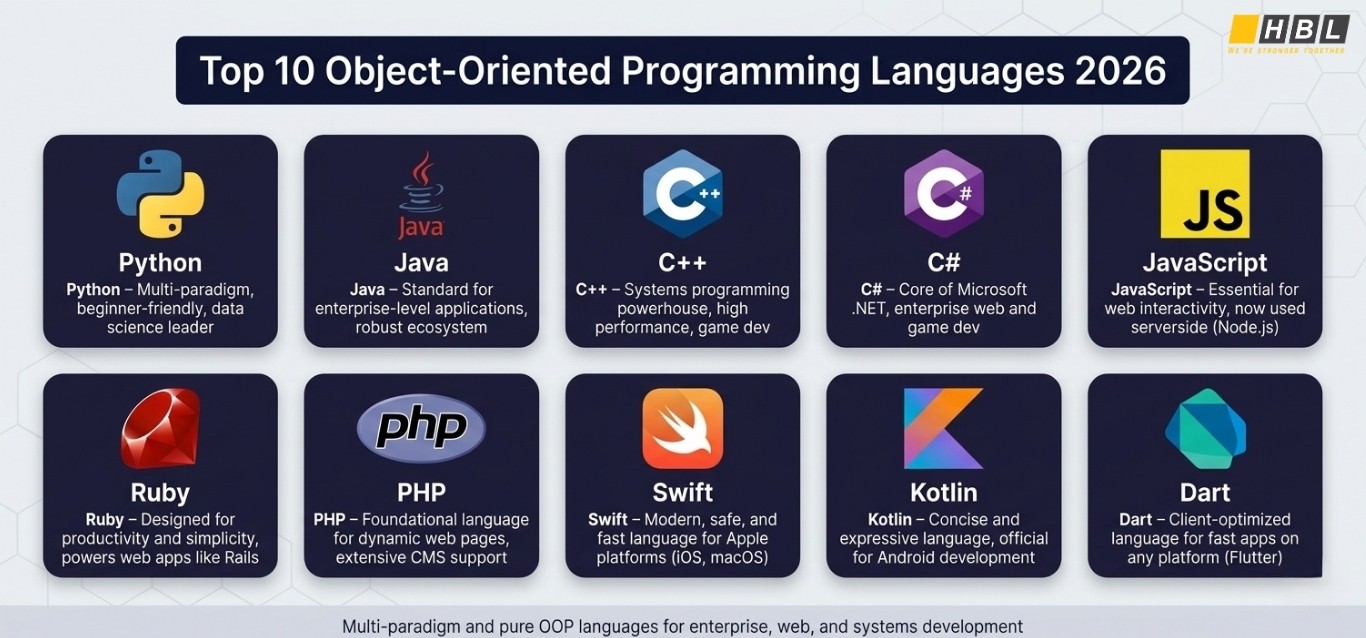
Python
Python is a multi-paradigm language widely used in data science, machine learning, web development, and automation. It ranks among the top three languages on the TIOBE Index and is frequently recommended for beginners due to its readable syntax and gentle introduction to classes and objects.
Java
Java is a class-based OOP language built around the principle of “write once, run anywhere.” It dominates enterprise backend development, Android mobile applications, and large-scale distributed systems, and is used by approximately 14 million developers worldwide.
C++
C++ extends the C language with full OOP capabilities and is the language of choice for systems programming, game engine development, and hardware-level performance applications. It occupies a unique position by allowing both high-level object-oriented design and low-level system access.
C#
C# is a modern OOP language developed by Microsoft for the .NET ecosystem. It is the primary language for Windows desktop applications, Unity game development, and enterprise web services using ASP.NET, with strong support for LINQ and async programming patterns.
JavaScript
JavaScript is a multi-paradigm language with prototype-based inheritance that gained full class syntax through the ES6 standard. It powers front-end web development, server-side applications via Node.js, and mobile frameworks like React Native, making it a practical choice for developers who want a single language spanning front-end and back-end environments.
Ruby
Ruby is a pure OOP language where every value, including primitive types like integers and booleans, is an object. It is best known as the language behind the Ruby on Rails web framework and prioritizes developer productivity and readability, making it a strong choice for startups and rapid prototyping.
PHP
PHP is a server-side scripting language that adopted full OOP features starting with PHP 5. It powers approximately 77 percent of all websites with a known server-side language, primarily through content management systems like WordPress and frameworks like Laravel.
Frequently Asked Questions
1. What is an OOP programming language?
An OOP programming language is any language that supports the object-oriented paradigm through built-in constructs for defining classes, creating objects, and applying the four pillars of OOP. Examples include Java, Python, C++, C#, JavaScript, Ruby, and PHP.
2. Is OOP a programming language?
OOP is not a programming language. It is a programming paradigm, a style or approach to structuring code. Multiple OOP languages implement this paradigm in different ways, but the underlying principles remain consistent across all of them.
3. What are the best OOP languages to learn in 2025?
- Python for beginners and data science
- Java for enterprise development
- C++ for systems programming
- C# for game development and Windows applications
- JavaScript for web development
4. What are the four main properties of OOP?
Encapsulation bundles data and methods while restricting external access. Inheritance allows classes to derive properties from parent classes. Polymorphism enables objects to respond to the same method call in different ways. Abstraction hides complex implementation details behind simple interfaces.
5. What is the difference between a class and an object in OOP?
A class is a blueprint that defines the structure and behavior its instances will share. An object is a specific instance of a class that holds its own distinct data and occupies memory during program execution. The class defines what attributes and methods an object will have; the object stores actual values for those attributes.
6. Is Python a good OOP language for beginners?
Yes. Python supports all core OOP concepts including classes, inheritance, encapsulation, and polymorphism, allowing new developers to learn object-oriented principles without the complexity of stricter languages like Java or C++.
7. What are the main drawbacks of OOP?
The main drawbacks include a steep learning curve, performance overhead compared to procedural programming, unnecessary complexity for small projects, risk of tight coupling between classes, and difficulty testing systems with deep inheritance hierarchies. These drawbacks indicate that OOP is not universally the best approach for every programming task.
Read more:
– The Website Development Process in the Age of AI: Can ChatGPT Build Your Website?
– Hybrid Cloud Networking Explained: Architecture, Benefits, and How It Actually Works
– Team Software Process (TSP) and Personal Software Process (PSP)