Understanding how much mobile app development costs is essential to making informed financial decisions, whether you are a startup founder preparing your first product launch, a small business owner expanding into mobile commerce, or a product manager evaluating budget requirements for an enterprise solution.
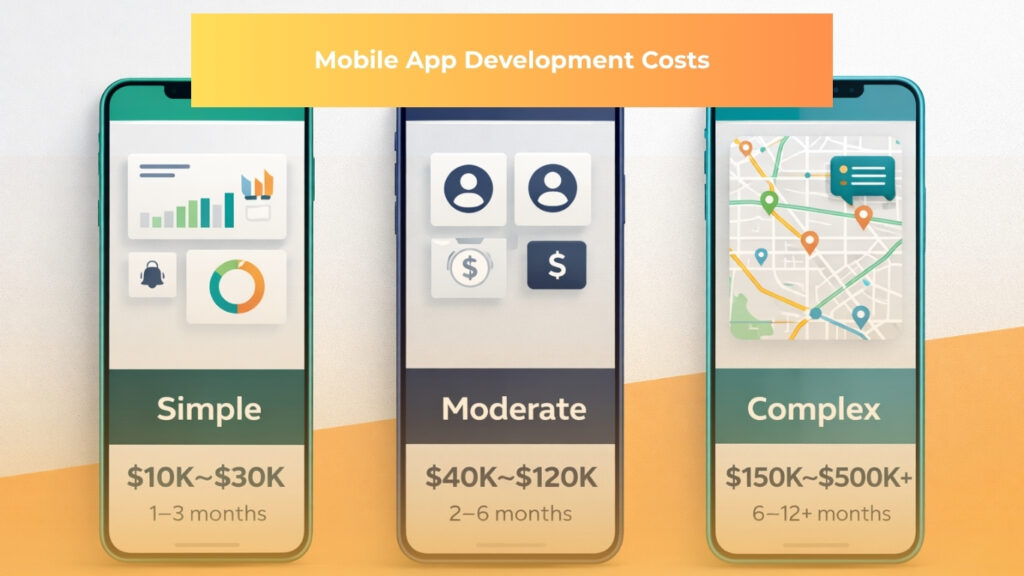
The reality is that mobile app development costs in 2026 span an enormous range, from as little as $10,000 for the simplest applications to well over $500,000 for advanced enterprise platforms with sophisticated backend systems and custom integrations.
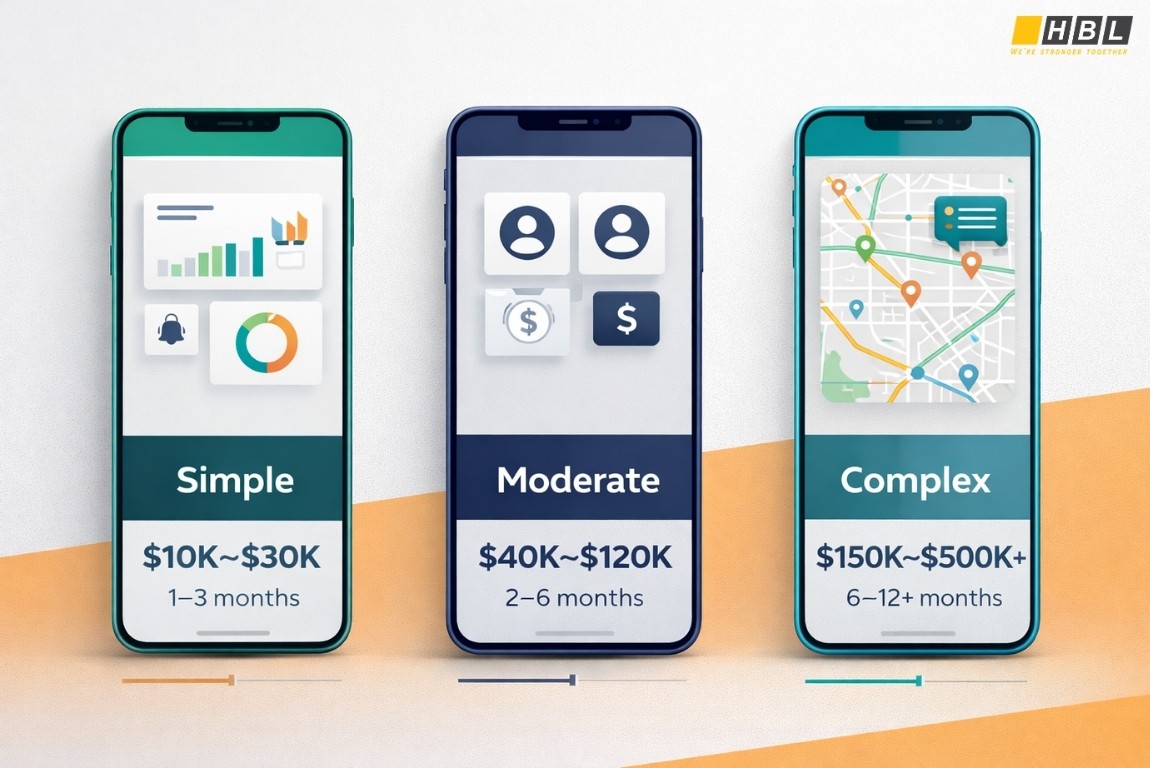
This guide breaks down every aspect of mobile app development costs, from the initial discovery phase through ongoing maintenance and updates.
You will learn exactly what you are paying for at each stage, why developer rates vary so dramatically across regions, which features add the most cost to your project, and how to build a realistic budget plan for mobile app development that accounts for both initial creation and long-term sustainability.
The Phases of Building a Mobile App
Understanding what happens at each stage helps you see where your budget goes and why skipping phases often leads to higher costs later. The total cost of mobile app development is the sum of all these phases, and each one contributes essential work.
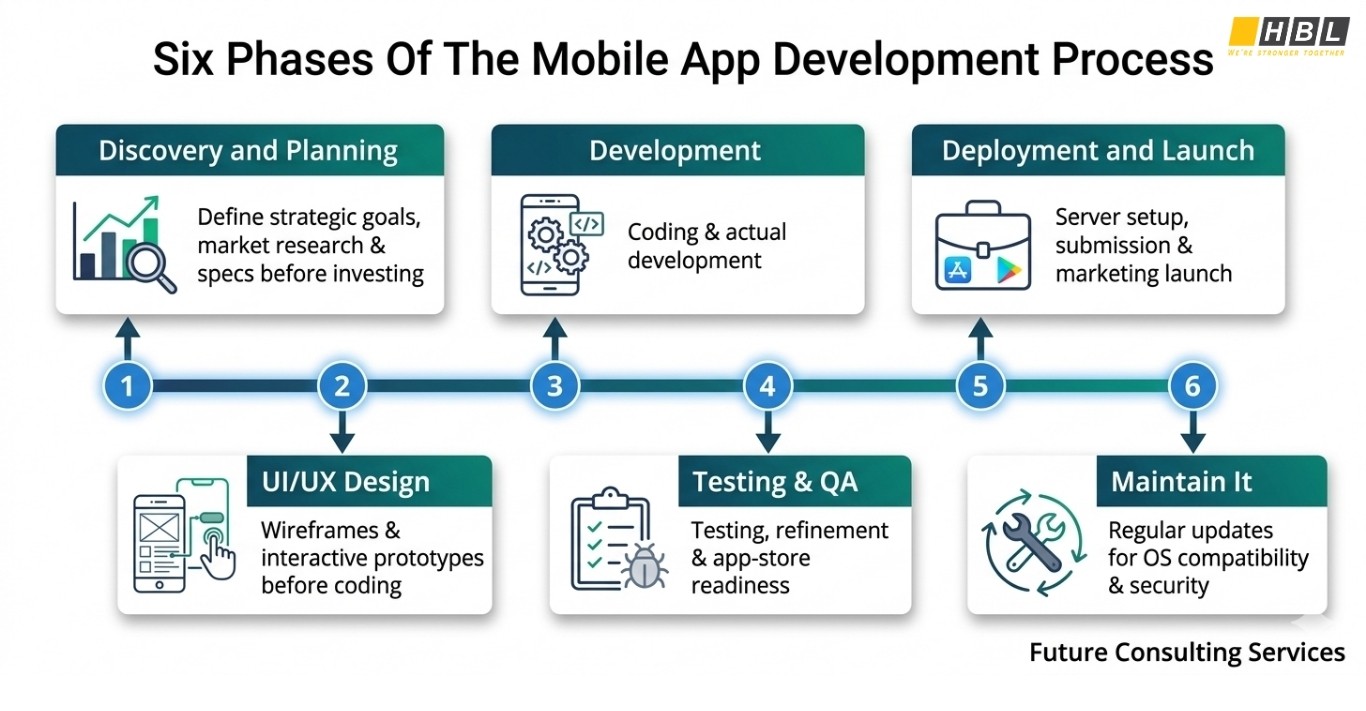
Discovery and Planning Phase
The discovery and planning phase involves market research, competitive analysis, user persona development, feature prioritization, and creation of detailed technical specifications. A business analyst or product strategist typically leads this work, collaborating with stakeholders to define exactly what the application will do and who it will serve.
The deliverables from this phase include a product requirements document, user stories, wireframes, and a detailed project roadmap.
UI/UX Design Phase
The user interface (UI) and user experience (UX) design phase transforms your requirements into visual mockups and interactive prototypes. UI/UX designers create the visual language of your application, including color schemes, typography, icon systems, and interaction patterns. This phase typically accounts for 20 to 25 percent of your total mobile app development budget, with costs ranging from $8,000 for basic template-based designs to over $30,000 for premium custom interfaces with sophisticated animations.
The design phase proceeds through several sub-stages:
- Wireframing creates simple black and white layouts that establish screen flow and information hierarchy
- Prototyping builds interactive mockups that simulate user flows and demonstrate core interactions
- Visual design applies your brand identity through color, typography, and imagery
Each sub-stage requires specialized skills and adds incremental cost, but the investment prevents expensive redesigns during development.
Development Phase
The development phase is where your mobile app development budget sees its largest expenditure. Front-end developers build everything users see and interact with, while back-end developers create the server infrastructure, database architecture, and application programming interfaces (APIs) that power the application from behind the scenes.
This phase typically consumes 40 to 55 percent of your total budget, with costs ranging from $25,000 for simple applications to over $200,000 for complex enterprise systems.
Development time varies dramatically based on application complexity:
- Simple apps with limited features: 800 to 1,200 hours
- Moderately complex apps with third-party integrations and user accounts: 1,500 to 2,500 hours
- Advanced applications with real-time features or machine learning: 3,000+ hours
At average developer rates of $50 to $150 per hour, these hour requirements translate directly into substantial budget allocations.
Testing and Quality Assurance Phase
Quality assurance (QA) testing ensures your application functions correctly across devices, operating system versions, and user scenarios. QA engineers perform manual testing, automated testing, performance testing, security testing, and usability testing.
This phase typically accounts for 15 to 20 percent of your total mobile app development budget, with costs ranging from $5,000 for simple applications to over $40,000 for complex systems requiring extensive device coverage and security audits.
Testing also includes preparation for app store submission. Both Apple App Store and Google Play Store have specific technical requirements and review processes.
Preparing your application for submission, creating store listings, and addressing initial review feedback adds to this phase’s cost and timeline.
Deployment and Launch Phase
The deployment phase covers final preparation for public release. This includes server configuration, database optimization, content delivery network (CDN) setup, monitoring implementation, and app store submission.
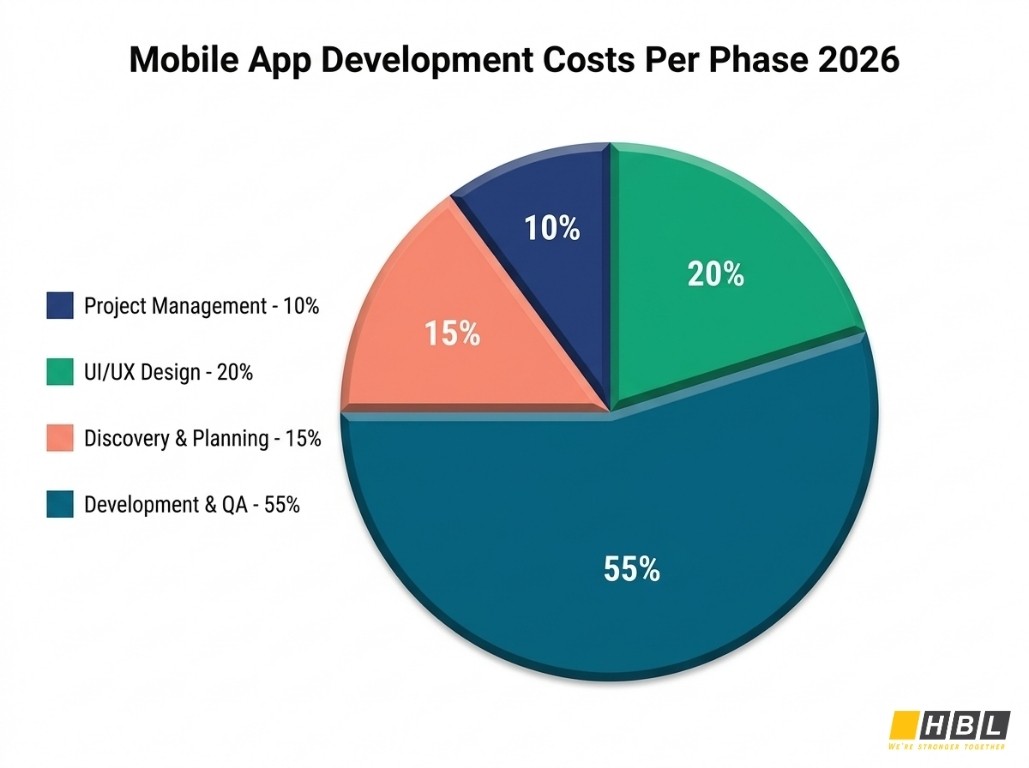
Costs typically range from $2,000 to $10,000 depending on infrastructure complexity and whether you require specialized DevOps expertise.
- Apple App Store charges $99 per year for developer account access
- Google Play Store charges a one-time $25 fee
Developer Rates and Why They Differ
Developer rates represent one of the most significant variables in mobile app development costs. The same application built by developers in different regions can cost dramatically different amounts, even when the quality of work is comparable.
Experience Level Impact on Rates
Developer experience directly correlates with hourly rates and productivity:
- Entry-level developers charge $15 to $25/hr and handle bug fixes, code documentation, and simple feature implementations under supervision
- Intermediate developers (2 to 5 years of experience) charge $25 to $60/hr and can independently complete most standard development tasks
- Senior developers (5+ years of experience) charge $60 to $150+/hr and bring expertise in architecture decisions, performance optimization, and complex feature implementation
A balanced team approach often provides the best value. Senior developers provide architectural leadership and tackle the most challenging problems, while intermediate and junior developers handle routine implementation tasks.
Geographic Rate Variations
Regional differences in developer rates create substantial opportunities for budget optimization in mobile app development.
| Region | Hourly Rate (USD) | Typical Team Quality |
|---|---|---|
| North America (USA/Canada) | $100 to $250 | Premium, same timezone |
| Western Europe | $70 to $150 | High quality, good English |
| Eastern Europe | $35 to $70 | Strong technical skills |
| South Asia | $20 to $50 | Cost-effective, large talent pool |
Table 1: Regional Developer Hourly Rates for Mobile App Development
Platform-Specific Rate Differences
Different mobile app development specializations command different rates:
- iOS developers skilled in Swift and Objective-C charge $16 to $45/hr on global freelance platforms
- Android developers with Java and Kotlin expertise charge similar rates of $15 to $45/hr
- React Native developers capable of building cross-platform applications charge $24 to $50/hr, reflecting the efficiency gains of writing code once for multiple platforms
Types of Mobile Apps and What Each One Costs
The type of mobile app you build significantly impacts your development costs. Each development approach offers different benefits, limitations, and cost implications.
Native Mobile Applications
Native mobile applications are built specifically for a single platform using that platform’s preferred programming language and development tools. iOS native apps use Swift or Objective-C with Xcode, while Android native apps use Java or Kotlin with Android Studio. Native development delivers the best possible performance, deepest access to device features, and most seamless user experience, but it requires building and maintaining separate codebases for each platform.
Native mobile app development costs range from $50,000 to $300,000 or more per platform. Building for both iOS and Android effectively doubles your development costs since you are creating two separate applications. Native development timelines range from three to six months for simple apps, six to nine months for moderate complexity, and nine to twelve months or more for advanced applications.
Cross-Platform Applications
Cross-platform mobile app development uses frameworks like React Native or Flutter to build applications that run on both iOS and Android from a single codebase. This approach can reduce development costs by 20 to 40 percent compared to building separate native apps, while still delivering near-native performance and user experience. Cross-platform apps typically cost between $20,000 and $150,000 depending on complexity.
React Native, developed by Meta, uses JavaScript and React to build mobile applications. Flutter, developed by Google, uses the Dart programming language. Both frameworks have mature ecosystems and large developer communities. Cross-platform development is ideal for business applications, e-commerce platforms, and content-based apps that do not require extensive device hardware access or computationally intensive graphics.
Hybrid Applications
Hybrid applications combine web technologies with native container wrappers. They are built using HTML, CSS, and JavaScript, then packaged as native applications using frameworks like Apache Cordova or Ionic. Hybrid development offers the lowest cost option for mobile app development, typically ranging from $10,000 to $50,000. However, hybrid apps deliver inferior performance compared to native or cross-platform alternatives and may not provide the smooth user experience modern users expect.
Progressive Web Applications
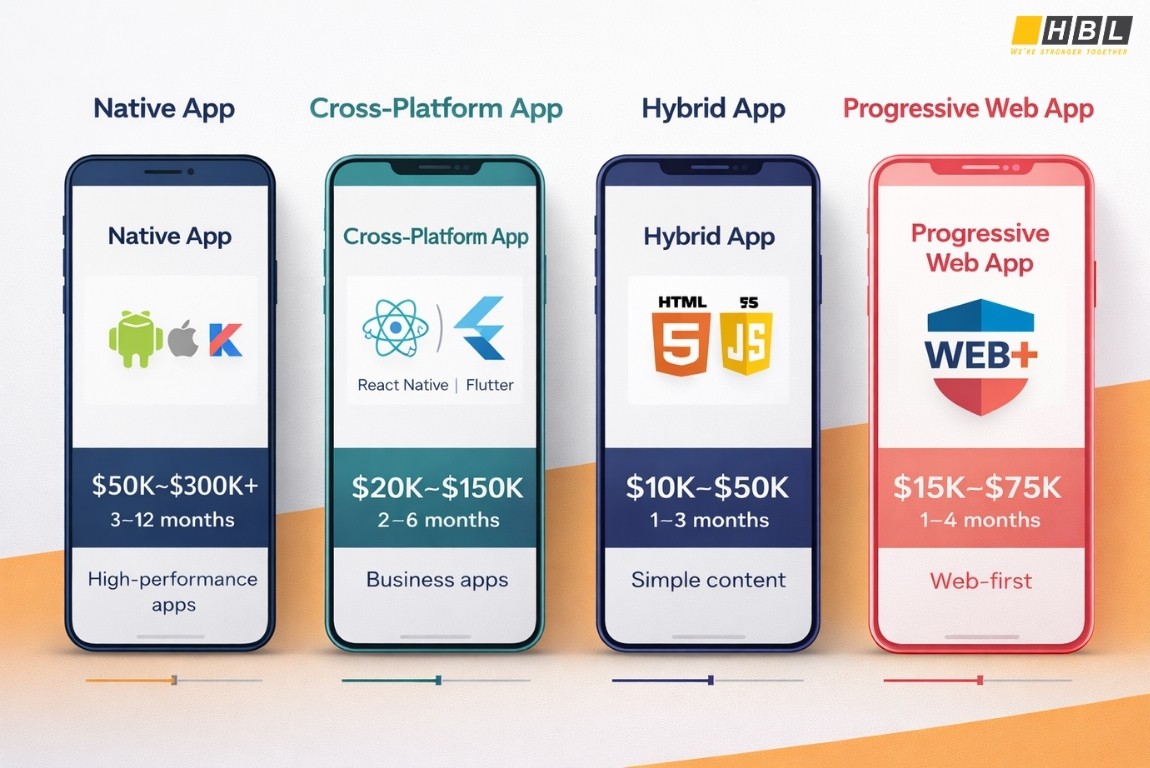
Progressive Web Applications (PWAs) represent a web-first approach to mobile app development. PWAs are websites that function like native applications, offering offline capability, push notifications, and home screen installation. PWA development costs range from $15,000 to $75,000, making them an attractive option for budget-conscious projects. However, PWAs cannot access all device features and may not meet app store distribution requirements if your strategy depends on marketplace visibility.
| App Type | Cost Range | Timeline | Best For |
|---|---|---|---|
| Native iOS/Android | $50K to $300K+ | 3 to 12 months | High-performance apps |
| Cross-Platform | $20K to $150K | 2 to 6 months | Business/utility apps |
| Hybrid | $10K to $50K | 1 to 3 months | Simple content apps |
| PWA | $15K to $75K | 1 to 4 months | Web-first strategy |
Table 2: Mobile App Development Costs by Application Type
Mobile App Features That Directly Affect Your Budget
The features you include in your mobile app development project directly determine your budget requirements. Each feature adds development hours, testing requirements, and often ongoing operational costs. Understanding feature costs helps you prioritize effectively and build a realistic budget plan for mobile app development.
User Authentication and Account Management
User authentication systems allow users to create accounts, log in securely, and manage their profiles:
- Basic email and password authentication adds $3,000 to $8,000
- Social login integration (Google, Facebook, or Apple) adds $2,000 to $5,000 per provider
- Two-factor authentication (2FA) adds $5,000 to $10,000
- Enterprise single sign-on (SSO) integration can add $15,000 or more depending on the identity provider
Payment Processing Integration
Payment gateway integration enables in-app purchases, subscription billing, and e-commerce functionality. Integrating with established providers like Stripe, Braintree, or PayPal typically costs $5,000 to $15,000 depending on complexity. Apple Pay and Google Pay integration adds $3,000 to $8,000.
Multi-currency support, recurring billing, and complex tax calculation requirements can increase costs to $25,000 or more. Payment features also incur ongoing transaction fees, typically 2.5 to 3.5 percent of transaction value.
Real-Time Messaging and Notifications
Real-time messaging functionality enables chat features, live updates, and instant notifications:
- Basic push notifications cost $3,000 to $8,000
- In-app messaging with media sharing, read receipts, and message history adds $10,000 to $25,000
- Video chat integration can add $20,000 to $50,000 depending on whether you use existing platforms or build custom solutions
Geolocation and Maps Integration
GPS and mapping features enable location-based services, delivery tracking, and navigation. Basic location tracking and map display integration typically costs $5,000 to $15,000. Real-time location sharing, route optimization, or geofencing features can add $15,000 to $40,000. Complex mapping applications like ride-sharing platforms can require $50,000 to $100,000 or more in location-related development.
Artificial Intelligence and Machine Learning
AI (Artificial Intelligence) integration is transforming mobile app development capabilities and costs. Basic AI features like chatbots or recommendation engines add $10,000 to $30,000. Custom machine learning (ML) models for image recognition, natural language processing (NLP), or predictive analytics can add $25,000 to $100,000 or more depending on training requirements and model complexity. AI features also incur ongoing cloud computing costs for model inference.
Internet of Things Connectivity
IoT (Internet of Things) integration connects your mobile application to smart devices, wearables, and sensors. Basic Bluetooth connectivity for simple devices adds $10,000 to $25,000. Complex IoT ecosystems with multiple device types, real-time data synchronization, and edge computing can require $50,000 to $150,000 or more. IoT features also require ongoing infrastructure investment for data processing and storage.
Additional Budget Considerations
The initial development cost is only part of your total investment in mobile app development. Ongoing operational costs, maintenance requirements, and third-party service fees continue throughout your application’s lifecycle. A responsible budget plan for mobile app development accounts for these continuing expenses.
App Store Fees and Requirements
Both major app stores charge fees for developer account access:
- Apple App Store requires an annual developer program membership of $99
- Google Play Store charges a one-time registration fee of $25
- Apple takes 15 to 30 percent commission on digital goods depending on revenue and subscription duration
- Google takes 15 to 30 percent on similar terms
These commissions significantly impact monetization models for many mobile app development projects.
Annual Maintenance Costs
Mobile applications require ongoing maintenance to remain functional and secure. Operating system updates from Apple and Google regularly introduce compatibility issues that require code modifications. Bug fixes, security patches, and performance optimizations are continuous requirements.
Industry best practice recommends budgeting 15 to 20 percent of your initial development cost annually for maintenance. For a $100,000 development project, you should allocate $15,000 to $20,000 per year for ongoing maintenance.
Server and Hosting Infrastructure
Backend infrastructure costs scale with your user base and data requirements. Cloud hosting from providers like Amazon Web Services (AWS), Google Cloud Platform (GCP), or Microsoft Azure offers flexible pricing but can become expensive at scale:
- Simple applications with limited data requirements: $50 to $200/month
- Applications with significant traffic, real-time features, or large media libraries: $1,000 to $10,000+/month
Third-Party API and Service Subscriptions
Modern mobile applications rely on numerous third-party services, each with associated costs. Analytics platforms, push notification services, payment processors, mapping services, email delivery tools, customer support platforms, and monitoring solutions all add to monthly operational costs. Budget $500 to $5,000 monthly depending on your service stack and user scale.
Security and Compliance
Security requirements add both initial development costs and ongoing operational expenses. SSL certificates, data encryption, secure authentication, and regular security audits are essential for applications handling sensitive information.
Compliance with regulations like GDPR (General Data Protection Regulation), HIPAA (Health Insurance Portability and Accountability Act), or PCI DSS (Payment Card Industry Data Security Standard) requires additional development, legal consultation, and ongoing monitoring. Security compliance can add $10,000 to $50,000 or more to initial development costs depending on regulatory requirements.
The Mobile App Development Team and What Each Role Costs
Mobile app development requires a coordinated team of specialists working together throughout the project lifecycle. Understanding each role helps you plan your budget and appreciate where development resources are allocated.
| Role | Hourly Rate | Typical Hours | Cost Range |
|---|---|---|---|
| Project Manager | $40 to $100 | 100 to 400 | $5K to $25K |
| UI/UX Designer | $35 to $90 | 150 to 500 | $8K to $50K |
| Front-End Developer | $30 to $80 | 300 to 1,500 | $10K to $120K |
| Back-End Developer | $35 to $90 | 200 to 1,000 | $7K to $90K |
| QA Engineer | $25 to $60 | 100 to 400 | $3K to $24K |
| DevOps Engineer | $50 to $120 | 50 to 200 | $3K to $24K |
Table 3: Mobile App Development Team Roles and Costs
Project Manager
The project manager coordinates all aspects of your mobile app development project, including timeline management, resource allocation, stakeholder communication, and risk mitigation. Project managers typically charge $40 to $100/hr depending on experience and region, with total project management costs ranging from $5,000 to $25,000.
UI/UX Designer
The UI/UX designer creates the visual design and user experience architecture for your application. This role encompasses user research, wireframing, prototyping, visual design, and design system creation. Designers typically charge $35 to $90/hr, with total design costs ranging from $8,000 for basic designs to $50,000 or more for premium custom interfaces with animations.
Front-End Developer
Front-end developers build everything users see and interact with in your application. They implement designs, create animations, manage state, and ensure responsive performance across devices. Front-end developers typically charge $30 to $80/hr. A typical mobile app development project requires 300 to 1,500 front-end development hours depending on complexity.
Back-End Developer
Back-end developers create the server infrastructure, database architecture, and APIs that power your application. They implement business logic, manage data storage, ensure security, and build integrations with third-party services. Back-end developers typically charge $35 to $90/hr. Complex applications may require 500 to 2,000 or more back-end development hours.
Mobile Developer
Mobile developers specialize in building applications for iOS, Android, or cross-platform frameworks. They understand platform-specific requirements, device capabilities, and mobile user interface patterns. iOS and Android developers typically charge $35 to $90/hr. React Native or Flutter developers charge similar rates but can deliver both platforms from a single codebase.
QA Engineer
QA (Quality Assurance) engineers test your application across devices, operating system versions, and user scenarios. They identify bugs, verify fixes, perform regression testing, and ensure the application meets requirements. QA engineers typically charge $25 to $60/hr, with QA costs representing 15 to 20 percent of the total development budget.
DevOps Engineer
DevOps engineers manage the infrastructure, deployment pipelines, monitoring, and operational aspects of your application. They automate builds, manage cloud resources, implement continuous integration and deployment (CI/CD), and ensure application reliability. DevOps engineers typically charge $50 to $120/hr, with initial infrastructure setup costs ranging from $5,000 to $20,000.
How to Reduce Mobile App Development Costs
Emerging technologies are creating new opportunities to reduce mobile app development costs while accelerating time to market.
AI-assisted development tools and low-code/no-code platforms can significantly reduce development time and labor costs for certain types of applications.
AI-Assisted Development Tools

AI coding assistants like GitHub Copilot, Amazon CodeWhisperer, and ChatGPT are transforming how developers write code. These tools can generate code snippets, suggest implementations, debug problems, and document existing code. Studies indicate AI assistants can improve developer productivity by 20 to 50 percent for routine coding tasks, potentially reducing development costs proportionally.
AI tools excel at:
- Generating boilerplate code and implementing standard patterns
- Writing API integrations and form validation logic
- Implementing standard user interface components
- Suggesting solutions to common development problems
However, AI tools cannot replace human judgment in architecture decisions, complex business logic implementation, or user experience design.
Low-Code and No-Code Platforms
Low-code platforms typically reduce development costs by 40 to 60 percent compared to custom development. A simple application that might cost $50,000 in custom development could potentially be built for $20,000 or less using a low-code platform.
These savings come with trade-offs. Low-code platforms limit customization options, may not support complex features, and create vendor dependency that can complicate future scaling or platform migration.
What AI and Low-Code Tools Cannot Replace
While AI and low-code tools offer significant cost savings for certain use cases, they cannot replace all aspects of mobile app development. The following still require traditional development approaches:
- Custom user interfaces with unique interactions
- Complex business logic and real-time features
- Deep hardware integration
- Applications with strict performance requirements or extensive offline functionality
The decision between AI-assisted development, low-code platforms, or traditional custom development should be based on your specific requirements, timeline constraints, budget limitations, and long-term scalability needs.
Outsourcing vs. App Builder Platforms
The choice between hiring a development team or agency versus using an app builder platform represents one of the most significant decisions in your mobile app development journey.
Custom Development Outsourcing
Outsourcing mobile app development to an agency or freelance team offers maximum flexibility and customization. You can build exactly the features you need, create unique user experiences, and scale your application without technical limitations. Custom development is appropriate when your application requires unique functionality, complex integrations, or a distinctive user experience that differentiates you from competitors.
The primary disadvantage is cost. Hiring a professional development team typically costs $50,000 to $300,000 or more depending on complexity. You also accept responsibility for ongoing maintenance, updates, and technical evolution. Custom development provides full ownership of your codebase, freedom from platform dependencies, and the ability to iterate based on user feedback without platform constraints.
App Builder Platforms
App builder platforms offer a faster, lower-cost alternative for straightforward applications. These platforms provide pre-built templates, drag-and-drop interfaces, and integrated hosting that can reduce development time from months to weeks. Costs typically range from $50 to $500/month in subscription fees, plus initial setup and customization investment ranging from $5,000 to $30,000 if you hire assistance.
App builder platforms are ideal when you:
- Need a simple application with standard features
- Have a limited budget or require rapid time to market
- Are testing a concept before committing to larger investment
- Need basic business applications, content delivery, simple e-commerce, or internal tools
They limit your ability to create unique features, may not scale efficiently, and create dependency on the platform provider.
About HBLAB
Building mobile and web applications for global enterprises has been at the core of HBLAB’s work for over 10 years. What has always set us apart is our ability to deliver enterprise-grade quality at a cost structure that makes serious development accessible, typically 30 percent more cost-efficient than comparable local market rates.

That foundation is now significantly stronger.
With AI expertise dating back to 2017 and deep capability in low-code and no-code platforms, HBLAB now delivers the same high-quality mobile app development faster and at lower labor cost than traditional approaches allow. We apply these tools precisely where they reduce hours without reducing output, accelerating timelines across design, development, and testing phases while keeping your budget under control.
Our team of 700+ IT professionals, including 30% at senior level with five or more years of hands-on experience, brings both technical depth and proven delivery discipline to every engagement. Our CMMI Level 3 certification reflects the process rigor global enterprises rely on when quality and IP protection are non-negotiable.
Whether you are budgeting for your first mobile product or scaling an existing platform, HBLAB structures engagements around your goals, with flexible models that give you full control over workflows, tools, and delivery.
CONTACT US FOR A FREE CONSULTATION
FAQ
1. Why do mobile app development costs vary so much?
Mobile app development costs vary because no two projects are the same. The biggest cost drivers are app complexity, features required, development approach (native, cross-platform, or hybrid), and developer location. A simple single-platform app built by a South Asian team at $20/hr costs a fraction of an enterprise platform built by a North American team at $200/hr. Add variables like custom UI design, AI integrations, payment systems, and real-time features, and costs can shift by hundreds of thousands of dollars.
2. Should I use an app builder platform to develop mobile apps?
It depends on what you need to build. App builder platforms like Bubble, FlutterFlow, and Glide are a strong fit if you need a simple application quickly, have a limited budget, or are validating a concept before committing to full development. They can cut costs by 40 to 60 percent compared to custom development. However, if your app requires unique features, complex integrations, or long-term scalability, custom development is the more reliable investment.
3. How to create mobile apps that make a lot of money?
Revenue comes from user value and the right monetization model, not from the development approach you choose. The most consistently profitable apps use subscription billing, in-app purchases, or transaction-based revenue tied to genuine user demand. Focus first on solving a specific problem for a clearly defined audience. Then choose a pricing model that reflects the value your app delivers and build retention into the product from day one.
4. How much can a 1,000 downloads app make?
Downloads alone determine nothing. An app with 1,000 engaged subscribers paying $10/month generates $10,000 in monthly recurring revenue. The same app with 1,000 passive, non-paying users generates zero. Revenue depends entirely on your monetization model, user engagement, and value proposition. Focus on the quality and retention of your users rather than the volume of downloads.
READ MORE: