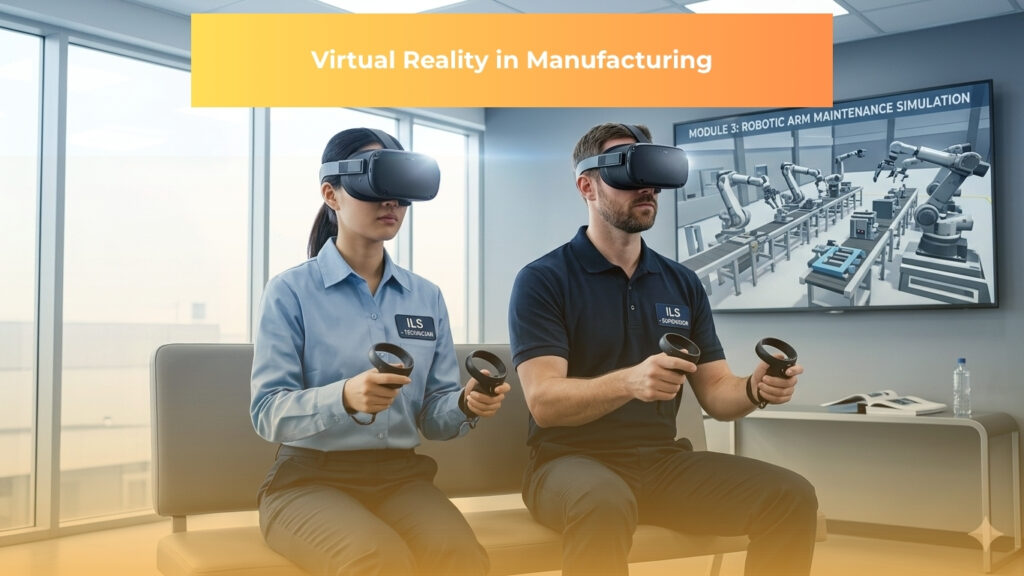
Virtual reality in manufacturing has moved well past pilot programs. Across automotive, aerospace, electronics, and heavy industry, organizations are running operational deployments with documented returns on investment.
The Reality-Virtuality Continuum
Paul Milgram’s Reality Virtuality Continuum, established in 1994, positions augmented reality (AR) and virtual reality (VR) not as separate products but as two points on the same spectrum. At one end sits the physical world. At the other lies a fully simulated environment generated entirely by computer systems.
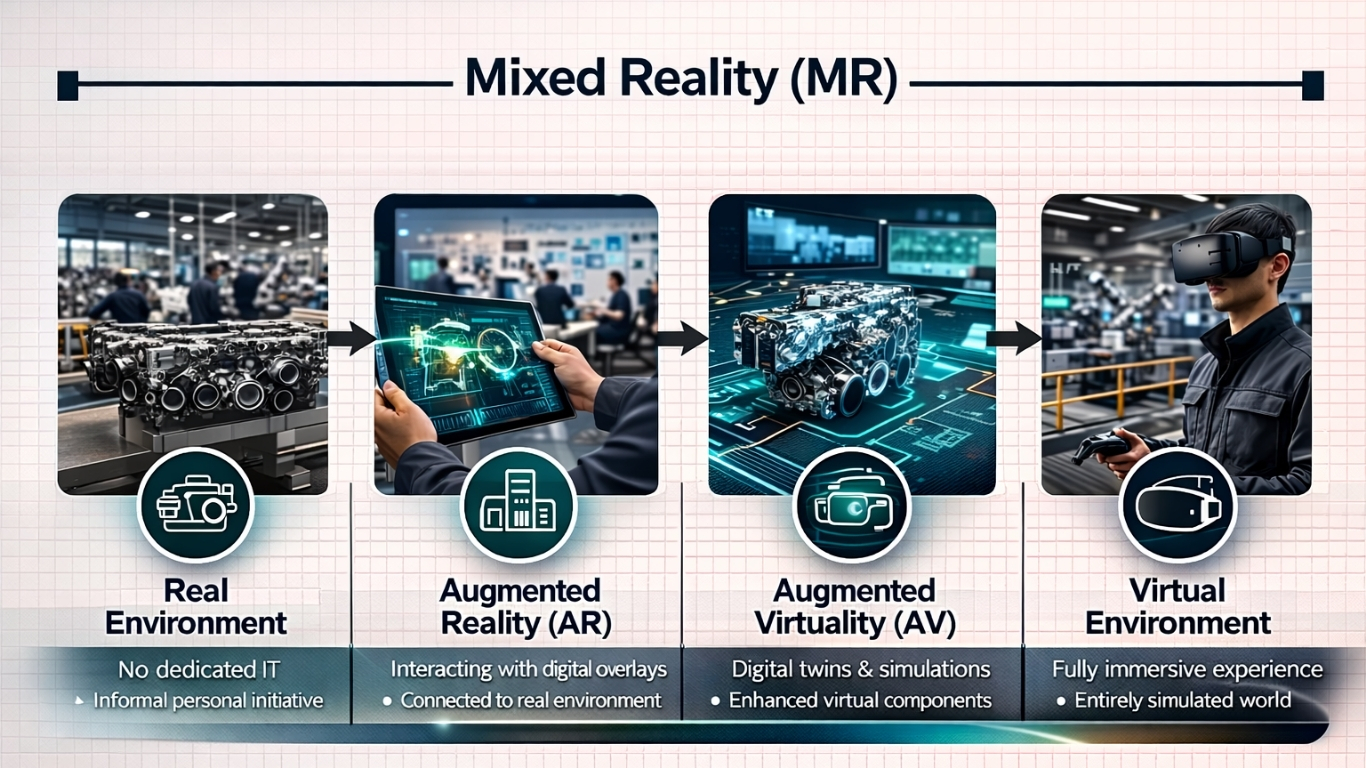
The space between them encompasses what researchers now call mixed reality, where digital and physical elements coexist in varying proportions.
Extended reality (XR) serves as the umbrella term covering AR, VR, and everything in between.
How VR Actually Works
VR works by presenting two slightly offset images to each eye, a principle inherited from the 19th-century stereoscope. The brain interprets this offset as depth, creating the perception of three-dimensional space. Inertial measurement units (IMUs) and inside-out cameras detect where the user’s head is pointing and update the rendered image in real time.
The key to presence, the feeling of actually being somewhere, is low latency. A headset with moderate visual fidelity but excellent tracking produces a stronger sense of presence than a high-resolution display with perceptible lag.
For manufacturing applications, the goal is accurate spatial simulation, not visual spectacle. Workers training on virtual equipment need to develop genuine procedural memory.
How AR Actually Works
AR uses a camera to capture the real environment and overlay digital images anchored to specific coordinates in physical space. Two dominant tracking approaches exist:
- Marker-based tracking uses printed codes or fixed reference points to anchor virtual objects
- Feature-based tracking uses the physical environment itself, recognizing edges, surfaces, and textures as anchor points
Feature-based tracking is the approach winning in 2025 because it functions in dynamic factory environments without requiring physical markers installed throughout the facility.
Devices relevant to manufacturing include the Microsoft HoloLens 2, Magic Leap 2, and Apple Vision Pro, each with different tradeoffs in field of view, battery life, and software compatibility.
Unlike VR, AR preserves the user’s view of the physical world while layering digital information over it.
The Decision Rule
One practical rule applies across nearly every manufacturing application:
If no real machine exists yet, or the environment is too dangerous or expensive for live practice, use VR
If the worker is standing in front of real equipment and needs information without putting down their tools, use AR
From Gaming Headsets to Factory Floors
Most people associate VR with gaming headsets like Meta Quest, PlayStation VR, and SteamVR. That mental model is the first barrier to understanding its industrial relevance. The tracking sensors and real-time rendering engines powering consumer gaming are the same systems being repurposed for factory use.
>> See more: How to Make a VR Game
Manufacturing decision-makers sometimes dismiss VR as entertainment technology. This ignores the fact that precise motion tracking, low-latency rendering, and spatial audio serve the same engineering purpose regardless of whether the content is a game or a training simulation.
Market Maturity in 2025
The global Virtual Reality in manufacturing market was valued at $5.69 billion in 2024 and is projected to reach $38.93 billion by 2032, a compound annual growth rate of 27.2%.
Asia-Pacific leads adoption, driven by automotive and electronics sectors in China, Japan, and South Korea. Product design and development represents the dominant application segment, ahead of training and safety.
The collective AR and VR in manufacturing market is projected to reach $72.4 billion by 2031, according to Allied Market Research.
Case Studies That Established the Field
A handful of documented deployments established the operational credibility of this technology:
- Boeing cut per-employee training time by 75% after implementing VR-based assembly training, through faster skill acquisition and reduced error correction
- Lockheed Martin used Microsoft HoloLens 2 to reduce an eight-hour assembly task to 45 minutes with zero errors across 57,000 fastener installations on the Orion spacecraft
- Mondelēz compressed a 3D product concept design process from weeks to hours using VR combined with collaborative 3D tools, catching problems that would otherwise have surfaced only during physical prototyping
AR vs. VR in the Factory
Many People May Get This Wrong:
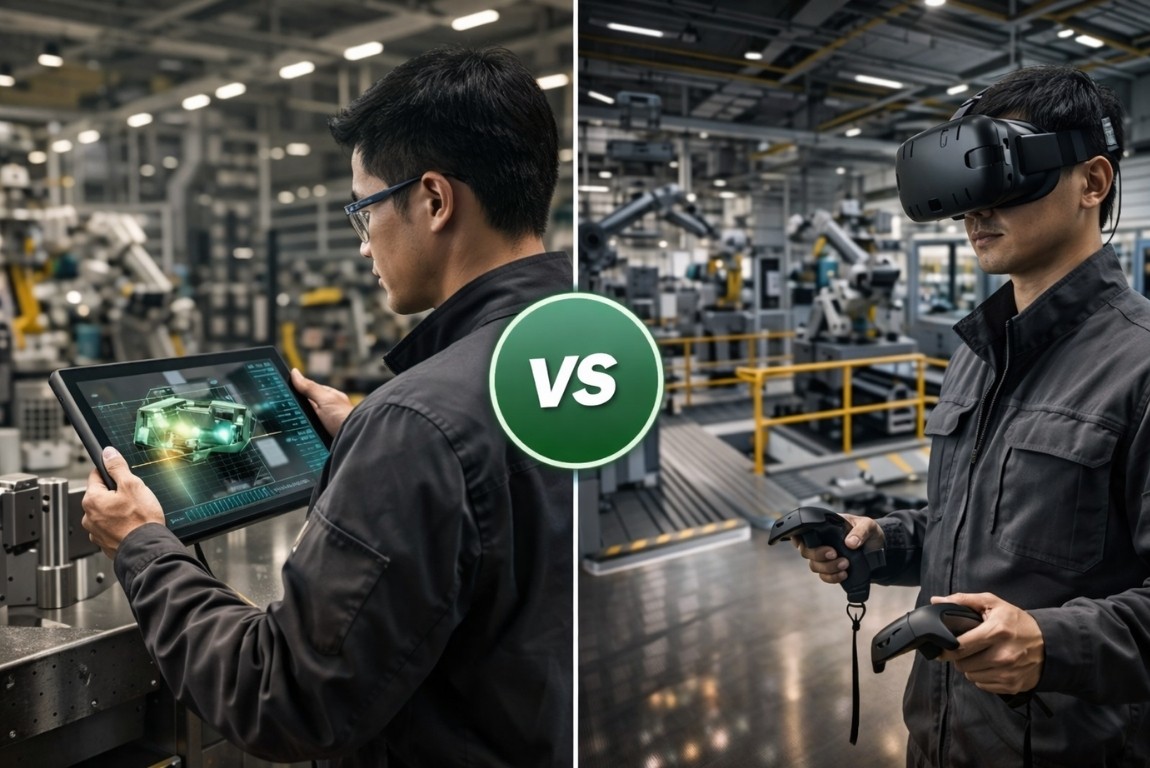
The manufacturing industry often groups AR and VR under the label XR, which creates a false equivalence. Choosing between them is a strategic operational decision. Using the wrong tool creates friction and fails to solve the actual problem.
When to Use VR
VR is appropriate when the real world is a liability rather than an asset. Three specific situations define its value proposition:
Safety training. A factory fire, chemical release, or heavy machinery failure cannot be realistically simulated in a live environment. VR allows workers to practice emergency protocols inside a virtual replica of their actual facility, experiencing the spatial pressure of the scenario without physical consequence.
Factory layout and pre-commissioning. When a new production line has not yet been built, VR allows engineers to walk through the proposed layout at full scale before a single machine is installed. Worker ergonomics, robot clearance paths, and material flow can all be tested and adjusted in virtual space, preventing expensive post-installation errors.
Skills simulation for high-cost physical training. Welding, CNC operation, spray painting, and press operation involve expensive materials and unforgiving equipment. A VR training environment allows multiple full practice repetitions in the time a single physical attempt would take, with no material waste and no equipment risk.
When to Use AR
AR is appropriate when the worker is already at the machine and needs contextual information without interrupting their physical task.
Assembly guidance places step-by-step instructions, including arrows pointing to specific connectors, torque specs, and sequence alerts, directly in the worker’s field of view as they look at the actual component. Boeing used AR wiring guidance to cut technician work time by 25% while improving quality consistency.
Remote maintenance support allows a field technician to stream their live view to a remote expert, who draws virtual annotations directly onto the machine the technician is looking at. The guidance appears in the technician’s headset as if drawn onto the physical equipment, eliminating specialist travel costs and reducing downtime.
Quality control uses AR to overlay the original CAD design as a transparent ghost layer onto the manufactured component. Dimensional deviations become immediately visible without separate measurement instruments.
VR Applications Across the Manufacturing Lifecycle
Product Design and Prototyping
Engineers use VR to review full-scale three-dimensional models before any physical version is built. At Ford and BMW, design teams across different locations evaluate the same full-size virtual vehicle together, checking proportions, interior ergonomics, and component clearances in real space. Changes can be made and reviewed in real time, catching errors before tooling begins.
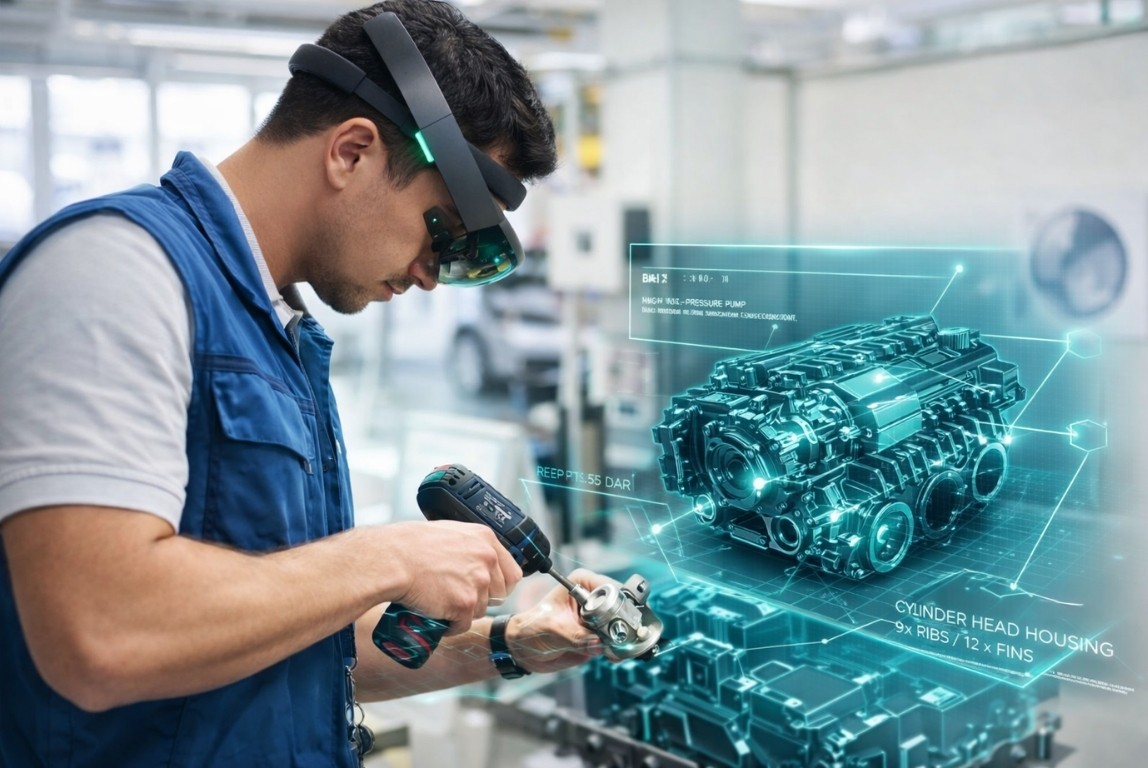
Teams spread across continents can occupy the same virtual space, pointing at components and discussing changes as if standing in the same room. Physical prototype shipping delays and version-control miscommunication both disappear.
Factory Layout and Process Planning
Before installing machinery, teams simulate the complete factory floor in VR, including robot movement paths, conveyor routing, pedestrian walkways, and emergency exits. Collision risks, ergonomic problems, and workflow bottlenecks are identified and resolved virtually. BMW and Volkswagen have used VR factory simulation to compress new-model launch timelines by resolving layout conflicts before construction begins.
Digital twins of proposed production lines can also be populated with simulated material flow, allowing engineers to identify bottlenecks and throughput limitations before committing capital to physical construction.
Workforce Training and Onboarding
Training workers to operate industrial presses, work near robots, or handle hazardous materials carries significant risk when done on live equipment. VR removes that constraint. The same module can be deployed globally without instructor travel, and scenarios can be reset and repeated as many times as needed.
PwC research found that traditional classroom training results in roughly 10% knowledge retention at the 90-day mark, while VR training consistently achieves 75% or higher retention over the same period. The improvement comes from cognitive architecture: VR engages spatial memory and procedural learning systems that classroom instruction accesses only indirectly.
AR Applications Across the Manufacturing Lifecycle
Assembly Guidance on the Production Line
AR headsets overlay holographic step-by-step instructions directly onto physical components as the worker looks at them, removing the cognitive split between reading a separate instruction and performing a physical action. The result is fewer errors, faster cycle times, and reduced dependence on experienced workers to guide newer employees.
Traditional work instructions require workers to shift attention between the reference material and the task. Each context switch introduces the possibility of error. AR keeps the instruction in the worker’s visual field throughout, eliminating that discontinuity entirely.
Remote Maintenance and Expert Assistance
When a machine breaks down and the on-site technician lacks the expertise to resolve the fault, AR eliminates the need to fly in a specialist. The technician’s live view streams to a remote expert, who annotates the physical machine in real time. The technician sees those annotations in their headset as if drawn onto the actual equipment.
This capability becomes increasingly important as experienced workers approach retirement. A single expert can support technicians across multiple facilities without travel, effectively multiplying the reach of specialized knowledge.
Quality Control and Inspection
AR quality inspection places the original CAD design as a transparent overlay on the manufactured component, making deviations from specification immediately visible. Combined with AI-based object detection methods such as YOLO (You Only Look Once), AR inspection systems identify defects in real time during production rather than at a separate downstream inspection stage.
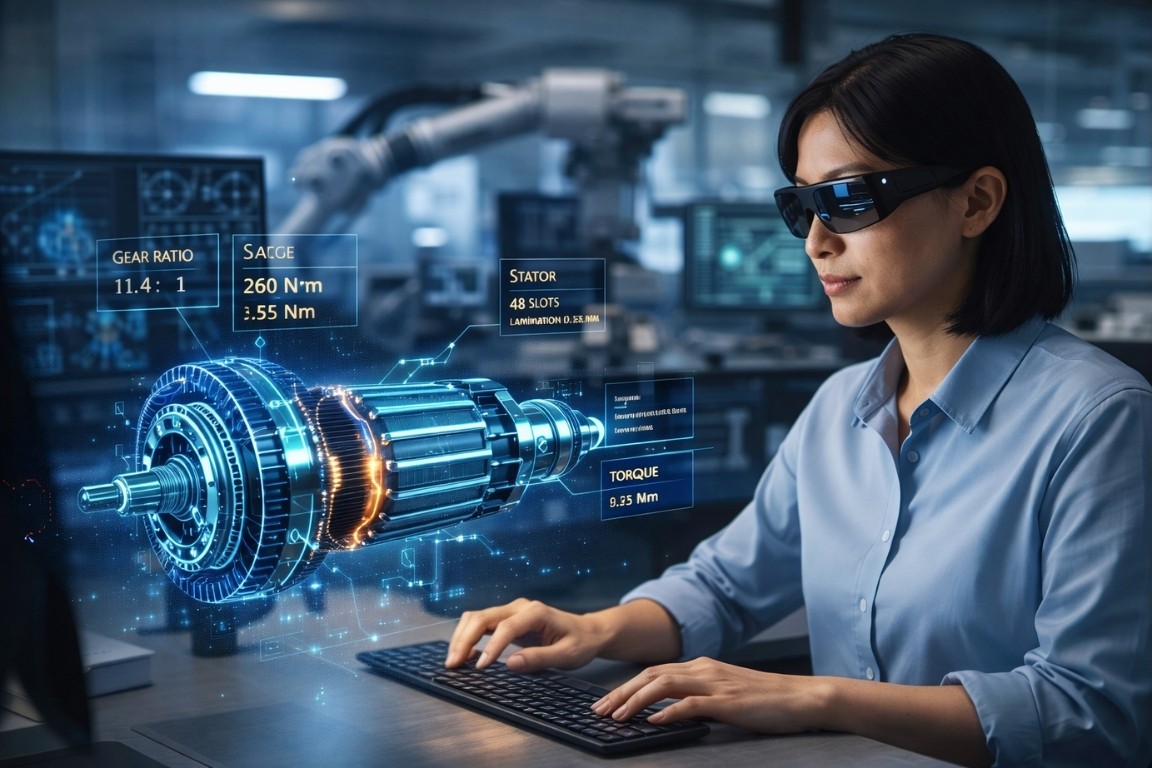
Traditional inspection relies on physical measurement instruments and human judgment, both of which introduce variability between inspectors and shifts. AR inspection produces consistent results regardless of individual experience, generating traceable digital records of each inspection.
Digital Twins: Why VR Needs a Live Data Partner
What a Digital Twin Is
A digital twin is a virtual replica of a physical asset, process, or system that is continuously updated by real sensor data from its physical counterpart. A CAD model is a blueprint of how something was designed. A digital twin is a real-time mirror of how that thing is operating right now.
Gartner defines it as an encapsulated software object or model that mirrors a unique physical object, process, or other abstraction. The digital twin market is projected to reach $126 billion by 2030.
Why VR Without Live Data Becomes Stale
A VR environment built from a factory’s original design reflects how that factory was configured at the time of modeling, not what changed on the production floor last week. Without a connection to live data, Virtual Reality in manufacturing is a snapshot, not a window.
Digital twins solve this by feeding current operational data into the virtual environment, so what the user walks through in VR reflects present conditions rather than historical ones.
What the Combined VR and Digital Twin System Delivers
When a VR environment is connected to a live digital twin, four capabilities emerge that neither technology provides independently:
- Immersive factory monitoring: A plant manager walks through a live virtual production floor and sees real-time sensor data on each machine, identifying bottlenecks without entering a hazardous environment
- Fault simulation and predictive maintenance: Engineering teams simulate failure modes on the digital twin before they occur on physical equipment, training technicians on rare but catastrophic faults
- Virtual commissioning: PLC programs and robot movement paths are tested inside VR before any physical equipment is installed, catching programming errors at zero cost
- Continuous deviation tracking: A virtual twin updated after each construction stage captures divergences from the original CAD specification before they compound into structural problems
Where This Fits in Industry 4.0
IoT sensors embedded throughout the physical factory generate continuous operational data. The digital twin consumes that data and maintains an accurate virtual model. VR gives human operators an intuitive spatial interface through which to interact with and interpret that model.
VR Against Traditional Methods
Training Cost and Time
Traditional manufacturing training requires access to live equipment, which means scheduling time on a production line, renting specialist machinery, or running dedicated training facilities. Errors during practice can damage equipment, waste materials, or injure trainees.
Deloitte found that VR-based programs deliver up to 40% cost savings and 50% time reduction compared to traditional approaches, a scale of difference that fundamentally changes the economics of enterprise workforce development.
Knowledge Retention
The Ebbinghaus Forgetting Curve shows that people forget roughly 70% of what they learn within 24 hours of a conventional training session. At the 90-day mark, classroom training leaves participants retaining approximately 10% of the material.
VR training produces retention rates above 75% at the same interval. The reason is the mechanism it enables: active, spatially grounded experience encodes information more durably than passive instruction.
Safety
The most fundamental limitation of traditional safety training is that the most critical scenarios cannot be safely recreated. Telling workers what to do in a chemical spill is not the same as placing them in a simulated one.
VR safety training has been shown to:
- Reduce workplace accident risk by over 40% in documented industrial deployments
- Increase measurable hazard identification in post-training assessments
- Produce a 45% decrease in accidents compared to traditional methods, per University of Maryland’s Virtual Reality Lab
Design and Prototyping Speed
Physical prototyping is slow and expensive, limiting how many design iterations are financially viable. Evaluating a design on a flat screen requires stakeholders to mentally project scale and spatial relationships, which produces judgment errors.
Mondelēz compressed a concept design phase from weeks to hours using VR combined with collaborative 3D tools. The acceleration came from faster decision convergence: stakeholders could see and understand options immediately rather than interpreting technical drawings.
Error Rate in Production
Workers consulting paper manuals during assembly must constantly shift attention between the document and the component. Quality inspectors using physical measurement tools work methodically but slowly, with results that vary between individuals and shifts.
AR on the production line addresses both problems simultaneously. The instruction stays in the worker’s field of view as they look directly at the part. The CAD ghost overlay makes dimensional deviations visible without any separate instrument. Lockheed Martin’s result of zero errors across 57,000 fastener installations represents what this guidance approach delivers at full implementation.
Who Sees What: Roles, Views, and Outcomes
The Design Engineer
A design engineer using VR walks around a full-scale product, steps inside an engine bay, checks clearances beneath a chassis, and invites colleagues from other offices to appear as avatars in the same virtual space. Design flaws that would only surface during physical prototyping become visible during the review itself. The iteration cycle shrinks from weeks to days.
The New Worker
A new employee using VR for onboarding stands in a virtual replica of the exact facility they will work in, operating virtual versions of the machines they will use, and encountering the emergency scenarios they must be prepared for. They arrive on the physical production floor having already made and corrected their mistakes in the virtual environment, with procedural confidence built from experience rather than instruction.
The Assembly Worker
An assembly worker using AR glasses sees holographic guidance layered directly over the component in front of them. The arrow points to the exact connector. The correct torque specification appears next to the bolt being turned. An alert fires if a step is completed out of sequence. Error rates fall, cycle times improve, and quality becomes consistent across all shifts and operators regardless of individual experience.
The Maintenance Technician
A maintenance technician has two distinct experiences depending on the situation:
- Before the repair: VR allows the technician to practice the procedure on a virtual replica of the machine, learning what a specific fault looks like and how to resolve it without any risk to production equipment
- During the repair: AR overlays live sensor data onto the physical machine, with temperatures, pressure readings, and vibration levels visible in context alongside the components they affect. If expert input is needed, the remote expert sees exactly what the technician sees and can draw guidance directly onto the machine
The Quality Inspector
A quality inspector using AR sees the original design intent overlaid on the manufactured part as a transparent reference layer. Dimensional deviations that would otherwise require manual measurement become immediately visible as misalignments between the ghost overlay and the physical surface. Inspections become faster, results become consistent across inspectors, and every inspection generates a traceable digital record.
The Plant Manager
A plant manager using VR connected to a live digital twin can walk through a virtual production floor and see real-time operational data on each machine: throughput, temperature, cycle time, maintenance status. Bottlenecks become visible spatially and in context, before they cascade into downtime. Process changes can be tested virtually before being implemented physically.
Benefits of Augmented Reality and Virtual Reality in Manufacturing
Speed. VR compresses training timelines. AR compresses assembly and maintenance timelines. In each case the mechanism is the same: replacing slow, constrained physical processes with faster, repeatable virtual ones.
Cost reduction. The savings come from eliminating costs associated with physical training facilities, specialist travel, material waste during practice, and unplanned downtime. At enterprise scale, these savings become the primary argument for adoption.
Safety. For industries involving hazardous materials, heavy machinery, or complex emergency protocols, the ability to train workers on scenarios that cannot be safely recreated in a live environment is often the primary justification for the investment.
Quality. AR guidance during assembly and AR overlay during inspection address the same root problem: the gap between what was designed and what is built. Closing that gap at the point of assembly rather than at the point of inspection substantially reduces the cost of quality improvement.
Scalability and knowledge transfer. The same training environment can be deployed to any facility globally without additional instructor cost. As experienced workers retire, their institutional knowledge can be captured in modules or made available through remote AR assistance.
Where the Technology Stands Now
Not every application is at the same stage of maturity:
- Operationally deployed at scale: VR safety training, VR prototype review, AR remote maintenance
- Growing rapidly: AR assembly guidance, AR quality inspection
- Still emerging: Full VR and digital twin integration, AI-driven AR anomaly detection
Manufacturers evaluating adoption should match their investment to where the technology is mature, not where it is most visible in marketing materials.
The Competitive Dimension
The manufacturers investing seriously in VR and AR now are building a structural operational advantage in three areas:
- The speed at which they can train and redeploy workers
- The consistency and quality of what comes off their production lines
- Their ability to maintain equipment and support technicians without being constrained by where their most experienced people happen to be physically located.
The organizations that establish these capabilities first will be measurably harder to compete with as the technology matures and the performance gap widens.
READ MORE: