Vietnam AI engineers are considered highly competent, fast-learning, and cost-effective, making them a top choice for global tech companies. They possess strong foundations in math and software development, particularly in computer vision and natural language processing.
While only around 15% have large-scale project experience, they adapt quickly to complex architectures.
Why Vietnam Is Becoming a Regional AI Powerhouse
Vietnam ranked 39th out of 139 countries in Oxford Insights’ 2024 AI Readiness Index, climbing 19 positions in a single year and placing among the top five nations in ASEAN. This trajectory reflects a decade of deliberate policy construction, accelerating private investment, and a national technology ambition that is starting to pay measurable dividends.
The Infrastructure Bets That Signal Intent
The government’s national AI strategy targets top-30 global readiness by 2030, a goal that has drawn serious infrastructure commitments from both the state and the private sector. A national AI supercomputing center is in active development, designed to give domestic researchers and companies access to the computational capacity that serious model training requires.
- NVIDIA’s Vietnam Research and Development Center, launched in 2024, now anchors more than 100 AI startups through its Inception program and maintains 65 university partnerships across the country.
- Google formalized its Vietnamese presence in 2025 by establishing Google Vietnam Company Limited, headquartered in Ho Chi Minh City.
- Qualcomm has established an AI R&D center in Vietnam, a signal from a company that calibrates every element of its global footprint with precision.
These are are structural commitments by organizations that move slowly and carefully when they move at all.
The Market Numbers Behind the Momentum
Vietnam’s AI market was estimated at $932 million in 2025 and is projected to reach $6.91 billion by 2031. The broader IT industry, representing more than 70,000 digital technology enterprises and a workforce of 1.5 million people, is forecast by VINASA to generate $170 billion in revenue by 2025.
Eighteen percent of Vietnamese businesses now regularly apply AI. Among those, 61% report average revenue growth of 16%, a figure that speaks to normalized deployment rather than proof-of-concept activity.
Vietnam vs. the Alternatives
Comparing Vietnam to competing destinations requires precision. Singapore’s AI ecosystem is more mature and better capitalized, but costs are substantially higher and available talent pools are far smaller. India offers scale but faces increasing rate pressure from its own growth cycle. Eastern Europe’s talent base has been significantly disrupted since 2022.
Vietnam offers a combination of cost position, talent depth, and ecosystem momentum that no single competing market fully replicates.
The Trends Driving Vietnam’s AI Innovation Capacity
From Execution to Ownership
The most consequential structural shift in Vietnam’s technology sector is the move away from pure labor arbitrage. For two decades, the country competed primarily on cost, offering reliable software delivery at rates that Western markets found attractive.
That model is not disappearing, but it is being supplemented, and in some firms replaced entirely, by a different ambition: building proprietary AI products designed from inception for global markets.
Make in Vietnam: Policy Meets Product
“Make in Vietnam” is a strategic policy launched in 2019 by the Ministry of Information and Communications (MIC) to shift the nation from assembling/outsourcing to designing, creating, and manufacturing technology products domestically. It aims to foster technological self-reliance, solve local problems, and boost economic value, targeting 50% domestic value contribution by 2030.
Supporting Measures:
- Legal Framework: Development of the Digital Technology Industry Law to facilitate innovation and provide an enabling environment.
- Talent Development: Focus on training high-quality human resources, including incentives for students in digital fields and encouraging foreign expertise.
- Investment & Support: The government is shifting from direct financial support to using “vouchers” to encourage the use of innovative products and services.
Key Results: The policy has increased the domestic value contribution of the ICT sector to 31.8% in 2024, from 21.35% in 2019, with around 1,500 ICT firms generating overseas revenue.
This national policy pushes technology enterprises to design and develop products domestically rather than execute specifications imported from abroad. Nearly 500 AI-focused startups are operating in Vietnam as a direct consequence.
Companies are building in-house R&D centers and deploying AI solutions that require not just trained models but sustained engineering commitment over timescales that pure outsourcing contracts rarely accommodate.
Building the Next Generation of Specialists
The talent pipeline is being rebuilt to match this ambition. FPT University, in partnership with NVIDIA, has constructed an AI-specific curriculum targeting 8,000 specialized graduates per year by 2030.
That number matters because the volume of general IT graduates, approximately 57,000 annually, has not kept pace with quality requirements. Only around 30% of those graduates currently meet practical industry standards. The FPT-NVIDIA collaboration is precisely calibrated to close that gap at the specialist level rather than the generalist level.
The Efficiency Advantage
Vietnamese engineers are developing a technically significant specialization in resource-efficient AI. Building production-grade models on constrained hardware has become a genuine competitive differentiator. Teams accustomed to working under resource constraints produce leaner, faster architectures than engineers trained exclusively on cloud-scale infrastructure, a quality that translates directly into lower deployment costs for enterprise clients.
Vietnamese-language NLP research adds a further dimension: handling a tonal language with historically limited digital training data requires a distinct problem-solving approach that is both technically demanding and commercially valuable across Southeast Asian markets.
The Current Reality: Vietnam’s AI Talent Pool
What the Numbers Actually Say
Approximately 5,000 Vietnam AI engineers are currently active in the market, according to TopDev’s 2024 survey. Of those, only 10 to 15% have substantial experience on large-scale, production-grade projects.
That concentration at the top matters enormously in practice. The best Vietnamese AI engineering teams compete on global terms, while the broader base continues developing the deployment depth that enterprise AI work demands.
Reading the Shortage Correctly
A projected deficit of 150,000 to 200,000 IT workers by 2025, measured across the full technology sector, does not map directly onto AI engineering availability. It reflects a structural tension between the pace of demand and the pace of talent formation.
International recruitment of senior Vietnamese technology talent surged 111% in 2024, capturing both how sought-after that expertise has become and how real the brain drain risk is. More than 500 Vietnamese AI experts currently work at global research institutions. The Ministry of Science and Technology had contacted 306 of them through its global network initiative as of mid-2025, attempting to channel expertise back into Vietnam’s domestic ecosystem.
The Right Framework for Hiring
Supply is constrained, but quality exists. The search process required to find the right Vietnam AI engineers is more demanding than equivalent searches in larger markets.
Companies approaching Vietnam with a volume mindset, expecting to scale from ten engineers to a hundred overnight, will find the market resistant. Companies that invest in identifying and partnering with the right teams access capabilities that are genuinely difficult to find elsewhere at equivalent cost.
70% of Vietnam’s population is under 35, meaning the talent base is young, motivated, and operating in an ecosystem that is accelerating rather than plateauing. That changes the calculus of medium-term access significantly.
What Vietnam AI Engineers Actually Know

Core Technical Competencies
- Python as the primary development language, with Java and C++ for performance-critical systems
- PyTorch, TensorFlow, Keras, and HuggingFace Transformers for model development and fine-tuning
- Pandas, NumPy, and SQL for data engineering and production pipeline construction
- LLMs, RAG systems, and agentic AI architectures
- MLOps and cloud deployment across AWS, Azure, and GCP
- Computer vision and image processing at production scale
- Vietnamese-language NLP, including work with unstructured tonal language data at depth unavailable in any other market
What Differentiates Them
- Strong mathematical foundations and formal logical reasoning, reflecting Vietnam’s education system emphasis on rigorous mathematics
- Demonstrated flexibility in constrained hardware environments, producing architecturally efficient models
- Deep familiarity with unstructured Vietnamese data, a specialized capability rare outside the domestic market
- Proven effectiveness in mixed international teams, with documented track records on cross-border product development
The Product Mindset Gap
The product mindset gap is the more nuanced challenge. Vietnam AI engineers trained in execution-focused outsourcing contexts sometimes need structured encouragement to own product decisions and push back constructively on requirements that compromise long-term model quality.
This is an artifact of how the industry has been structured historically, not a fixed disposition, and it changes rapidly under the right organizational conditions. Teams operating within product companies, or within outsourcing firms that have deliberately cultivated product thinking, demonstrate judgment that meets or exceeds what comparable teams in higher-cost markets produce.
English and Ethical Reasoning
English proficiency is non-negotiable for enterprise AI roles, and the talent market reflects this. Senior engineers engaging on international projects communicate effectively in written and spoken English; the friction that characterized outsourcing engagements a decade ago is meaningfully reduced in the AI-specialist cohort.
Ethical reasoning and critical thinking about model outputs, growing expectations in enterprise AI deployment, are areas where the best teams demonstrate increasingly sophisticated judgment, shaped by the complexity of the Vietnamese-language and regulatory environments in which they have built systems.
Why Choosing Vietnam AI Developers Is a High-ROI Decision
Acknowledge the Selection Challenge Upfront
Engaging Vietnam AI engineers for serious technical work involves a genuine selection challenge. The pool of engineers with large-scale production experience is roughly 500 to 750 people, applying the 10 to 15% figure to the 5,000 total. Competition for those individuals is intense, from both domestic product companies and international firms that have already discovered the market.
Treating that selection challenge as a dealbreaker misreads the ROI structure. The companies achieving the highest return are not the ones who solved the scarcity problem; they are the ones who invested in finding the right people and built structures that retained them.
The Cost Case
- 60 to 80% cost savings versus Silicon Valley
- 40 to 60% lower rates than Singapore
- ROI typically visible within 3 to 4 months for teams of three or more senior AI developers
On a three-year engagement, the cumulative financial advantage is substantial enough to fund additional product investment that would be impossible at Western market rates. The cost case is compelling, but it remains the weaker part of the full argument.
The Capability Case
The stronger case rests on capabilities that higher-cost markets do not reliably provide.
- Mathematical precision. Vietnam’s engineering education produces model architects whose work is structurally cleaner and more efficient than output from engineers trained primarily through self-directed or boot-camp pathways.
- Resourcefulness under constraint. Teams that have built production systems on hardware that Silicon Valley considers inadequate carry a practical efficiency mindset that reduces infrastructure costs and accelerates iteration cycles.
- Localization depth. If any element of the target market involves Southeast Asian users, particularly Vietnamese-language speakers, the combination of technical skill and native linguistic intuition is simply not available at any price from engineers who have not spent years working with Vietnamese data.
The Mixed-Team Model
The mixed-team model, combining Vietnam AI engineers with international colleagues on joint product development, has produced documented success across international projects. It offers a reproducible structural template for companies navigating this market for the first time, capturing the cost advantage while maintaining quality controls familiar to Western engineering leaders.
>> IT Outsourcing Models: Types, Pricing, and How to Choose
The Window Is Open Now
Vietnam’s AI ecosystem is currently in its highest-momentum phase. Major infrastructure is being constructed, formal talent pipelines are being activated, and the diaspora network is being systematically engaged.
The Vietnam AI engineers who will lead the next generation of the country’s most ambitious technology companies are working and accessible today. The competitive window for engaging with that talent before it becomes significantly more expensive is measured in years, not decades.
The companies that move within that window will hold structural advantages that latecomers will find difficult to close.
Work With Vietnam’s AI Engineers Through a Partner Built for It
Finding the right team matters more than finding volume. HBLAB is the operational answer to that argument.
Founded in 2015 and headquartered in Hanoi, HBLAB established its AI R&D Department in 2016, well before AI outsourcing became a mainstream enterprise priority. That head start is now a tangible advantage: the company fields over 50 AI specialists, with team leaders recognized as Kaggle Experts in the top 0.5% globally, and has built proprietary tooling that addresses the reliability gaps generic solutions consistently fail to close.
Its M-Series product suite reflects the kind of production-grade thinking this article describes.
- M-RAG eliminates hallucination risk by generating responses strictly from source documents.
- M-Workspace functions as a centralized platform for deploying AI agents across different roles and multi-agent AI workflows
- M-Avatar Real-time conversational character with face and voice cloning capability across English, Japanese, and Korean.
- M-OCR achieves over 98% accuracy on printed text and 95% on handwritten input, with native Vietnamese, Japanese, and Korean support
HBLAB delivers under a “One Team” model, integrating directly into client operations rather than operating as a detached vendor. In 2025, the company founded the AI Factory Lab in collaboration with Vietnam National University and launched Migurei, a subsidiary dedicated entirely to AI R&D and implementation.
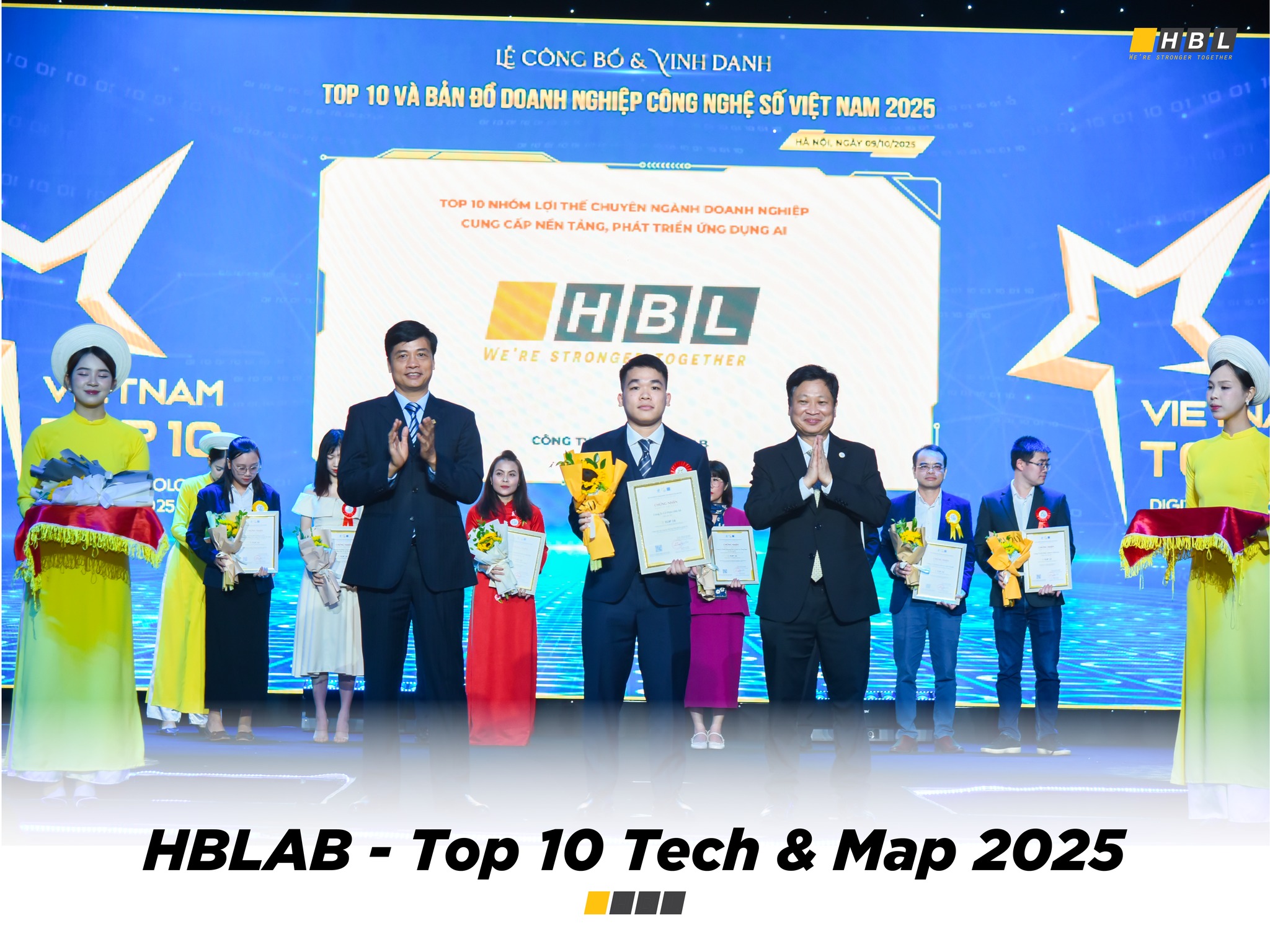
With 700+ engineers across Hanoi, Da Nang, Tokyo, Fukuoka, Seoul, and Singapore, a 95% client retention rate, and consecutive Top 10 AI Vietnam Company recognition from 2019 to 2024, HBLAB combines the R&D credibility, product depth, and geographic reach that serious enterprise AI partnerships require.