What Is a Technology Strategy?
A technology strategy (also called an information technology strategy or IT strategy) is a plan that defines how a company will use technology to meet its business goals. It sets out objectives, principles, and tactics, determining which systems to build or buy, so that every technical decision drives a measurable business outcome.
Rather than purchasing technology because it is new or trendy, a sound technology strategy forces a clear purpose. It ensures that IT teams and business leaders share a common vision, and that every technology investment directly serves the organization’s goals.
A technology strategy is typically developed by a cross-functional group of business and IT leaders, often led by a CIO or CTO, across a multi-year horizon. It includes a roadmap of projects, budgets, and success metrics so that progress can be tracked with precision.
By making the plan explicit, the strategy transforms technology from a cost center into a genuine business enabler. A retailer might use its technology strategy to grow online sales through a new e-commerce platform. A hospital might prioritize secure patient records and efficient scheduling systems. In each case, the strategy assigns metrics so every project can be measured against real business objectives.
The reason a technology strategy matters is straightforward: it prevents wasted effort and missed opportunities. When IT and business goals are aligned, organizations operate more efficiently, and technology projects streamline operations, enhance customer experiences, or open new markets rather than consuming budget without direction. A clear strategy also manages risk by incorporating plans for cybersecurity, compliance, and disaster recovery, ensuring the business can trust its critical data and systems.
What Are the Core Components of a Technology Strategy?

Strategic alignment
Strategic alignment means explicitly tying every IT project to a business objective. When a strategy aligns technology with business goals, IT is treated not as just support but as a driver of value. In practice, this means the strategy starts by understanding the company’s mission and then ensuring that technology initiatives (like a new CRM system or an e-commerce site) directly support priorities such as growing revenue or cutting costs.
Digital architecture and roadmap
A roadmap is a timeline of technology projects, showing how the pieces fit together. It might specify that in Year 1 the company will adopt cloud-based accounting software, in Year 2 launch a customer portal, and so on. By defining the architecture (the high-level design of systems and data flows) and sequencing projects over time, the strategy prevents chaos. For instance, it ensures that core systems are integrated in the right order or that legacy systems are replaced without disrupting daily operations. This way, technology changes happen in a planned, incremental fashion that aligns with business capacity.
Investment management
The strategy must guide which projects to fund and in what order. Instead of randomly upgrading technology, it ranks initiatives by return on investment and impact. High-value projects that support the company’s goals get priority funding, while low-impact projects are postponed or canceled. Alongside this, risk management and cybersecurity planning protect the business. A technology strategy identifies major risks – like data breaches or system outages – and sets out defenses. This can include security architectures (encryption, firewalls, identity controls) and disaster recovery plans (regular backups, failover systems). For example, a strategy might require encrypting customer data by default and running simulated hack drills. By baking risk planning into the strategy, companies keep hackers and accidents from derailing their objectives.
Talent development and training
Talent development means ensuring that the organization has the right skills. If a strategy decides to use a new analytics platform, it should also plan training for staff or hiring data experts. As one expert notes, strategy should ensure employees have the necessary skills and training to leverage new technology effectively. In other words, tech alone isn’t enough – people must know how to use it to create value.
Performance metrics and continuous review
An effective strategy defines success measures (for example, “reduce system downtime to 99.9% uptime” or “cut processing costs by 20%”) and sets up a way to track them. As a Wikipedia source explains, a successful technology strategy involves documenting assumptions and success metrics so initiatives stay on track. Regularly reviewing these metrics allows leaders to adjust the strategy as the business or technology landscape changes. Together, these components – alignment, architecture, budgeting, risk, talent, and metrics – ensure the strategy is not just a document but a practical guide for technology to serve the business.
How to Create a Technology Strategy
Building a technology strategy from scratch is less complicated than it appears, provided the process follows a logical sequence. Each stage has a clear purpose and feeds directly into the next.
Step 1: Assess the current technology state
Conduct a thorough audit of all existing systems, tools, and workflows. Identify what is working, what is creating friction, and where the most significant gaps exist. Involve frontline staff, as they often have the clearest view of operational pain points that leadership may not see from above.
Step 2: Define SMART goals aligned to business objectives
Use the assessment findings to set targets that are Specific, Measurable, Achievable, Relevant, and Time-bound. A goal such as “implement an online ordering system to increase sales by 15% within 12 months” gives the team clear direction and a way to measure success. Every goal should trace directly back to a core business objective.
Step 3: Evaluate technology options and vendors
With goals defined, research the solutions available. Compare platforms, software, and service providers on cost, integration capability, ease of use, and vendor support. Where relevant, trial shortlisted options before committing. The aim is to select technologies that best serve the stated goals within the approved budget.
Step 4: Build an implementation roadmap
Translate the strategy into a sequenced plan with milestones, owners, timelines, and budgets assigned to each phase. Dependencies matter: some projects must be completed before others can begin. The roadmap should be detailed enough to guide day-to-day decisions, and flexible enough to accommodate changing priorities.
Step 5: Establish a continuous review process
A technology strategy is not a one-time document. Schedule regular reviews, quarterly being a common benchmark, to assess progress against KPIs, identify what is underperforming, and reallocate resources where needed. As one expert notes, successful IT alignment requires ongoing monitoring and adjustment to keep initiatives relevant. This feedback loop allows the strategy to evolve alongside the business.
Types of IT Strategies — And How They Are Used in Practice
1. Digital Transformation Strategy
The digital transformation strategy emerged prominently in the 2010s, when cloud computing, mobile platforms, and artificial intelligence began enabling entirely new business models. It represents the most ambitious form of technology strategy: a fundamental reimagining of how an organization operates and delivers value, with technology embedded into every process and decision.
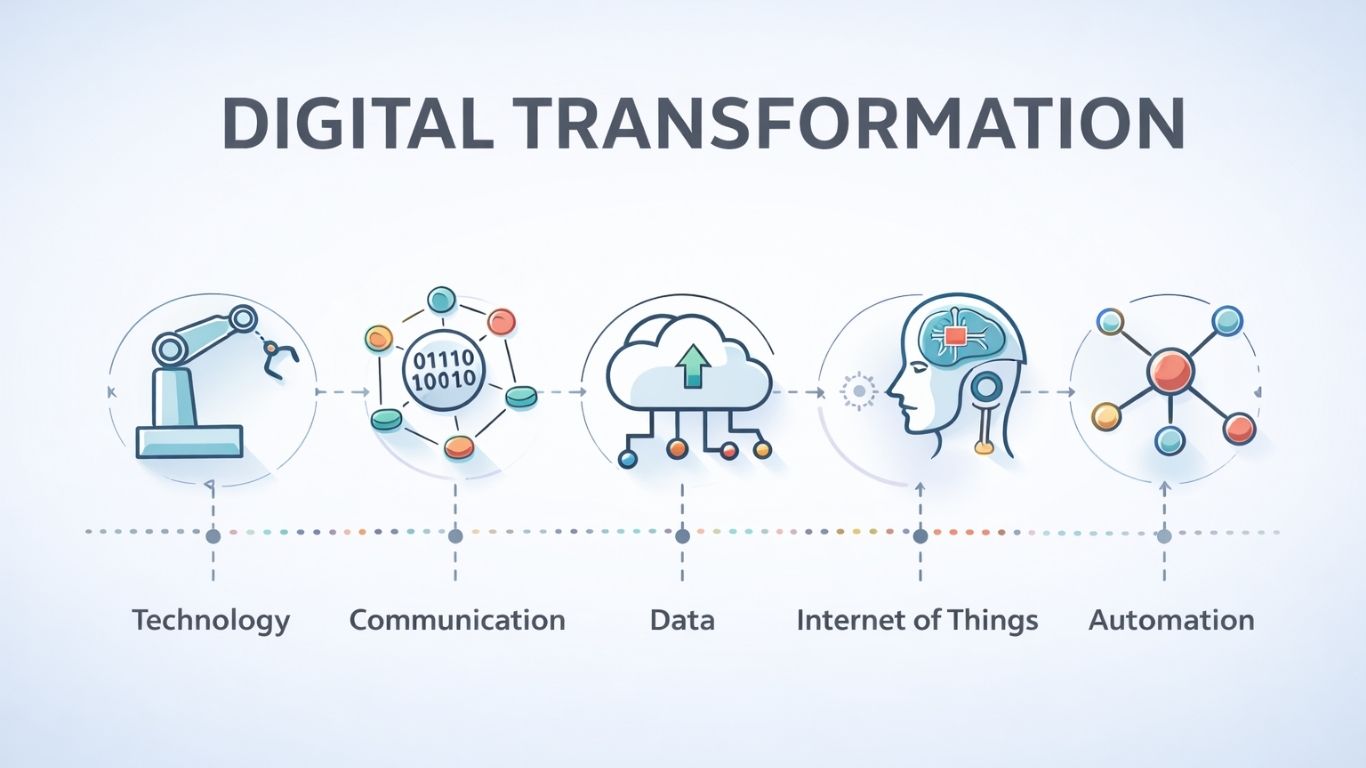
Organizations adopt this strategy when incremental improvements are no longer sufficient to remain competitive. It is not about upgrading individual tools; it is about redesigning the business itself.
>> Digital Transformation Company: How to Turn 70% Failure into Momentum
Domino’s Pizza offers one of the clearest examples. Facing more tech-savvy competitors and plateauing traditional sales, Domino’s invested heavily in digital ordering infrastructure in the late 2000s. The company built a modern online ordering platform, a mobile app, and the now-famous Domino’s Tracker, which gave customers real-time visibility into every stage of their order. The rollout was phased, integrated tightly with existing operations, and backed by a strong marketing push.
The results were transformative. Domino’s repositioned itself as a technology company that happens to sell pizza, and it became one of the world’s most valuable restaurant brands by market capitalization.
2. Cloud-First Strategy
The cloud-first strategy gained serious traction in the 2010s as providers such as AWS, Microsoft Azure, and Google Cloud matured into reliable enterprise platforms. Under this approach, cloud-based services become the default choice for all new systems, rather than building or buying on-premises infrastructure.
Organizations turn to this strategy when they need:
- Faster deployment of new services without capital expenditure on hardware
- The ability to scale capacity up or down in response to demand
- Improved reliability through built-in redundancy provided by cloud vendors
Netflix is the benchmark case. As its streaming service scaled globally, managing unpredictable traffic spikes through traditional data centers became unsustainable. Netflix migrated virtually all of its infrastructure to AWS, solving the problem of capacity limits while trading fixed hardware costs for a flexible, pay-as-you-go model. The move gave Netflix the ability to expand into new markets rapidly and without heavy upfront investment.
3. Cybersecurity-First Strategy
In industries where a security breach would be catastrophic, including finance, healthcare, technology, and government, some organizations make security the architectural foundation of their entire IT strategy. Rather than bolting on protection after systems are built, a cybersecurity-first strategy treats defense as a non-negotiable design requirement from day one.
This approach accelerated in response to rising cyberattack frequency and landmark regulations such as GDPR, which introduced significant financial penalties for data breaches.
Google embedded this philosophy into its BeyondCorp zero-trust security model: the system does not automatically trust any user or device, even those already inside the corporate network. Access is granted only after rigorous identity verification. Companies implement this strategy through DevSecOps practices, integrating security controls, end-to-end encryption, multi-factor authentication, and continuous threat monitoring into every project from the outset.
The strategic payoff is trust from customers, partners, and regulators, along with a measurable reduction in the risk of incidents that could halt operations or expose sensitive data.
4. DevOps and CI/CD Strategy
The DevOps strategy, combined with Continuous Integration and Continuous Deployment (CI/CD), was born from frustration with slow, error-prone software release cycles. By breaking down the traditional silos between development and operations teams and automating the entire delivery pipeline, organizations can push new code to production with speed and confidence.
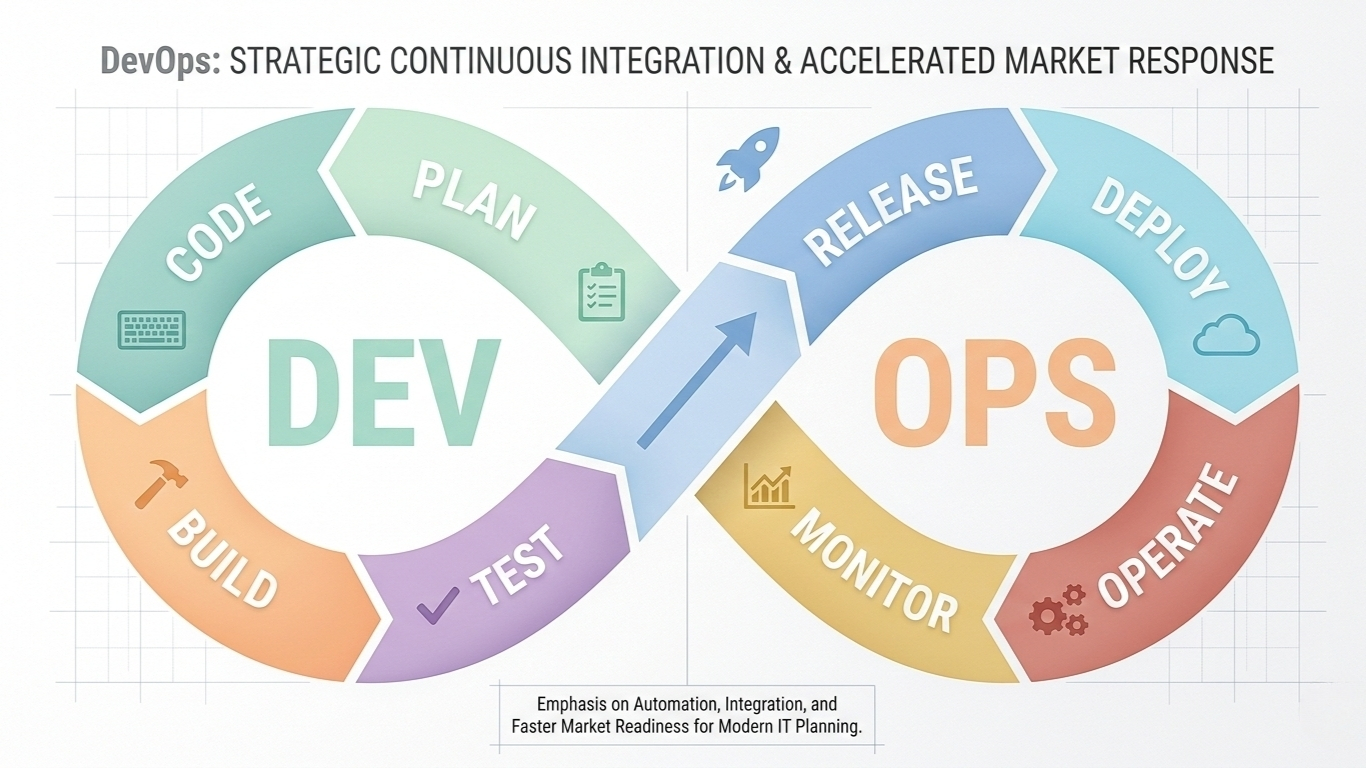
Netflix popularized this approach at scale, building an automated pipeline capable of deploying new code hundreds of times per day. Implementation requires standardized deployment tools, a culture of shared ownership across development and operations, and a disciplined practice of frequent, small releases rather than large, infrequent ones.
The primary problem this strategy solves is time-to-market. Businesses using DevOps and CI/CD can ship new features, fix bugs, and respond to market conditions far faster than competitors running traditional release cycles, with automated testing providing a safety net at every stage.
5. Business-Driven IT Strategy
This approach originated from a hard-learned lesson: technology projects consistently fail when they lack clear business sponsorship and purpose. In a business-driven IT strategy, senior executives define the outcomes they need, such as entering a new market, doubling productivity, or improving customer retention, and those goals then shape what technology is built or bought.

This model is most common in organizations where technology is a support function rather than the core product, including retail, manufacturing, healthcare, and professional services. Technology projects are selected and funded only when they carry a direct business case and a named sponsor accountable for results. The approach resolves the persistent problem of wasted technology spend by ensuring every investment has both a measurable goal and a business owner responsible for delivering it.
6. Technology-Driven IT Strategy
Where the business-driven approach starts with outcomes and works backward, the technology-driven strategy starts with emerging capabilities and works forward. It is most common in technology companies, research-intensive industries, and sectors where staying at the cutting edge is itself the competitive advantage.

Under this model, the organization actively monitors emerging technologies, including artificial intelligence, blockchain, advanced sensors, and quantum computing, and builds business plans around them. New departments, services, or entire product lines may be created to exploit a technological opportunity before competitors can respond. Effective execution requires strong market insight, a tolerance for calculated risk, and the organizational flexibility to pivot quickly if conditions change.
7. Hybrid IT Strategy
As cloud services became mainstream, a clear reality emerged: not every workload belongs in the public cloud. The hybrid IT strategy intentionally combines on-premises infrastructure with private clouds, public cloud platforms, and edge computing, placing each workload in the environment best suited to it.
A financial services firm, for example, might retain sensitive customer data on a private data center to meet regulatory requirements, while using a public cloud for customer-facing web services that need rapid scalability. According to industry surveys, approximately 82% of enterprises now operate with some form of hybrid IT mix.
The hybrid approach resolves the tension between flexibility and control. Organizations can innovate with cloud tools without abandoning legacy systems that still deliver value, while optimizing costs by ensuring every workload runs in the most appropriate and most economical environment.
Three Real-World Cases — Technology Strategy in Action
Case 1: Domino’s Pizza — Digital Transformation in Quick-Service Restaurants
In the late 2000s, Domino’s Pizza faced a straightforward but serious problem: traditional delivery sales were plateauing and a younger generation of customers expected digital convenience as standard.
The company chose a digital transformation strategy and committed significant capital to it. New investments included a redesigned online ordering platform, a dedicated mobile app, and the Domino’s Tracker, a real-time feature allowing customers to monitor every stage of their order from preparation to delivery. Each tool was integrated carefully with existing store operations and supported by a wide-reaching marketing campaign.
The business outcome was decisive. Domino’s repositioned itself not as a pizza company, but as a technology-first food brand, and it now ranks among the world’s most valuable quick-service restaurant chains by market capitalization.
Case 2: Capital One — Cloud-First Strategy in Banking
Capital One set an ambitious goal: to become the most digitally advanced bank in the United States. Its obstacle was aging data center infrastructure that made deploying new services slow, expensive, and operationally rigid.
The bank adopted a cloud-first strategy and committed to migrating virtually all operations to AWS. By 2020, Capital One had become one of the first major U.S. banks to close its own data centers entirely and operate at scale on public cloud infrastructure. The migration was executed with a strong emphasis on security and regulatory compliance throughout.
The performance gains were concrete and quantified. Analytics workloads that previously required 24 hours to complete were processed in approximately 1 hour after migration, a 96% reduction in processing time. Beyond speed, Capital One’s IT teams were freed from routine infrastructure maintenance, redirecting their capacity toward building new, customer-facing products.
Case 3: Residential Property Management — Business-Driven IT in Real Estate
A property management company overseeing multiple apartment buildings was struggling with a set of chronic operational inefficiencies. Rent collection, maintenance requests, and tenant communications were all handled manually, by phone, paper, and spreadsheet, producing slow response times, frequent errors, and growing tenant frustration.
The company adopted a business-driven IT strategy, starting not from technology trends but from a precisely defined business need: increase operational efficiency and improve tenant satisfaction. It selected a cloud-based integrated property management platform that allowed tenants to pay rent online, submit maintenance requests digitally, and receive real-time status updates through a self-service portal. Managers gained a single dashboard consolidating all properties, requests, and financial data.
The results, tracked after rollout, were significant:
- Maintenance response time reduced by approximately 40%
- Rent collection time reduced by approximately 50%
- Staff administrative hours saved: more than 10 hours per week
This case illustrates directly how technology improves tenant management strategies, not through sophisticated infrastructure or cutting-edge innovation, but through a targeted, business-first technology decision that solved real operational problems with measurable outcomes.
Partner With HBLAB to Build Your Technology Strategy
Across more than a decade of practice, HBLAB has consulted with and transformed businesses across a wide spectrum of industries, company sizes, and operational models, from lean startups navigating early digital adoption to established enterprises overhauling legacy infrastructure at scale.
We do not apply a single framework to every client. We examine your business model, identify where technology can create the most meaningful impact, and design an IT strategy tailored precisely to your organization’s stage, goals, and constraints.

Whether your priority is a cloud-first migration, a cybersecurity overhaul, a full digital transformation, or a hybrid architecture that balances innovation with operational stability, our team of 700+ IT professionals brings the technical depth and strategic clarity to see it through.
Our AI capabilities, active since 2017, alongside CMMI Level 3 certification for process excellence and enterprise-grade security safeguards, mean that quality and protection are built into every engagement from day one. With a global delivery presence and flexible engagement models including offshore, onsite, dedicated teams, and Build-Operate-Transfer arrangements, we integrate seamlessly into your workflows while keeping you in full control of your product and delivery.
Clients consistently achieve up to 30% cost efficiency compared to local market rates, without compromising on speed, quality, or technical rigour.
FAQ
1. What is an example of a technology strategy?
An example is a company planning to expand its online sales. Its technology strategy would outline the steps to achieve this, such as developing a new e-commerce platform, integrating it with existing inventory systems, and implementing cybersecurity measures to protect customer data.
2. What is the meaning of technology strategy?
A technology strategy is a high-level plan that outlines the physical and logical architecture of an organization’s information technology (IT) systems. It serves as a roadmap to ensure the company’s tech infrastructure supports its overall business goals.
3. What are the 4 types of innovation strategies?
-
Incremental Innovation: Making small, continuous improvements to existing products for current customers (e.g., releasing a new smartphone model with a slightly better camera).
-
Architectural Innovation: Reconfiguring existing technology to serve new markets or customer segments (e.g., shrinking massive mainframe computers down into desktop personal computers).
-
Disruptive Innovation: Introducing simpler, more affordable solutions that target overlooked markets and eventually displace established industry leaders (e.g., Netflix replacing physical video rental stores).
-
Radical Innovation: Creating entirely new products or markets using breakthrough technology, fundamentally changing how an industry works (e.g., the invention of the lightbulb or the airplane).
4. What are the 5 C’s of strategic planning?
The 5 C’s framework is an environmental scan used to evaluate a business’s internal and external environment.
The 5 C’s Explained:
-
Company: Assessing your organization’s internal strengths, weaknesses, resources, and goals.
-
Customers: Understanding the needs, behaviors, and demographics of your target audience.
-
Competitors: Analyzing the strengths, weaknesses, and market positioning of your rivals.
-
Collaborators: Identifying external partners, suppliers, agencies, and distributors that help your business operate.
-
Climate (Context): Examining external macro-environmental factors, such as economic trends, regulations, and technological shifts.
By evaluating these five interconnected areas, business leaders can clearly identify competitive advantages, uncover potential threats, and make informed, data-driven decisions to guide company growth.
What are 5 examples of technology?
Technology refers to the application of scientific knowledge for practical purposes. Five common, everyday examples include smartphones, personal computers, automobiles, washing machines, and coffee makers.