A complete guide to the 7 software development life cycle phases, covering SDLC history, each phase in depth, and how Waterfall, Agile, and Scrum work.
Every software project that ships on time, within budget, and with a working product behind it has one thing in common: a structured process.
The phases of software development life cycle give development teams a repeatable framework for moving from a business idea to a deployed, maintained application.
By the end of this guide, you will know exactly what each phase demands, what goes wrong when any one of them is skipped or rushed, and how the three dominant methodology models, Waterfall, Agile, and Scrum, organise those phases in practice.
What Is the SDLC?
The Software Development Life Cycle (SDLC) is a structured framework that guides software projects from initial concept through deployment and long-term maintenance. It organises development into clearly defined phases, each producing specific outputs that feed directly into the next, ensuring that both the process and the finished product meet agreed quality standards.
The History of SDLC
The framework has older roots than most practitioners realise. In June 1956, Herbert D. Benington presented a paper at the Symposium on Advanced Programming Methods for Digital Computers, describing the phased production process used to build programs for the Semi-Automatic Ground Environment (SAGE) system, a Cold War-era air defence network commissioned by the United States Navy.

That presentation is now recognised as the first explicit representation of a software development life cycle model in recorded history. Benington arranged development activities into a cascade of sequential stages, each dependent on outputs from the one before it.
The concept was formalised further in 1970, when Winston W. Royce, then director of the Lockheed Software Technology Center in Austin, Texas, published “Managing the Development of Large Software Systems.” Royce described a structured sequence of phases in a diagram that visually resembled a waterfall, though he never used that term. His actual argument was for more rigorous documentation and iterative feedback between phases, a nuance widely ignored by those who adopted the model.
The U.S. Department of Defense codified a rigid, sequential interpretation through DOD Standard 2167 in 1985, cementing the Waterfall model as the dominant methodology for major contracts for decades.
What made such a framework necessary was scale. Early software projects were small enough to manage informally. As software grew to underpin defence systems, financial infrastructure, and enterprise operations, the cost of errors discovered late in development became prohibitive. A structured lifecycle made the process auditable, manageable, and repeatable, and those pressures are no different today.
The 7 Phases of the Software Development Life Cycle
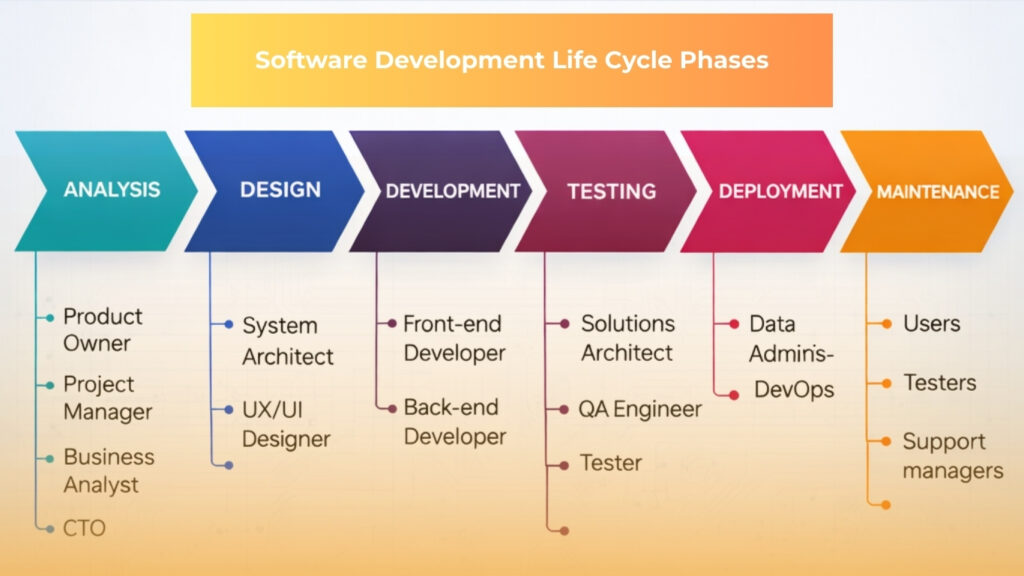
The seven software development life cycle phases are: Planning, Requirements Analysis, Design, Development (Coding), Testing, Deployment, and Maintenance. Each phase addresses a distinct question in the build process, from whether to build at all, to how to keep what was built running well.
Planning
Planning answers the foundational question of whether the project should exist. Stakeholders, project managers, and business analysts examine the proposed application’s commercial rationale, producing a feasibility report, preliminary cost estimates, a proposed timeline, and an initial scope definition. Roles involved include project sponsors, senior developers, and business leads.
When planning is weak, scope creep begins early and compounds costs through every subsequent phase. A project launched without a credible feasibility study often discovers its core assumptions are wrong only after significant resources have already been committed.
Requirements Analysis
Requirements Analysis begins once the decision to build has been made. Development team members, business analysts, subject matter experts (SMEs), and the end-users who will ultimately use the application all contribute to defining exactly what the system must do. The phase closes with a high-level requirements document that design depends on entirely.
Poor requirements analysis is among the costliest failures in software development, because vague or incomplete requirements are inherited and amplified by every downstream phase of software development life cycle work.
Design
Design translates the requirements document into a technical blueprint. Infrastructure choices are made here, covering cloud versus on-premise architecture, database management software, application frameworks, front-end structure, and back-end logic. For a web application, this includes interface wireframes and server configurations; for a mobile application, screen layouts.
This phase produces both a high-level design document and detailed functional specifications. If design is rushed, developers begin coding against an incomplete picture, producing a system that cannot be efficiently extended, tested, or maintained.
Development (Coding)
Development is where design becomes working software. Developers write front-end code handling the user interface and back-end code executing on the server. Web applications typically involve HTML, CSS, and JavaScript at the front end, with PHP, Java, or Python frameworks powering server-side logic.
In a Waterfall project, coding begins only after design is complete. In a Scrum project, the analysis, design, and coding phases often run concurrently within the same sprint. Unit testing occurs throughout this phase, with developers testing individual modules in a sandboxed development environment before passing them to formal quality assurance.
Testing
Testing verifies that the code works correctly under real conditions. The four principal testing categories that together constitute a complete quality cycle are:
- Unit testing: individual modules verified by developers during coding
- Integration testing: module groups tested together to confirm data flows correctly between them
- System testing: the complete application evaluated in a near-production environment, including load and performance testing
- User Acceptance Testing (UAT): the finished product presented to the client, who confirms it meets agreed requirements
Testing takes place in a Quality Assurance (QA) environment that mirrors the live production setup. Defects identified here are returned to the development team for rework. Skipping any layer of testing produces the kind of post-deployment failures that damage user trust and generate expensive emergency patches.
Deployment
Deployment moves the tested, approved application from the QA environment into the production environment, the live system real users interact with. DevOps engineers typically automate this transition using scripting tools and CI/CD pipelines to reduce human error. Customer training, user documentation, and bug-reporting protocols are also delivered during this phase.
Outcomes consistently improve when development, design, and operations teams collaborate throughout deployment rather than treating it as a one-way handoff.
Maintenance
Maintenance is the longest phase in any production application’s life. It encompasses four categories of ongoing activity:
- Corrective maintenance: fixing defects identified after deployment
- Perfective maintenance: adding features or enhancements requested by users
- Preventive maintenance: refactoring code for efficiency and updating documentation
- Adaptive maintenance: modifying the application to accommodate changes in underlying platforms, operating systems, or database versions
Beyond code changes, maintenance includes website monitoring, load testing, response time analysis, and analytics dashboards tracking key performance indicators (KPIs) such as uptime and availability. Applications that receive inadequate maintenance accumulate technical debt until they can no longer serve the business needs they were built for.
SDLC Models and How They Work in Practice
Understanding the software development life cycle phases is only half the picture. How those phases are sequenced, weighted, and repeated depends on which methodology model a team adopts. The three principal models, Waterfall, Agile, and Scrum, each reflect a fundamentally different set of assumptions about how software should be built.
Waterfall
Waterfall executes each of the seven phases sequentially, with no backward movement permitted once a phase closes. Analysis must be complete before design begins; design must be complete before coding starts. The model’s appeal is its predictability: cost and timeline can be estimated early, documentation is thorough, and progress is easy to audit.
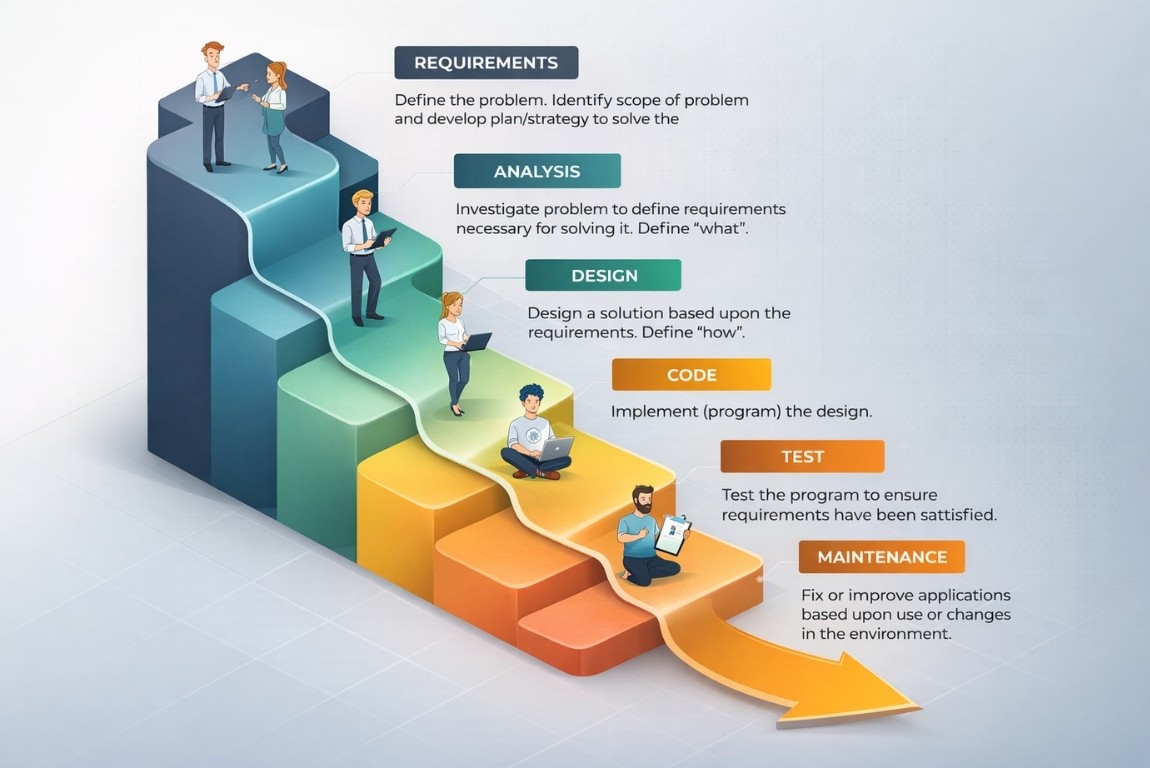
Defence contractors, aerospace manufacturers, and large enterprise ERP implementations continue to use Waterfall because those projects involve stable, contractually defined requirements, regulatory compliance obligations, and multi-team coordination that benefits from rigid phase gates.
The failure patterns are equally well documented. When requirements shift mid-project, as they routinely do in commercial software development, Waterfall has no legitimate mechanism for absorbing the change. Teams either freeze the requirement, delivering something users no longer want, or restart phases, blowing schedule and budget. The rigidity that makes Waterfall dependable in well-scoped, stable environments makes it fragile wherever scope evolves.
Agile
Agile was created as a direct response to those failure patterns. In February 2001, seventeen software developers met at a ski resort in Snowbird, Utah, and signed the Manifesto for Agile Software Development. The document established four core values: individuals and interactions over processes and tools; working software over comprehensive documentation; customer collaboration over contract negotiation; and responding to change over following a plan.
Those values, supported by twelve principles oriented around continuous delivery, sustainable pace, and self-organising teams, were not a prescribed methodology but a philosophical reorientation. The central premise was that requirements will change, and the development process should accommodate that reality rather than resist it.
Where Waterfall runs phases of the software development life cycle in strict sequence, Agile runs them concurrently within short development cycles called sprints. Planning, design, coding, and testing all happen within the same two-to-four-week window. The customer participates throughout, reviewing working increments and providing feedback that shapes the next cycle immediately.
This restructuring of which phase of the software development life cycle runs when keeps the cost of change low, because adjustments are incorporated continuously rather than batched until delivery. The trade-off is that Agile demands genuine customer availability and makes total project cost harder to predict upfront.
Scrum
Scrum is the most widely implemented Agile framework and the most instructive for understanding how the phases of the software development life cycle play out in a professional environment. Consider a mid-size SaaS company running a standard two-week sprint.
The Product Owner maintains the product backlog, a prioritised list of features expressed as user stories. At the start of each sprint, the team holds a sprint planning meeting, pulling items from the backlog into the sprint backlog based on capacity and priority. This session compresses the planning and requirements analysis phases into a focused, time-boxed conversation.
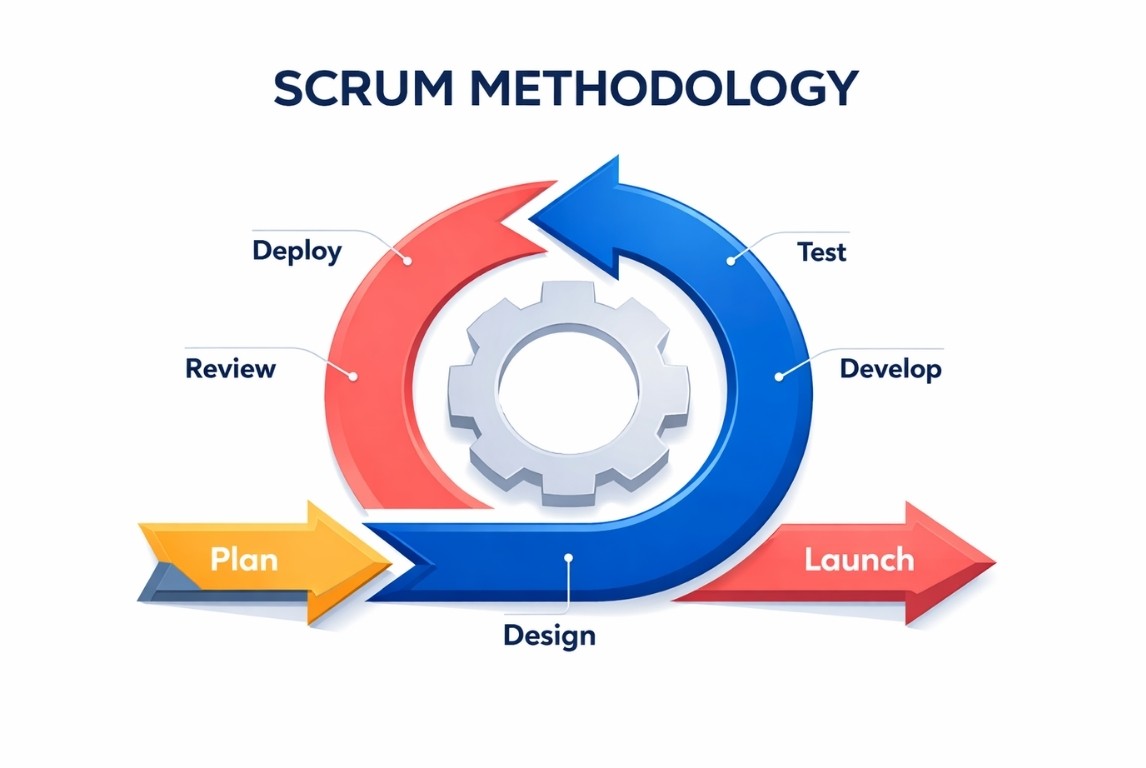
Development then proceeds over the sprint, with the team holding a daily standup of roughly fifteen minutes where each member reports what they completed previously, what they will complete that day, and what is blocking them. The Scrum Master removes those impediments; there is no traditional team leader or project manager.
At the end of the sprint, a sprint review demonstrates the completed increment to the Product Owner and relevant stakeholders. A sprint retrospective follows, focused on the process rather than the product itself. Accepted increments are moved to production, mapping directly to the deployment phase of the software development life cycle.
The Iterative/Incremental Model
The Iterative/Incremental model, classified in the SDLC literature as an Adaptive model category, occupies a practical space between Waterfall and Agile. The application is built in successive increments, each representing a small, functional portion of the finished system. If an increment does not meet requirements, it is reworked before the next begins.
Unlike Agile, the structure between iterations is more prescribed; unlike Waterfall, changes can be incorporated during the coding phase. Teams working with partially known requirements, or those transitioning from Waterfall toward Agile practices, frequently find the iterative approach a workable intermediate position that captures real software development life cycle phases benefits without requiring the full organisational transformation Agile demands.
Read more:
– Choosing the right Labor Management System Software
– Minimum Viable Product (MVP): Definition, Examples, and How to Build One Correctly
– Website Development Process: A Complete Step-by-Step Guide