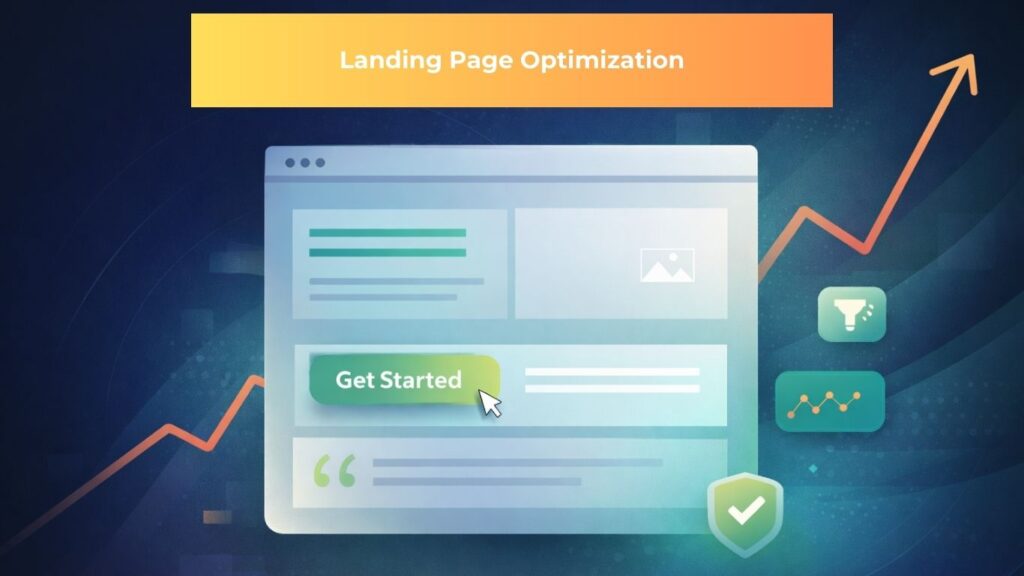
Master landing page optimization with a practical framework, technical fixes, and testing playbooks to increase conversions. Start optimizing today.
Introduction
Landing page optimization is where marketing strategy meets real user behavior. You can have great ads, great targeting, and a strong offer, then lose the conversion because the page loads slowly, the message does not match the ad, the form feels risky, or the call to action is unclear.
This guide teaches landing page optimization as a repeatable system you can run every week.
You will learn how to diagnose what is holding your page back, how to decide what to change first, how to implement improvements without guesswork, and how to build a testing rhythm that keeps performance improving across campaigns.
If you manage paid traffic, build lead gen funnels, design and develop pages, or run CRO programs, landing page optimization is one of the highest leverage skills you can build because it sits directly on the conversion path.
What is landing page optimization

Landing page optimization is the process of using data and structured testing to improve a landing page so more visitors complete the intended action, such as submitting a form, booking a call, or buying. It focuses on the elements that shape conversion behavior, including the value proposition, copy, layout, calls to action, forms, trust cues, speed, and measurement.
Landing page optimization matters because landing pages carry paid acquisition costs. Every click you buy has a real price, so every avoidable drop off on the page raises your cost per lead or cost per sale. Landing page optimization protects your spend by making more of your existing traffic convert, which is often faster than trying to buy your way to growth.
Landing page optimization is different from general website optimization because the goal is narrower and the page is more controlled. A website has many jobs, navigation paths, and audiences. A landing page has one primary job for one audience segment from one traffic source, so landing page optimization is about removing distractions and creating a clean path to action.
Landing page optimization is also tightly linked to ad performance. Your ad sets an expectation, and your page must confirm it immediately. When the message match is weak, people bounce even if the offer is good, because the page feels like the wrong destination.
A common misconception is that landing page optimization is mostly design tweaks.
In practice, the biggest wins come from alignment and clarity: right offer for the right audience, right promise for the right intent, right proof to reduce anxiety, and right measurement so you can learn quickly.
If you want one strong reason to care about landing page optimization on mobile, consider this: Google research cited by Google AdSense indicates 53 percent of visits are likely to be abandoned if a page takes longer than 3 seconds to load.
The two actions you always need to optimize a landing page
Measure real behavior so you know where users hesitate, get confused, or fail to convert.
Test improvements so you can separate what feels better from what actually converts better.
Landing page optimization fails when either piece is missing. Measurement without testing becomes opinions. Testing without measurement becomes random changes.
The landing page optimization workflow
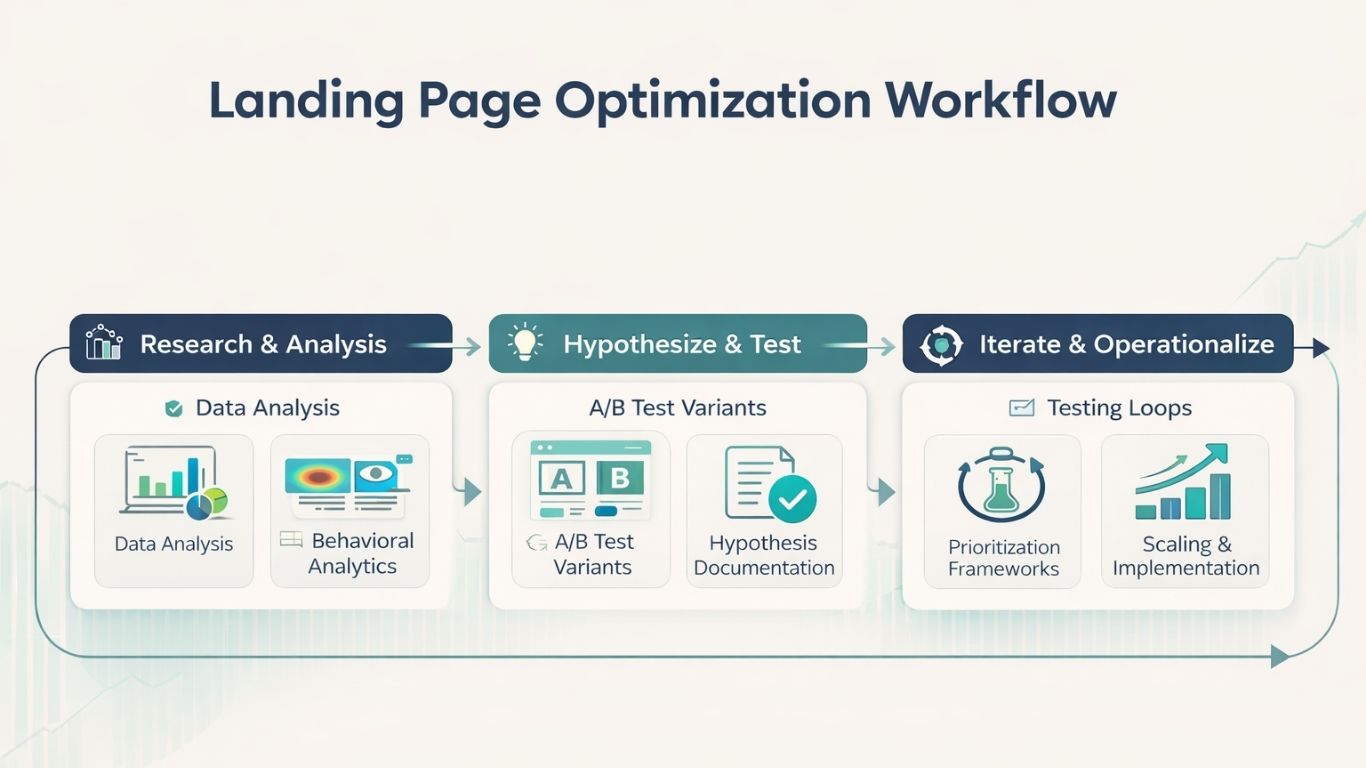
A useful way to think about landing page optimization is a loop with three phases: research and analysis, hypothesize and test, iterate and operationalize.
Phase 1: Research and analysis
Landing page optimization starts by identifying where conversion friction is happening. Begin with a single page and a single conversion goal, then layer your evidence so you see both the numbers and the reasons behind them.
Use quantitative data to locate the leak. Look at sessions, conversion rate, scroll depth, device split, traffic source split, and new versus returning visitors. If you run paid campaigns, segment by campaign, ad group, and keyword intent so your landing page optimization work is anchored in the audience that actually arrives.
Then use behavioral analytics to explain the leak. Heatmaps, scroll maps, and session replays show where users stop, what they ignore, and where they rage click or hesitate. Platforms like Contentsquare explicitly position session replay and heatmaps as core tools for understanding experience and improving conversion, which is exactly what you need in landing page optimization.
Finally, add voice of customer inputs so landing page optimization is not only based on observation. Read chat transcripts, sales call notes, support tickets, and user testing notes.
If you can only do one thing, run five quick interviews with people who match the target persona and ask what they expected to see on the page, what felt unclear, and what felt risky.
Phase 2: Hypothesis and prioritization
Landing page optimization becomes efficient when every change is tied to a hypothesis. A strong hypothesis connects a user problem to a page change and a measurable outcome.
Use a simple structure:
If we change X for audience Y, then metric Z will improve because reason R.
Example: If we replace the generic headline with a benefit statement that mirrors the ad promise for first time visitors from search campaigns, then form submissions will increase because users will confirm they are in the right place within the first few seconds.
Now prioritize. Most teams over optimize small details because they feel safe. Landing page optimization works better when you rank ideas by potential impact and effort. You can use ICE, PIE, or RICE scoring, but the key is consistency. Score each idea on expected impact, confidence based on evidence, and implementation effort, then test the top items first.
Phase 3: Test, learn, and institutionalize
Landing page optimization is where testing protects you from false confidence. Use controlled experiments when you can, and use structured rollouts when you cannot.
A practical rule: if the change is reversible and user facing, test it.
If the change is foundational, like fixing tracking or improving load time, implement it and validate outcomes with before and after monitoring.
A/B testing vs multivariate testing
A/B testing compares two versions where one key concept changes. It is the default method for landing page optimization because it is easier to interpret and you can run it with smaller traffic.
Multivariate testing changes multiple elements at once to estimate which combination performs best. It can be useful in landing page optimization when traffic is very high and you are refining a mature page, but it is easier to get misleading results if you do not have enough volume.
In intermediate teams, the fastest path is usually sequential A/B tests: test the biggest idea first, lock the winner, then test the next biggest idea.
How long should a landing page optimization test run
Do not end tests early because the numbers look exciting. Landing page optimization needs stability across weekdays and weekends, across traffic fluctuations, and across device splits.
A practical approach is to run tests until you have:
- At least one full business cycle that matches your traffic pattern, often one to two weeks
- Enough conversions per variant to reduce noise, which depends on your baseline rate and the expected lift
If you cannot get enough conversions, shift your landing page optimization approach toward larger changes with bigger expected lifts, or optimize earlier steps like message match and form friction so the effect is strong enough to detect.
Making sound decisions from test results
Landing page optimization decisions should follow three checks.
First, confirm the primary conversion metric improved, not just a proxy metric like time on page.
Second, check guardrail metrics like bounce rate, page speed, and lead quality indicators so you do not trade volume for junk.
Third, segment results by device and traffic source. It is common in landing page optimization for a variant to win on mobile and lose on desktop, or win for paid search and lose for social traffic, because intent and attention differ.
Building a continuous optimization culture
Landing page optimization is not a one time project. Treat each experiment as knowledge. Maintain a simple log with the hypothesis, the change, the audience, the result, and what you learned.
When this becomes routine, landing page optimization stops being stressful because you are no longer betting on one big redesign. You are running a system that compounds.
How to optimize a landing page with a structure that matches real intent
When people ask how to optimize a landing page, they often want a step sequence they can follow without overthinking.
Use this structure because it aligns with how visitors decide.
Step 1: Confirm intent and message match within 5 seconds
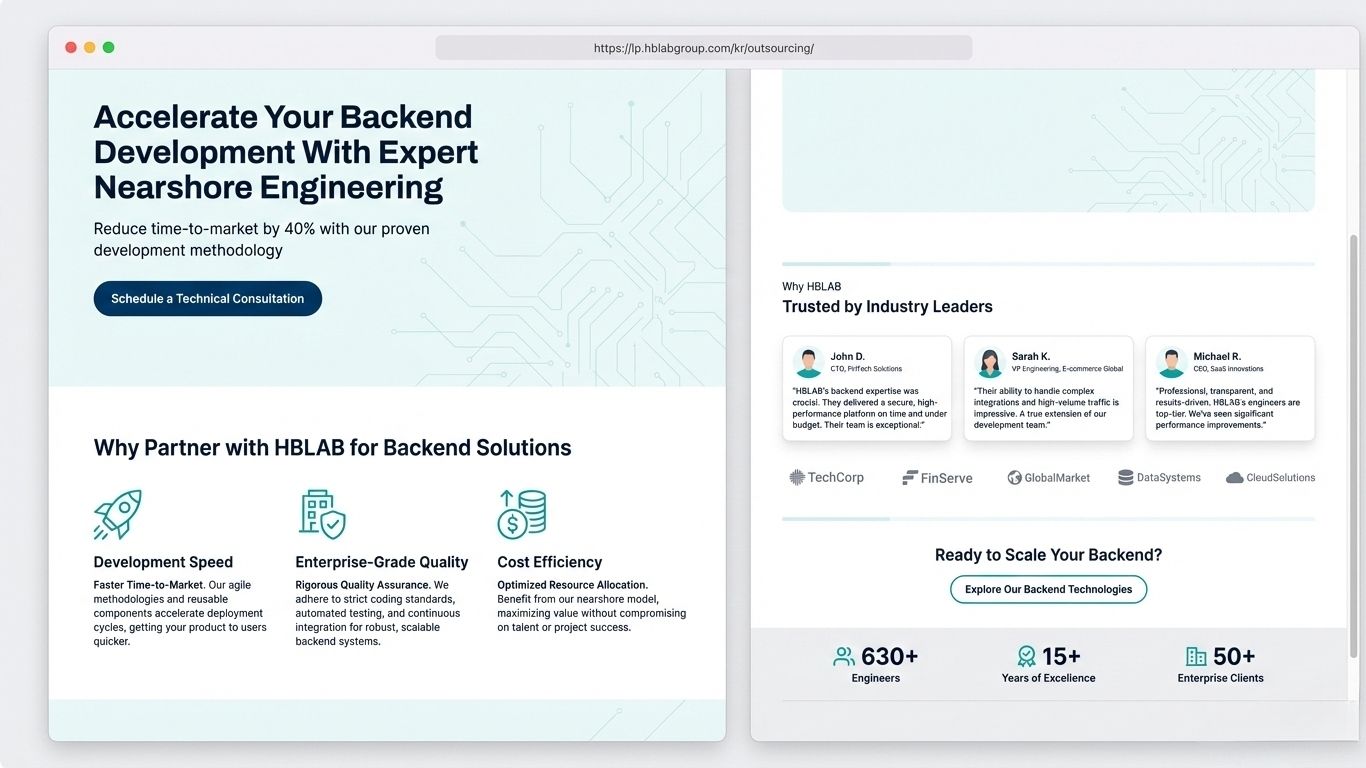
Landing page optimization starts at the top of the page because users decide fast whether the page is relevant. The headline should reflect the promise that brought the click. If the ad mentions a free audit, the headline should not talk about a broad platform. If the keyword implies urgency, the above the fold content should acknowledge that urgency.
A helpful trick in landing page optimization is to write the headline after you write the ad. Copy the key phrase from the ad into the headline, then rewrite it into a clear benefit statement.
Step 2: Make the offer feel obvious and safe
Landing page optimization fails when the offer is unclear or risky. Your page should answer three questions without requiring effort: What is this, who is it for, and what do I get if I act now.
Then reduce perceived risk. Add privacy reassurance near the form, remove unnecessary required fields, and show proof that real people trust you. Dynamic Yield highlights trust indicators like testimonials, case studies, and recognizable logos as fundamental conversion drivers, which maps directly to landing page optimization priorities.
Step 3: Reduce friction on the path to the call to action
Landing page optimization is often about subtraction. Remove links that let people escape before converting. Remove jargon that forces interpretation. Remove form fields that are nice to have but not necessary.
Keep one primary call to action. If you need a secondary action, make it a softer commitment that still keeps the conversation going, such as viewing pricing or downloading a sample.
Step 4: Validate performance and responsiveness
Landing page optimization must include speed and mobile usability because they change how users experience everything else. A great page that loads slowly or shifts around while loading will lose trust before your offer is even processed.
Use Core Web Vitals as a shared language between marketers and developers. Google recommends targets like:
- Largest Contentful Paint at 2.5 seconds or less
- Interaction to Next Paint at 200 milliseconds or less
- Cumulative Layout Shift at 0.1 or less
Step 5: Instrument tracking so you can learn
Landing page optimization requires clean measurement. If you cannot trust your conversion events, your testing results will be fragile.
Track the final conversion and the key steps that predict it. For lead gen, track form start, form submit attempt, validation errors, and successful submit. For purchases, track add to cart, checkout start, payment attempt, and purchase.
Technical Instructions for landing page optimization
This section is written so a marketer can understand what to ask for and a developer can implement it. Use it as your landing page optimization build checklist.
Page speed optimization that improves Core Web Vitals
Landing page optimization speed work should start with measurement, then move to the few fixes that create most of the improvement.
What to measure first
Use PageSpeed Insights and Lighthouse for a quick view, then confirm with field data. The Core Web Vitals thresholds are evaluated at the 75th percentile of page loads, segmented by mobile and desktop, which matters because a page can feel fast on your laptop and fail in the real world.
Also note a major recent change: Interaction to Next Paint replaced First Input Delay as a Core Web Vital on March 12, 2024. If your landing page optimization reporting still focuses on First Input Delay, update it.
High impact speed fixes for landing page optimization
Optimize the largest above the fold element
Largest Contentful Paint measures when the largest visible image or text block renders. For landing page optimization, that is often the hero image, headline block, or product visual. Compress images, serve modern formats where possible, and avoid oversized hero assets that load late.
Reduce server and platform overhead
Use caching, a CDN, and efficient hosting. If your landing page is built in a heavy builder, audit unused scripts and plugins. Landing page optimization speed work often fails because pages accumulate marketing tags over time, so remove tags you no longer use.
Defer non critical scripts
Load analytics and experimentation scripts responsibly. If you use multiple tag containers, simplify. If you must run many tools, consider server side tracking for part of the stack so the browser does less work on first load.
Lazy load below the fold media
Do not load all images and videos immediately. Load what is needed to render the above the fold experience, then load the rest as users scroll. Landing page optimization should protect the first impression above everything else.
Prevent layout shifts
Cumulative Layout Shift increases when elements move as the page loads. Reserve space for images and embeds, avoid inserting banners above existing content, and be careful with late loading web fonts. A stable page feels more trustworthy, which is a landing page optimization advantage even before users read the copy.
Improve responsiveness for Interaction to Next Paint
Interaction to Next Paint reflects how quickly the page responds to taps, clicks, and keyboard input. Reduce long JavaScript tasks, break up heavy work, and avoid running large scripts on load that block the main thread.
Mobile responsiveness best practices and testing
Landing page optimization on mobile is not only about fitting the layout. It is about touch behavior, attention, and friction.
Use a single column layout above the fold. Keep the primary call to action visible without scrolling when possible. Increase spacing so buttons are easy to tap. Avoid popups that cover the page, especially early, because they interrupt intent.
Test on real devices, not only responsive previews. In landing page optimization, small differences in keyboard behavior can break forms, especially on iOS.
Form optimization for higher lead conversion
For lead gen, forms are the conversion gate, so landing page optimization must treat them like product flows.
Reduce fields until you are only asking for what you will actually use. If sales insists on more data, test progressive profiling where you collect the minimum first, then enrich later through follow up steps.
Use inline validation so users see errors immediately, not after they click submit. Keep error messages specific and helpful. Enable autofill and use the right input types so mobile keyboards adapt.
Place privacy reassurance near the submit button. A short line about how you will use the data can reduce anxiety without taking attention away from the call to action.
Call to action placement, design, and copywriting
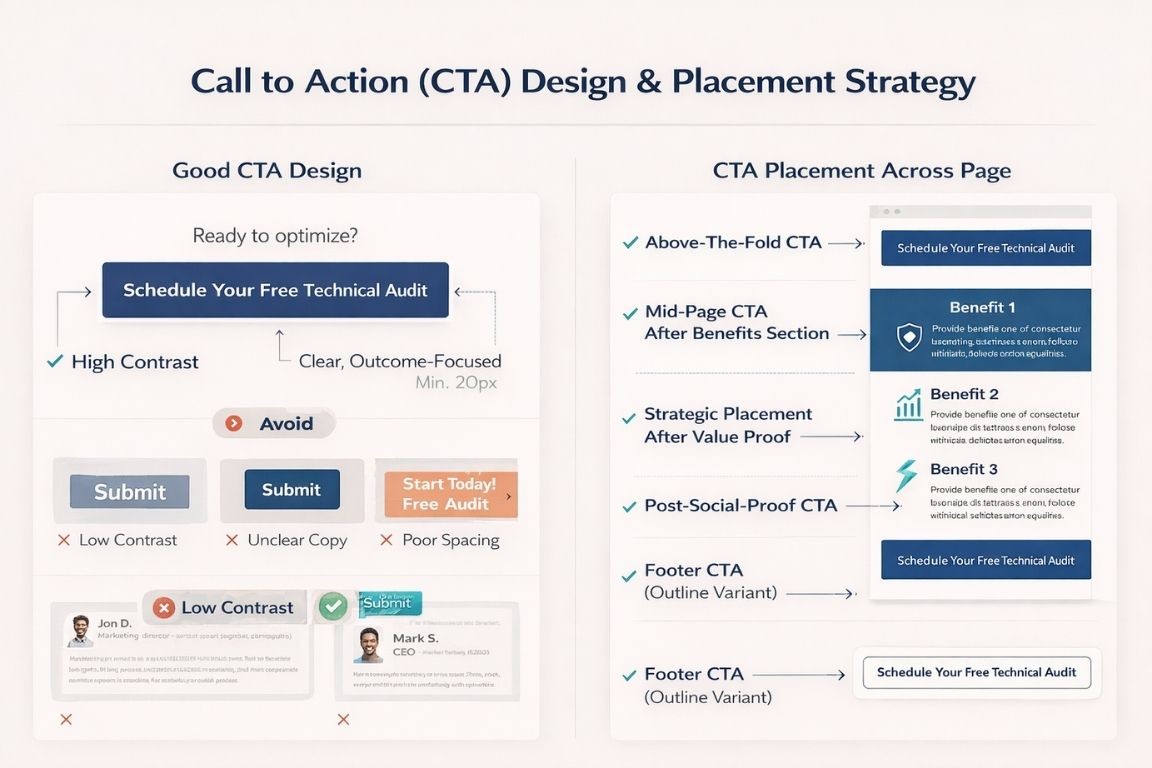
Landing page optimization calls to action work when they are visible, specific, and aligned with intent.
Use one primary call to action above the fold, then repeat it after key persuasion blocks such as benefits, proof, and FAQs. Make the button label describe the outcome, not the action. Download the guide, Get the estimate, Book the demo, Start the trial.
Design the call to action with contrast and whitespace so it is visually dominant. Dynamic Yield explicitly calls out contrast and whitespace as practical ways to make a call to action stand out.
Above the fold optimization that prevents early drop off
Landing page optimization above the fold is about instant confirmation.
Include:
- A benefit driven headline that matches the traffic source promise
- A short supporting statement that clarifies who it is for
- A primary call to action
- One strong trust cue, such as a customer logo row, a rating, or a short testimonial
Avoid putting a slideshow, long video, or multiple competing offers above the fold. Users should not need to interpret what to do.
Visual hierarchy and eye tracking principles
Landing page optimization design should guide the eye from value to proof to action.
Use size and spacing to indicate importance. Use a clear reading path, often a Z pattern on simple pages or an F pattern on text heavy layouts. Use directional cues like a person looking toward the call to action or an arrow built into the layout, but keep it subtle.
When you design for clarity, you reduce cognitive load, which is one of the most reliable conversion drivers in landing page optimization.
Social proof integration that feels real
Social proof is powerful when it is concrete. Use testimonials that include a full name, role, and specific outcome. Use case studies that show before and after, not just praise. Use recognizable client logos only if you have permission.
Place social proof near the call to action and near the points where skepticism rises, such as pricing, form fields, or claims that feel too good to be true.
Reducing friction points in the conversion path
Landing page optimization friction points are often invisible to the team because the team knows the product too well.
Look for:
- Unclear terms, acronyms, and internal language
- Too many options that create decision paralysis
- Hidden costs or missing details that delay commitment
- Confusing form labels and required fields
- Slow load, layout shifts, and unresponsive taps
Use session replays to spot these patterns quickly, then validate with tests.
Schema markup and SEO technical elements for landing pages
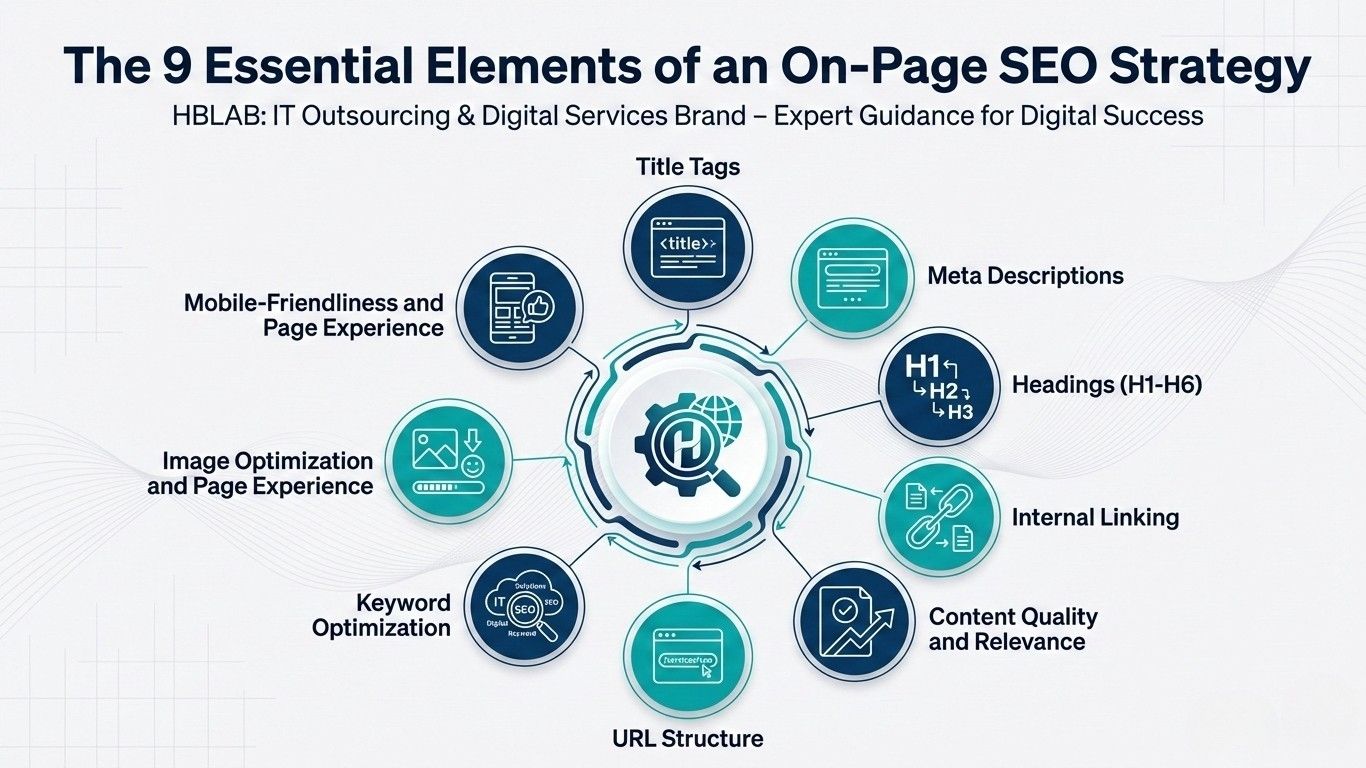
Landing page optimization often focuses on paid traffic, but many teams also need organic visibility. When you do search engine optimization landing page work, you need both content relevance and technical accessibility.
Follow Google Search Essentials guidance: create helpful, reliable, people first content, use words people search for in prominent places like the title and main heading, and make content crawlable.
For technical setup:
- Use a unique title tag and a clear main heading that reflect the primary query intent
- Avoid thin pages that exist only to capture leads without delivering value
- Ensure the page is indexable if you want organic traffic, and do not block it with robots rules
- Use a canonical tag if you have near duplicates for tracking variants
Tracking setup for reliable landing page optimization
Landing page optimization measurement should be built before you start tests.
At minimum, implement:
- Analytics event for the conversion success
- Event for form start
- Event for validation errors
- Event for submit attempt
- Event for successful submit confirmation view
Also confirm your pixels fire on the confirmation state, not just on button click, so landing page optimization reporting reflects real conversions.
If you run heatmaps and session replays, ensure you mask sensitive form fields so you remain privacy compliant.
Landing page optimization checklist
Use this checklist as your landing page optimization SOP. Keep it in a shared doc so marketing and development can work from the same page.
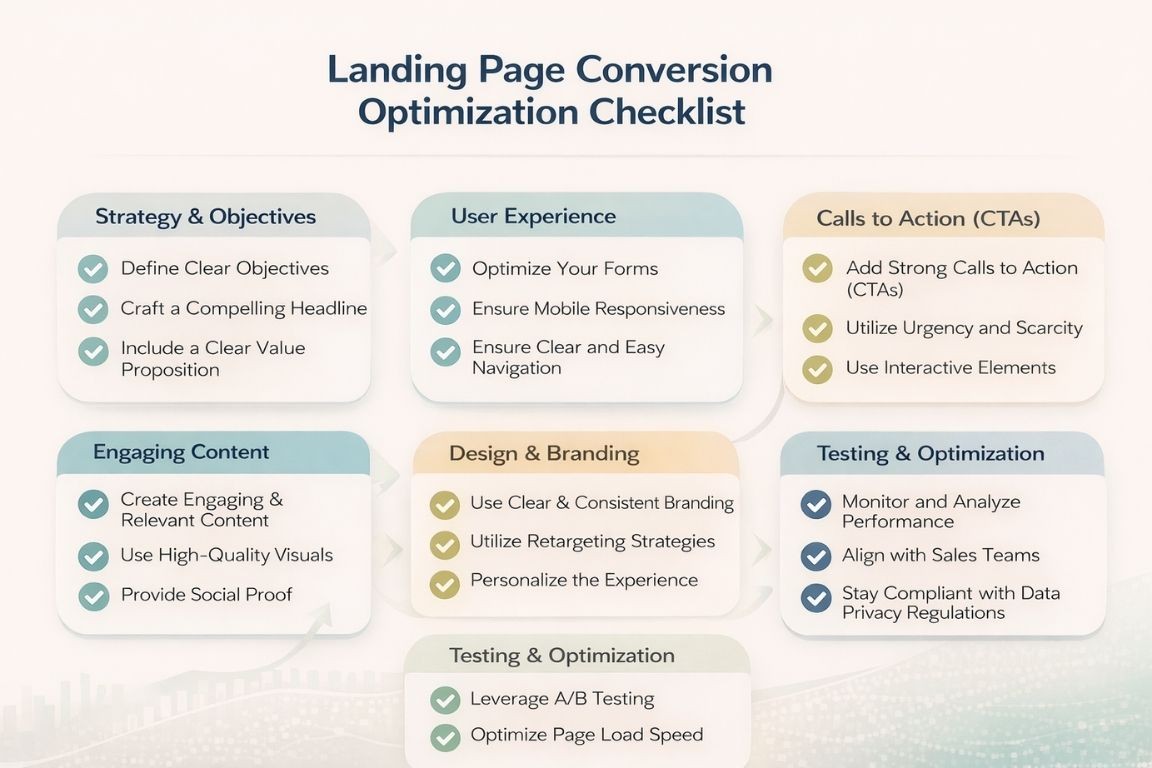
Pre launch checklist
- Define one primary conversion goal and one primary audience segment
- Confirm message match between ad promise and page headline
- Confirm the offer is specific, with clear deliverables and constraints
- Confirm the call to action is visible above the fold
- Remove navigation links that distract from the primary action
- Prepare a thank you experience and follow up workflow
- Confirm legal, privacy, and consent language where needed
Technical performance checklist
- Measure Core Web Vitals on mobile and desktop
- Ensure Largest Contentful Paint target is achievable by optimizing the hero element
- Ensure Interaction to Next Paint is monitored and improved for responsiveness
- Reserve space for images and embeds to prevent layout shifts
- Compress images and use appropriately sized assets
- Defer non critical scripts and remove unused tags
- Test the page on real devices and slower connections
Content and copywriting checklist
- Headline states the primary benefit in plain language
- Supporting copy clarifies who it is for and why it is different
- Benefits are specific, not vague claims
- Objections are addressed with proof, details, or FAQs
- Call to action text describes the outcome
- Microcopy near the form reduces anxiety and clarifies what happens next
Design and UX checklist
- One clear visual hierarchy leading to the call to action
- High contrast call to action with enough whitespace
- Readable typography and comfortable spacing on mobile
- Trust cues visible early, not buried at the bottom
- No distracting animations that compete with the offer
- Accessibility basics covered, including focus states and readable contrast
Conversion funnel checklist
- Form fields reduced to essentials
- Inline validation implemented with clear error messages
- Autofill supported with correct input types
- Thank you page confirms success and sets expectations
- Follow up email or sales handoff triggers correctly
- Lead quality signals captured without adding major friction
SEO checklist for landing pages
- Page is indexable if organic traffic is a goal
- Title tag and main heading align with target query intent
- Content provides real value, not only a gate
- Internal links exist when relevant, especially from supporting content
- Structured data added only when it matches visible content
- FAQ markup expectations are realistic given Google changes
Testing and analytics setup checklist
- Baseline conversion rate recorded for the current version
- Primary metric defined, guardrails defined
- Segments defined by device and traffic source
- Experiment tool configured with correct audience split
- Events validated in analytics and tag debugging tools
- Heatmaps and session replays enabled for the target page
Post launch monitoring checklist
- Monitor conversion rate daily for major drops
- Watch error logs and form failure rates
- Check speed and layout shifts after new tags are added
- Review session replays weekly for friction patterns
- Add learnings to your experiment log so landing page optimization compounds
Advanced landing page optimization techniques
Psychological triggers
Landing page optimization often improves when you reduce uncertainty and increase motivation.
Scarcity and urgency work when they are true. If an offer expires, show the deadline. If capacity is limited, explain why. Fake urgency damages trust and raises refund and complaint risk.
Authority works when you show credentials that matter to the buyer. Use certifications, awards, and expert quotes, but connect them to the buyer’s risk.
Reciprocity works well for lead gen. Give something genuinely useful, such as a benchmark template or a short audit, then ask for the email.
Commitment works when you offer a small first step, such as a short assessment, then expand the commitment after the user is invested.
Personalization
Dynamic Yield emphasizes segmentation and personalization as a way to deliver the right message to the right users.
In landing page optimization, start personalization where it is easiest to defend.
If the visitor comes from paid search, mirror the keyword intent in the headline and show the most relevant use case first.
If the visitor comes from social, lead with a visual and a short story because intent is often softer.
If the visitor is returning, reduce repeated explanation and focus on decision drivers like pricing, proof, and implementation steps.
Dynamic content
Dynamic headline insertion can lift relevance, but it can also feel creepy if done poorly. Use it for intent, not for personal details.
A safe pattern is to adapt the page by category, not by individual. For example, show a different hero and benefit set for retail, finance, and SaaS traffic, each mapped to the campaign group.
Multi step forms vs single step forms
Multi step forms can reduce perceived effort because the first step feels easy. They also allow qualification without asking everything upfront.
Single step forms often win when the offer is strong and the audience is warm, because fewer steps means fewer drop offs.
In landing page optimization, test multi step when your form is long or when you need qualification, and test single step when your audience already wants the offer.
Video on landing pages
Video helps when the product is hard to explain or when trust is the main barrier. Keep the video short, focus on the outcome, and add captions for silent viewing.
Do not let video harm speed. Use a lightweight embed strategy and a clear thumbnail. In landing page optimization, video should support the call to action, not replace it.
Chat widgets
Chat can increase conversion when visitors have last mile questions. It can also distract visitors who were ready to convert.
Use chat triggers based on behavior, such as hesitation near pricing or repeated form errors. On mobile, avoid chat widgets that cover the call to action.
Exit intent strategies
Exit intent popups can capture abandoning visitors with a smaller offer, such as a checklist or a consultation.
Do not show exit intent too early. If you interrupt before the user reads, you reduce conversion. Treat exit intent as a safety net inside your landing page optimization strategy, not the primary lever.
Advanced A/B testing strategies
Once you have a steady landing page optimization rhythm, use these tactics to grow faster.
Run tests by segment when you have mixed intent traffic. A variant that wins for one segment can lose overall because it is not designed for everyone.
Use holdouts when you personalize. If your system automatically routes users to predicted winners, keep a control group so you can measure the true uplift.
Test concepts, not button colors. Landing page optimization gains are larger when the test changes what the user believes, not only what the page looks like.
How to do SEO for a landing page without weakening conversion
People ask: How to do SEO for a landing page? The key is to decide whether the page is built for organic intent or paid intent, then design accordingly.
Paid intent landing pages can be more direct and more focused on conversion because the user arrived from a controlled message.
Organic intent landing pages must satisfy the searcher. Google emphasizes creating helpful, reliable, people first content and using words searchers use in prominent locations like titles and headings.
In practice, that means:
- Expand the content so it answers real questions, not only the sales pitch
- Add comparison, details, and FAQs that reduce pogo sticking back to search
- Consider capturing leads after value is delivered, not before, especially for informational queries
This is where many teams struggle: gating content too early can weaken organic performance because the page does not satisfy the query, which affects landing page optimization for SEO traffic.
FAQ
1. What is the Pareto rule, and how does it apply here
The Pareto rule, often called the 80/20 principle, is the idea that a small set of causes often drives a large share of outcomes. In landing page optimization, a few issues usually cause most conversion loss, such as slow load, weak message match, unclear offer, and high friction forms.
2. What is the 80/20 rule in SEO
The 80/20 rule in SEO is the same concept applied to ranking work. A smaller set of pages and queries often drive most organic traffic, so you prioritize the highest value topics, fix technical issues that affect many URLs, and improve the pages closest to ranking well.
3. What are the 3 Cs of SEO
A common interpretation of the 3 Cs is content, code, and credibility. Content answers the intent. Code ensures crawlability and performance. Credibility is authority signals like links and brand trust that make search engines confident.
4. What are the 4 pillars of SEO
Most modern SEO programs map to four pillars: technical foundations, on page relevance, content quality, and authority building. The names vary, but the idea is stable: you need a site Google can access, content that satisfies intent, and trust signals that support visibility.
5. What is the golden rule of SEO
The golden rule is to optimize for humans first. Google Search Essentials explicitly promotes helpful, reliable, people first content as a core principle.
How to optimize a landing page for lead generation
If your main goal is leads, how to optimize a landing page for lead generation comes down to reducing friction while increasing perceived value.
Start with the offer. A lead gen page converts when the value exchange is fair. If you are asking for business email and phone number, the offer must feel worth it, such as a strong report, a consultation, or a concrete tool.
Then tighten the path:
- Put the value proposition and form or button above the fold
- Reduce form fields and make the first step easy
- Add proof that the offer is real, such as a preview, a short testimonial, or a usage count you can defend
- Set expectations about what happens after submit, including timing and format
Finally, optimize the follow up speed. Landing page optimization for lead gen is wasted if the lead waits days for a response and goes cold.
What to avoid in a well optimized landing page
Avoid multiple competing calls to action above the fold.
Avoid generic headlines that could describe any company.
Avoid long forms that ask for sales qualification before the visitor trusts you.
Avoid heavy pages that shift around while loading.
Avoid stock proof that feels fake, like anonymous testimonials with no context.
Avoid sending paid traffic to a page that is not aligned with the ad promise. This is one of the fastest ways to waste budget and blame the landing page when the real issue is intent mismatch.
What makes a bad landing page, and what does a successful one look like
A bad landing page is usually not ugly. It is usually unclear.
A bad landing page forces the visitor to figure out what is being offered, who it is for, and why they should trust it. It often has weak hierarchy, too many links, vague copy, and a form that feels like a commitment without reassurance.
A successful landing page looks simple on purpose.
Optimizely’s examples consistently emphasize quick value communication, an obvious primary action, mobile readiness, and clear experimentation opportunities like testing hero visuals, headlines, and form fields.
If you want a quick benchmark, a strong landing page optimization layout often includes: a clear headline, a short benefit list, one primary call to action, a small set of trust indicators, and supporting sections that answer objections in the order they appear in the buyer’s mind.
Tools and landing page optimization services
Landing page optimization becomes easier when you standardize your stack. You do not need everything, but you do need coverage across measurement, behavior, and testing.

Practical tool stack by use case
- Analytics: Google Analytics for conversion tracking and segmentation, plus Search Console for organic performance context
- Behavioral analytics: Contentsquare for experience analytics, heatmaps, and session replay at scale
- Lightweight heatmaps and recordings: Hotjar for quick diagnostic work across forms and scroll behavior
- Experimentation: Optimizely or VWO when you need controlled A/B tests, targeting, and reliable result interpretation
- Performance: PageSpeed Insights and Lighthouse for speed audits and developer handoff
- Copy support: Readability tools and user testing platforms when the problem is clarity, not layout
When to consider landing page optimization services
Landing page optimization services are worth considering when:
- You have significant paid spend and conversion changes materially affect CAC
- You lack internal experimentation expertise
- You need development support to implement speed and tracking fixes
- You want a repeatable testing program, not a one time redesign
A good landing page optimization services engagement should include: analytics audit, behavioral research, hypothesis backlog, prioritization, experiment design, implementation support, QA, and a learning system so your team can keep running landing page optimization after the engagement ends.
When evaluating landing page optimization services, ask how they handle measurement integrity, sample size constraints, segmentation, and engineering coordination. Ask for example experiment logs and how they report negative results, because serious landing page optimization includes tests that fail.
CONTACT US FOR A FREE CONSULTATION
Conclusion
Landing page optimization works best when you treat it as a system, not a set of tricks. Measure real behavior, fix the fundamentals that shape trust and clarity, then test the highest impact ideas with discipline.
If you want the fastest start, do landing page optimization in this order: confirm message match, simplify the offer and call to action, shorten the form, improve speed on mobile, and instrument tracking so every change teaches you something useful.
When you run that loop consistently, landing page optimization stops being a project and becomes a growth capability your team can rely on.
Read more:
– Top-Rated Software Outsourcing Companies in Vietnam [2026 Update]
– The Future of Rust Programming Language: Unleashing a New Era in Tech (2026)
– Most Common Programs for App Development: A Complete Guide for 2026