
IT outsourcing has evolved beyond simple cost cutting. Today, it enables access to specialized expertise that internal teams cannot match at scale. Worldwide IT spending is projected to reach $6.08 trillion in 2026, with much of this growth driven by companies seeking AI capabilities, cloud infrastructure, and development velocity.
An outsourcing model defines the structural framework for contracting external IT resources. It covers team composition, management responsibility, pricing mechanics, and risk allocation. The right model accelerates product roadmaps while reducing operational burden. The wrong choice creates coordination overhead that cancels out cost benefits.
The conversation among executives has shifted dramatically.
CTOs now evaluate vendors based on how effectively teams leverage AI-powered development tools. Junior developers equipped with GitHub Copilot and Cursor demonstrate 40% higher productivity than their counterparts from just two years prior.
This fundamental change affects how businesses select pricing structures and evaluate vendor capabilities.
Organizations that approach model selection as purely a financial exercise overlook critical factors. Control levels, flexibility requirements, intellectual property protection, and alignment with internal development practices all influence long-term success.
Geographic Outsourcing Models
Location determines more than hourly rates. It shapes communication patterns, legal compliance, and operational dynamics. Understanding these geographic models helps businesses balance cost efficiency with collaboration quality.
Onshore Outsourcing
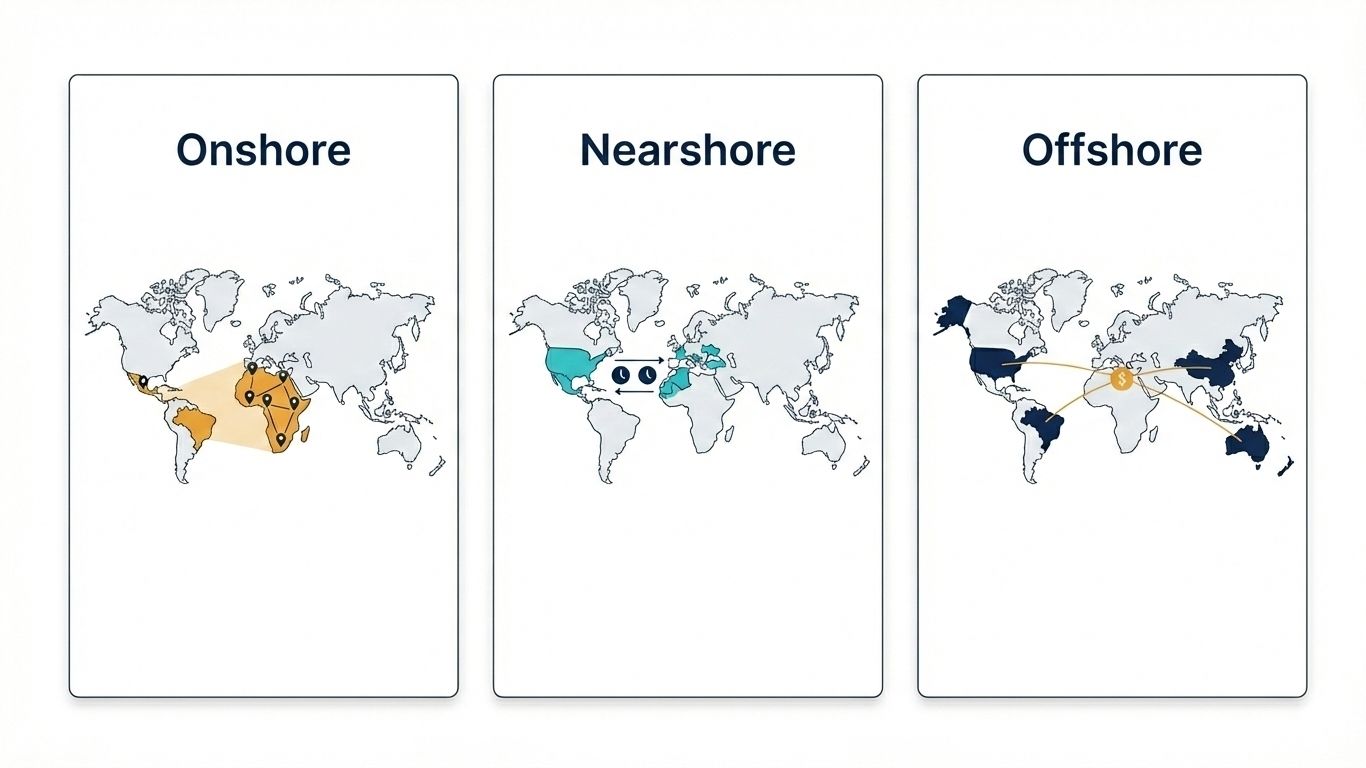
Onshore outsourcing connects you with providers within your own country, often in different cities or regions. US firms working with teams in secondary tech hubs benefit from identical time zones and seamless cultural alignment. This reduces friction in requirements gathering and iterative feedback cycles.
European enterprises choosing Romanian or Bulgarian partners achieve cost efficiency while maintaining EU data protection compliance. For regulated industries like healthcare and finance, this compliance advantage often outweighs pure cost considerations. Legal frameworks align naturally, contracts enforce more predictably, and data sovereignty concerns dissolve.
Nearshore Outsourcing
Nearshore outsourcing targets neighboring countries with manageable time zone overlap and cultural compatibility. Mexican development centers serve US clients effectively. Polish teams support Western European companies with similar efficiency. The model balances affordability with operational ease.
Companies accept 15 to 20 percent premiums for nearshore locations to secure real-time collaboration windows. Latin American hourly rates typically run $12 to $19 for qualified developers. Teams can schedule joint planning sessions, daily standups, and urgent troubleshooting calls without requiring anyone to work overnight shifts.
This geographic sweet spot has gained traction among companies seeking alternatives to traditional offshore IT outsourcing models. The hybrid approach combines cost savings with practical collaboration advantages.
Offshore Outsourcing
Offshore outsourcing engages distant countries with substantial cost advantages, typically involving significant time zone separations. India leads as the dominant offshore destination with 5.4 million IT professionals and deep enterprise experience across technology stacks.
Senior developers in Poland cost $55 to $75 per hour versus $95 to $130 in the United States. This persistent economic incentive drives offshore arrangements despite coordination challenges. The Philippines excels in customer-facing roles where English proficiency creates competitive advantage. Vietnam has emerged as a cost-effective alternative for backend development and infrastructure work.
Success with offshore models requires strong project management processes. Asynchronous communication patterns need clear documentation standards. Code review cycles extend when teams operate across 12-hour time differences.
Engagement Models
The engagement structure determines who manages daily operations, who bears project risk, and how external resources integrate with your team. These structural variations produce dramatically different experiences even when working with the same vendor in the same location.
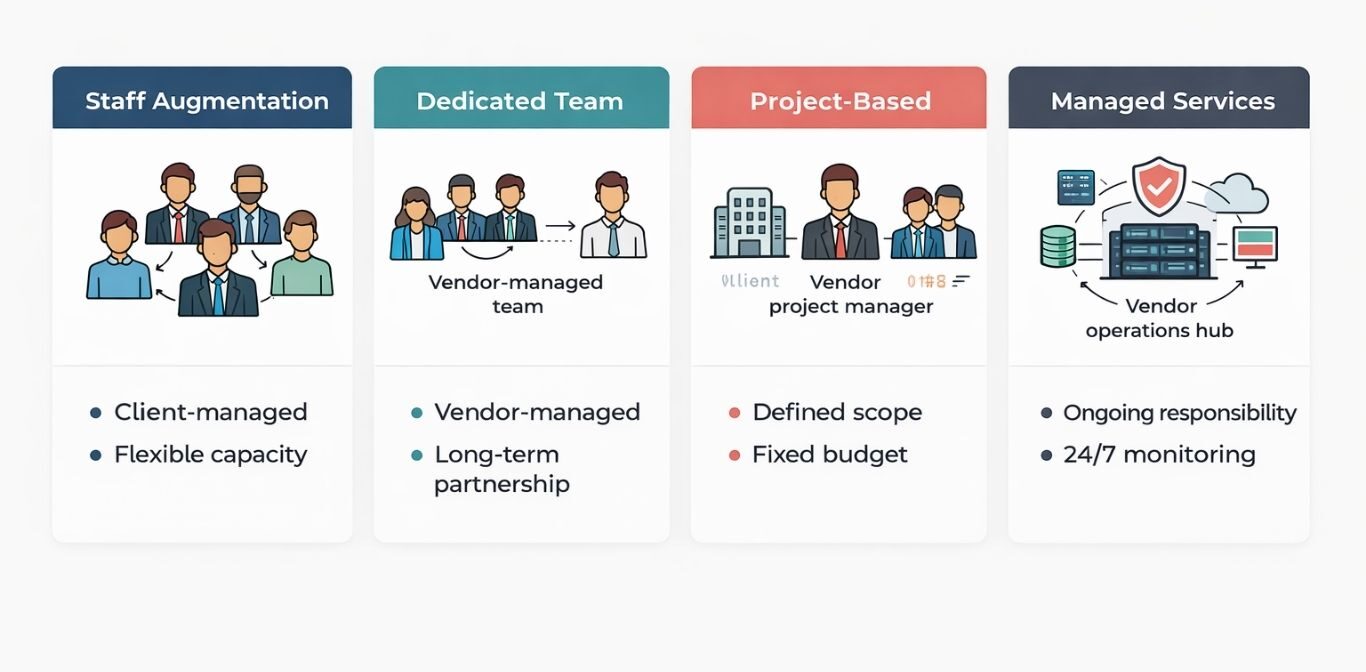
Staff Augmentation
Staff augmentation operates as talent rental where external developers join your existing team under your direct management. Your engineering manager assigns tasks, conducts code reviews, and includes augmented staff in daily standups exactly as they would internal employees.
This model excels when you need specific expertise for defined periods. Hiring a senior DevOps engineer for an 18-month cloud migration. Bringing in React specialists for a product rewrite. Building an agile development team with flexible capacity.
The model fails without internal capacity for clear direction and oversight. Augmented resources are not plug-and-play solutions that function autonomously. Organizations must account for onboarding time and management overhead when calculating total cost. Someone internally needs bandwidth to provide context, answer questions, and review work.
Dedicated Team Model
Dedicated team structures create a semi-autonomous unit that works exclusively on your projects while remaining managed by vendor leadership. Unlike staff augmentation where developers report to your engineering manager, dedicated teams maintain their own internal structure with a vendor-provided technical lead handling daily coordination.
Communication flows through designated contact points rather than requiring every team member to interface directly with client stakeholders. This approach suits long-term product development where you want consistent resources without management overhead. Information technology outsourcing through dedicated teams particularly benefits startups and mid-market companies building their first technical products.
The vendor technical lead translates your product requirements into actionable development tasks. They conduct sprint planning, remove blockers, and ensure code quality. You maintain strategic direction while delegating tactical execution.
Project-Based Outsourcing
Project-based outsourcing transfers both execution and management to the vendor. You define requirements and approve milestones. The vendor controls how work gets accomplished, which resources get assigned, and what technical decisions get made. They accept responsibility for delivering specified outcomes within agreed timelines and budgets.
This model works best for well-scoped initiatives with clear acceptance criteria. Migrating a legacy system to cloud infrastructure. Building a mobile application with defined feature sets. Implementing a payment processing integration with documented specifications.
Over 50% of fixed price projects exceed original effort estimates when requirements prove less stable than initially assumed. Thorough specification work becomes critical to project-based success. Ambiguity in requirements creates scope disputes and budget overruns.
Managed Services
Managed services represent the most comprehensive delegation. Vendors assume ongoing responsibility for entire IT functions such as infrastructure operations, security monitoring, or application support. Service level agreements define performance expectations, response times, and availability targets.
Vendors maintain dedicated teams and standardized processes to meet these commitments continuously rather than completing discrete projects. Organizations pursuing this model essentially outsource business capabilities. Managing information services becomes the vendor’s core responsibility rather than your internal team’s focus.
67% of companies plan to use external providers for DevOps services within 18 months. This represents more than double current adoption rates, indicating accelerating preference for managed service models in critical operational functions. Organizations want to focus internal expertise on product innovation rather than infrastructure maintenance.
Pricing Models
How you structure payment determines budget predictability, vendor incentives, and flexibility to accommodate changes. Each pricing approach distributes financial risk differently between you and your vendor, creating distinct dynamics suited to particular project characteristics.
Fixed Price Contracts
Fixed price contracts establish predetermined total cost for specified scope regardless of actual effort expended. Vendors quote a single number covering all development work, project management, and delivery. This provides absolute budget certainty from the outset.
Flat rate pricing typically runs $5,000 to $7,000 per month for comprehensive managed services. Organizations with rigid budgets, well-defined requirements, and limited tolerance for scope changes favor this model.
Budget certainty comes at a cost. The model breaks down when requirements evolve during development. Change requests trigger renegotiation and potential overruns that eliminate original predictability. Vendors build risk buffers into fixed quotes to account for uncertainty, potentially making this approach more expensive than alternatives for stable, well-governed projects.
Time and Materials
Time and materials billing charges actual hours worked at agreed hourly rates. A vendor charging $60 per hour for mid-level developers and $90 per hour for senior engineers invoices based on timesheets. Clients pay for resources consumed rather than outcomes delivered.
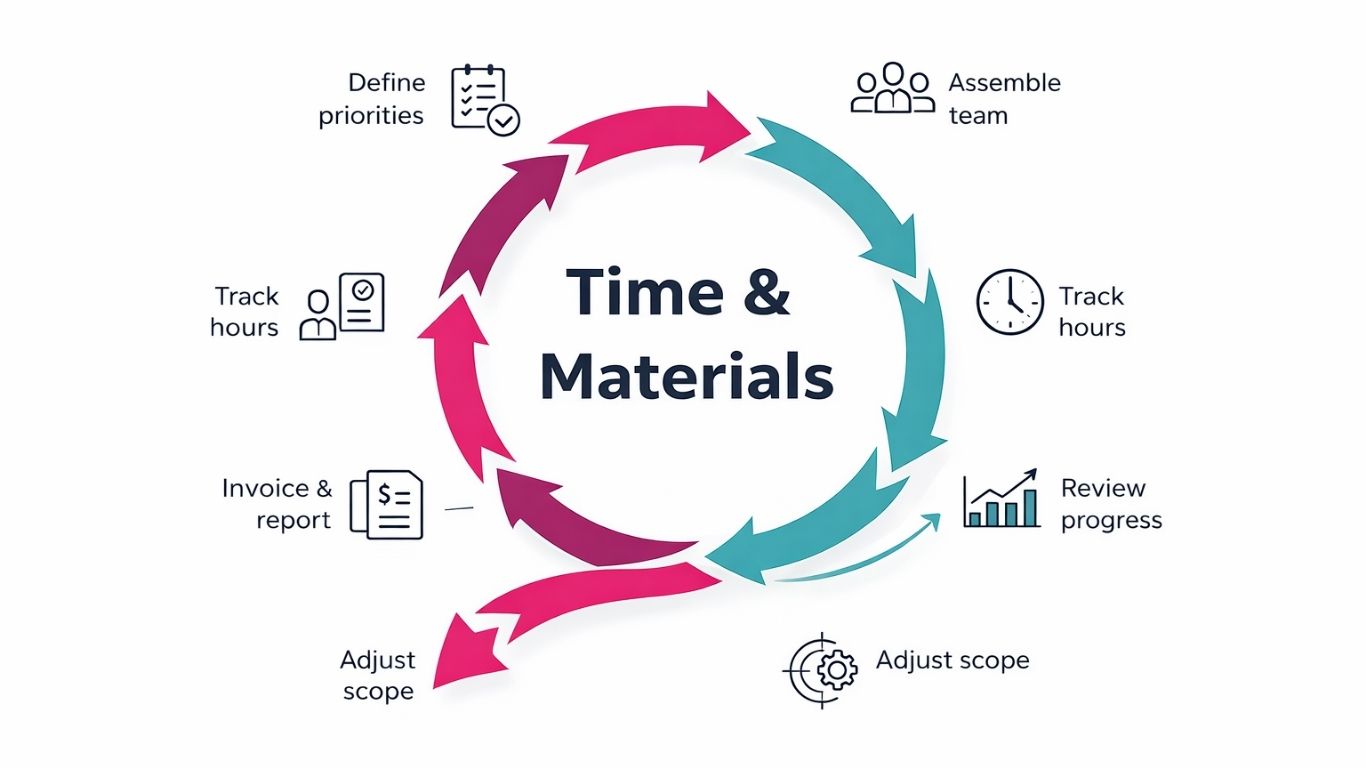
This model offers maximum flexibility when requirements remain unclear or likely to change as products evolve. Organizations maintaining strong governance and clear prioritization often find time and materials less expensive than fixed price. They avoid paying for risk premiums vendors build into fixed quotes.
The tradeoff requires accepting budget variability and investing in oversight. You need mechanisms to ensure hours get spent productively rather than consumed by inefficient processes or unclear direction. Regular sprint reviews and velocity tracking help maintain accountability.
Retainer Agreements
Retainer-based models reserve set hours or dedicated team capacity for recurring monthly fees. Arrangements typically cost $75 to $300 per hour or $1,000 to $10,000 per month depending on hours reserved and expertise required.
You pay for guaranteed availability and prioritized support rather than specific deliverables. This works well for ongoing needs where workload varies but continuous access to resources creates value. System maintenance, regular feature enhancements, and technical support all suit retainer structures.
Organizations essentially keep technical expertise on retainer similar to legal counsel for matters that arise unpredictably. The monthly fee provides insurance against delays when urgent work emerges.
Outcome-Based Pricing
Outcome-based pricing ties compensation directly to measurable business results rather than effort or time. Vendors receive payment based on successful product launches, user adoption metrics, system uptime percentages, or cost savings achieved through optimization.
The industry shifts toward outcome-based contracts where success gets measured by impact rather than activity. Providers gain incentive to innovate and automate because revenue depends on delivering tangible value, not maximizing billable hours.
This model requires sophisticated performance measurement, clear attribution of outcomes, and aligned expectations between parties. What metrics define success? How do you isolate vendor contribution from other factors? These questions need resolution before contracts get signed.
Software Development Delivery Models
Software development represents the most commonly outsourced IT function. Delivery models have evolved to address increasingly complex technical and organizational challenges. The choice impacts not just cost but development velocity, code quality, and long-term maintainability.
Waterfall vs Agile Approaches
Waterfall approaches work for initiatives with completely defined requirements where changes during development would be expensive or disruptive. Building compliance reporting systems with rigid regulatory specifications. Migrating legacy databases to modern platforms with documented schemas. These scenarios reward upfront planning.
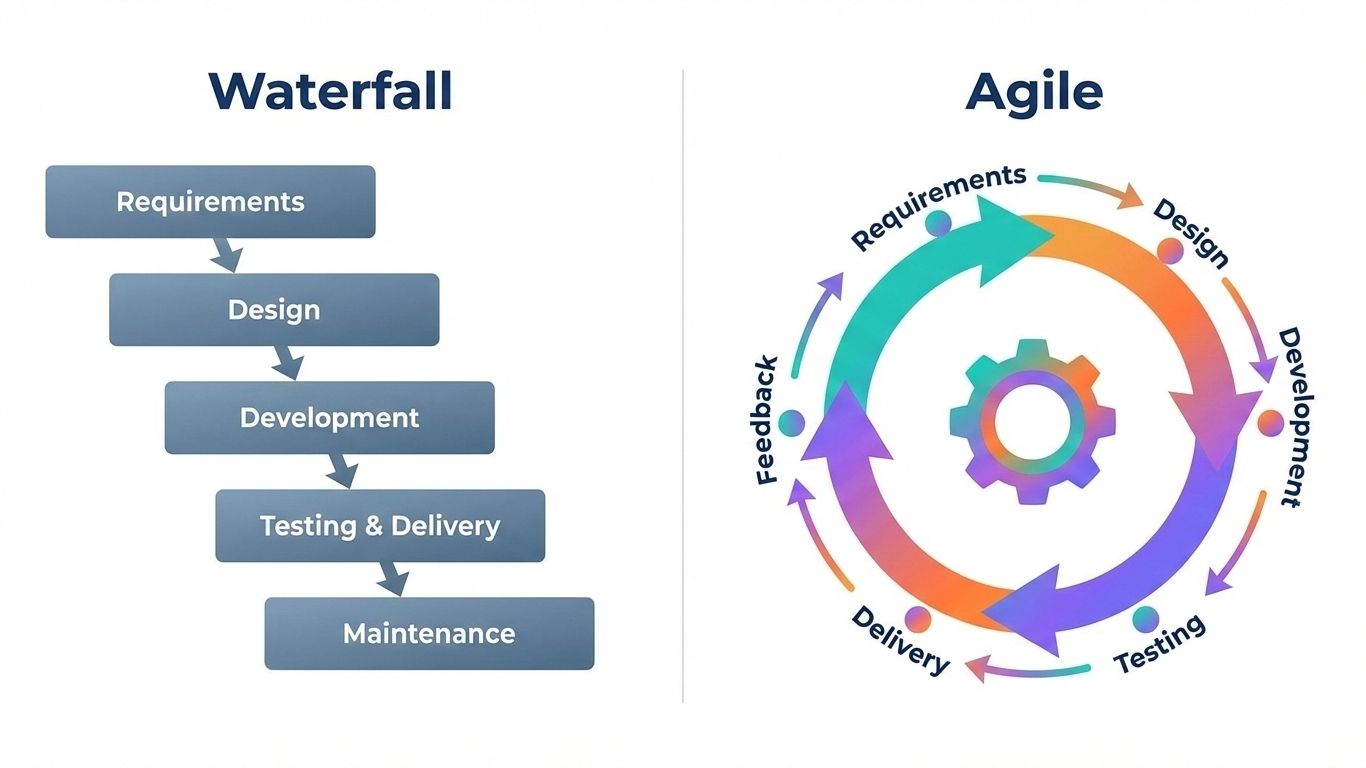
Vendors break work into sequential phases with formal approval gates, delivering according to predetermined specifications without ongoing iteration. This model has fallen from favor for product development where market feedback and user testing should inform feature evolution. The rigidity providing budget certainty also prevents beneficial course corrections.
Agile delivery dominates product work where requirements emerge through iteration rather than specification. AI automates repetitive tasks, boosting productivity by up to 30%, fundamentally changing how teams estimate effort and structure sprints.
Outsourced agile teams participate in two-week sprints, attend daily standups, and deliver working software incrementally. This enables course corrections based on stakeholder feedback. The model requires clients to maintain engaged product ownership and participate actively in backlog refinement. Teams cannot make product decisions independently.
Platform Engineering and DevOps Services
Platform engineering and DevOps as a service address the operational complexity of modern cloud-native applications. Rather than simply writing code, vendors establish continuous integration pipelines, implement infrastructure as code, and configure monitoring and observability systems.
This model suits organizations running microservices architectures, container orchestration, and event-driven systems. Deployment complexity rivals application logic complexity in these environments. Specialized expertise in Kubernetes, Terraform, and cloud provider services becomes critical.
Evaluating Vendors Beyond Hourly Rates
The decision framework for selecting an outsourcing model extends far beyond comparing cost per hour across geographies. Sophisticated buyers assess multiple dimensions determining whether partnerships create strategic value or merely shift headcount off balance sheets.
Domain-Specific Technical Expertise
Technical expertise in your domain matters enormously. Healthcare vendors understand HIPAA compliance, HL7 integration standards, and clinical workflow patterns that generalist developers would need months to learn. Fintech teams know payment processing, Know Your Customer requirements, and financial data security.
Healthcare IT outsourcing is expected to grow at 5.46% CAGR through 2031, driven by telehealth demand and AI-enabled diagnostics. This growth makes domain-specific vendor selection increasingly important. Generic development shops provide raw coding capacity. Specialized firms contribute architectural judgment and best practice knowledge accumulated across similar projects.
Security and Intellectual Property Protection
Intellectual property protection has become non-negotiable. Every developer must sign IP assignment agreements before accessing code. All work product becomes client property immediately upon creation. Code should remain in client-owned repositories rather than vendor accounts to maintain control.
For sensitive data handling, vendors should hold SOC 2 Type II certification demonstrating independently audited security controls. Annual penetration testing validates infrastructure resilience. Data encryption standards, access control policies, and incident response procedures all require evaluation.
Communication and Cultural Alignment
Communication practices determine whether distributed teams function smoothly or create constant friction. Vendors should demonstrate proactive communication patterns where teams surface blockers early rather than waiting for status meetings. Updated documentation accessible to all stakeholders. Adaptation to client communication preferences.
Time zone overlap matters less when teams excel at asynchronous communication through well-maintained wikis, detailed pull request descriptions, and comprehensive testing documentation. Cultural compatibility manifests in shared assumptions about work quality, deadline commitments, and professional responsibility.
Strategic Model Selection Framework for 2026
No single outsourcing model optimally addresses all organizational needs simultaneously.
The proliferation of hybrid approaches reflects growing recognition that matching engagement types to specific project characteristics produces better outcomes than forcing everything through one model.

Complexity and Uncertainty Matrix
Start by cataloging IT needs across complexity and uncertainty dimensions. Different quadrants call for different model selections:
- Low complexity, low uncertainty: Infrastructure monitoring and help desk support suit managed services with fixed monthly fees
- High complexity, low uncertainty: Enterprise system migrations match well with project-based fixed price contracts that transfer execution risk to experienced vendors
- High uncertainty product development: Requirements emerge through user validation, demanding time and materials or dedicated team models preserving flexibility
- Experimental features: Low complexity but high uncertainty scenarios like AI pilots might use staff augmentation to access specific skills without long-term commitments
Multi-Region Geographic Strategy
Geographic strategy increasingly involves multi-region deployment rather than single country concentration. Companies might maintain nearshore resources in Mexico for real-time product collaboration while leveraging offshore teams in India for platform infrastructure work and overnight QA cycles.
This diversification provides risk mitigation against geopolitical disruption, natural disasters, and regional talent shortages. It optimizes the cost-to-collaboration tradeoff across different work streams. Governance complexity rises with geographic distribution, requiring clear responsibility matrices and communication protocols to prevent coordination failures.
Aligning Pricing with Risk Tolerance
Pricing model selection should align with organizational risk tolerance and financial planning constraints. Startups with uncertain runway benefit from time and materials flexibility avoiding large upfront commitments. Established enterprises often prefer fixed price predictability simplifying annual budgeting.
Outcome-based pricing makes sense when success metrics are well-defined and largely within vendor control. It proves problematic when business results depend on factors beyond development quality like market timing or sales execution.
Iterative Model Evolution
The most successful outsourcing relationships treat model selection as iterative process rather than one-time decision. Organizations beginning with project-based engagements often transition to dedicated teams as relationships mature and knowledge transfer reduces the need for detailed specification.
Companies might start with staff augmentation to access immediate expertise before building sufficient internal capability to shift toward managed services for operational functions. Vendor flexibility in supporting model evolution signals partnership orientation versus transactional mindset focused solely on current contract structure.
Nearly half of organizations plan to increase outsourcing levels, with many implementing multi-model strategies. This trend reflects maturing understanding that different IT functions require different engagement approaches. Core product development might use dedicated teams while infrastructure operations use managed services and specialized short-term needs use staff augmentation.
Partner with HBLAB
Choosing the right outsourcing model requires a partner who understands your unique business context and can adapt to your evolving needs.
HBLAB brings 10+ years of experience delivering custom digital solutions through flexible engagement models tailored to your project requirements.

With 700+ IT professionals including 30% senior-level talent, we offer the technical depth and strategic expertise to support projects of any complexity.
Whether you need staff augmentation for immediate capacity, dedicated teams for long-term product development, or managed services for operational excellence, our engagement frameworks align with your control preferences and timeline constraints.
Our approach delivers measurable value:
- 30% cost efficiency compared to traditional onshore rates without sacrificing quality
- Multiple engagement options: offshore development, onsite collaboration, dedicated teams, and BOT (Build-Operate-Transfer) models
- Full client control over workflows, development tools, and product delivery decisions
- Enterprise-grade security with rigorous IP protection and CMMI Level 3 certified processes
- Global delivery capability with headquarters in Vietnam and presence across Australia, Singapore, Japan, and South Korea
We combine the cost advantages of offshore outsourcing with the collaboration quality of nearshore partnerships.
Our strong English proficiency and overlapping work hours with major markets enable real-time communication when it matters most.
CONTACT US FOR A FREE CONSULTATION
FAQ
1. What is an outsourcing model?
An outsourcing model is the structural framework that defines how organizations contract external IT resources. It specifies team composition, management responsibility, pricing structure, and risk allocation between client and vendor.
2. What are the types of IT outsourcing?
IT outsourcing has three main types by location:
- Onshore: Same-country partnerships with identical time zones
- Nearshore: Neighboring countries with manageable time overlap
- Offshore: Distant countries with significant cost advantages
3. What are the 4 types of outsourcing?
The four engagement types are:
- Staff Augmentation: External developers join your team under your direct management
- Dedicated Team: Vendor-managed team working exclusively on your projects
- Project-Based: Vendor handles complete delivery of defined projects
- Managed Services: Vendor assumes ongoing responsibility for entire IT functions
4. What are the different outsourcing models?
Outsourcing models can be categorized three ways:
- By Location: Onshore, nearshore, offshore
- By Engagement: Staff augmentation, dedicated teams, project-based, managed services
- By Pricing: Fixed price, time and materials, retainer-based, outcome-based
5. What are the 4 stages of outsourcing?
The four stages of outsourcing implementation are:
- Planning: Define requirements, budget, and success criteria
- Vendor Selection: Evaluate providers and negotiate contracts
- Transition: Onboard team and transfer knowledge
- Management: Monitor performance and optimize collaboration
6. What is the best outsourcing model?
No single model is universally best. The optimal choice depends on:
- Staff augmentation works best when you need specific expertise with direct control
- Dedicated teams suit long-term product development without management overhead
- Project-based fits well-scoped initiatives with clear deliverables
- Managed services excels for ongoing operational responsibilities
Your project complexity, budget flexibility, and internal management capacity determine the best fit.
7. Which outsourcing is the most common type of IT outsourcing?
Offshore outsourcing remains the most common type, particularly software development to countries like India, the Philippines, and Vietnam. However, nearshore outsourcing is rapidly growing as companies prioritize real-time collaboration over maximum cost savings.
8. What are the three levels of outsourcing?
The three levels refer to service depth:
- Tactical: Specific tasks like coding or testing (staff augmentation)
- Strategic: Complete project delivery or dedicated development (project-based, dedicated teams)
- Transformational: Full IT function responsibility (managed services, IT operations outsourcing)
9 What is the top 1 outsourcing country?
India is the top outsourcing country globally, with 5.4 million IT professionals and the most mature outsourcing ecosystem. It dominates in software development, IT support, and enterprise services. The Philippines ranks second for customer-facing roles, while Vietnam and Poland are rapidly growing alternatives.
Read more:
– AI Outsourcing Company in Vietnam: Top 5 Providers and What They Do
– What Will Be The Leading IT Outsourcing Trends in 2026?
– Vietnam IT Outsourcing: Why It’s the Leading Choice for Global Businesses