What is Backend Development?
The Foundation of Modern Web Applications
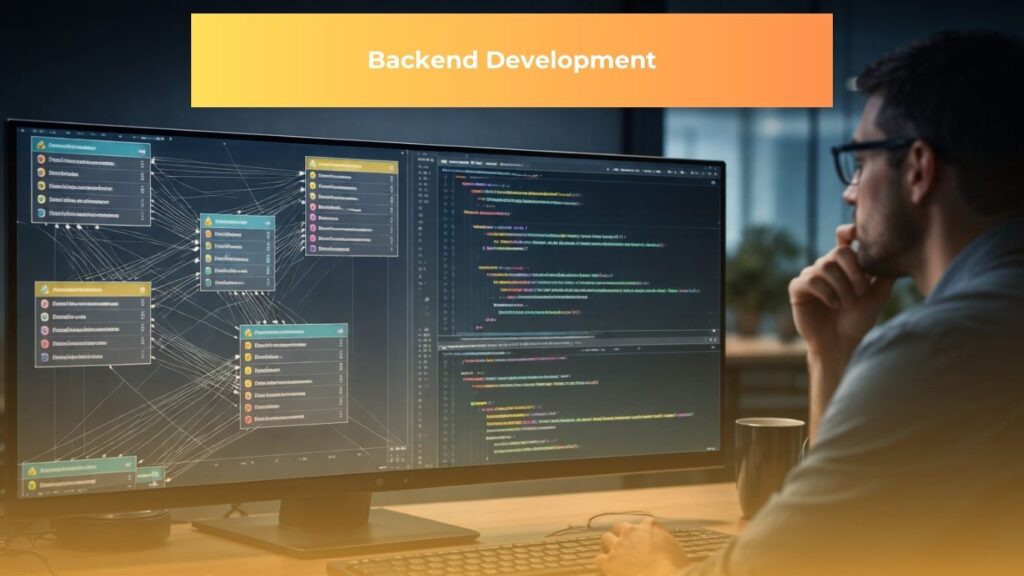
Backend development encompasses the server-side programming that powers web applications and digital systems. It refers to the code and infrastructure running on servers that process user requests, manage databases, implement business logic, and return data to front-end interfaces.
While users never see backend development directly, they depend on it for every interaction with a website or mobile application.
How Backend Systems Process Requests
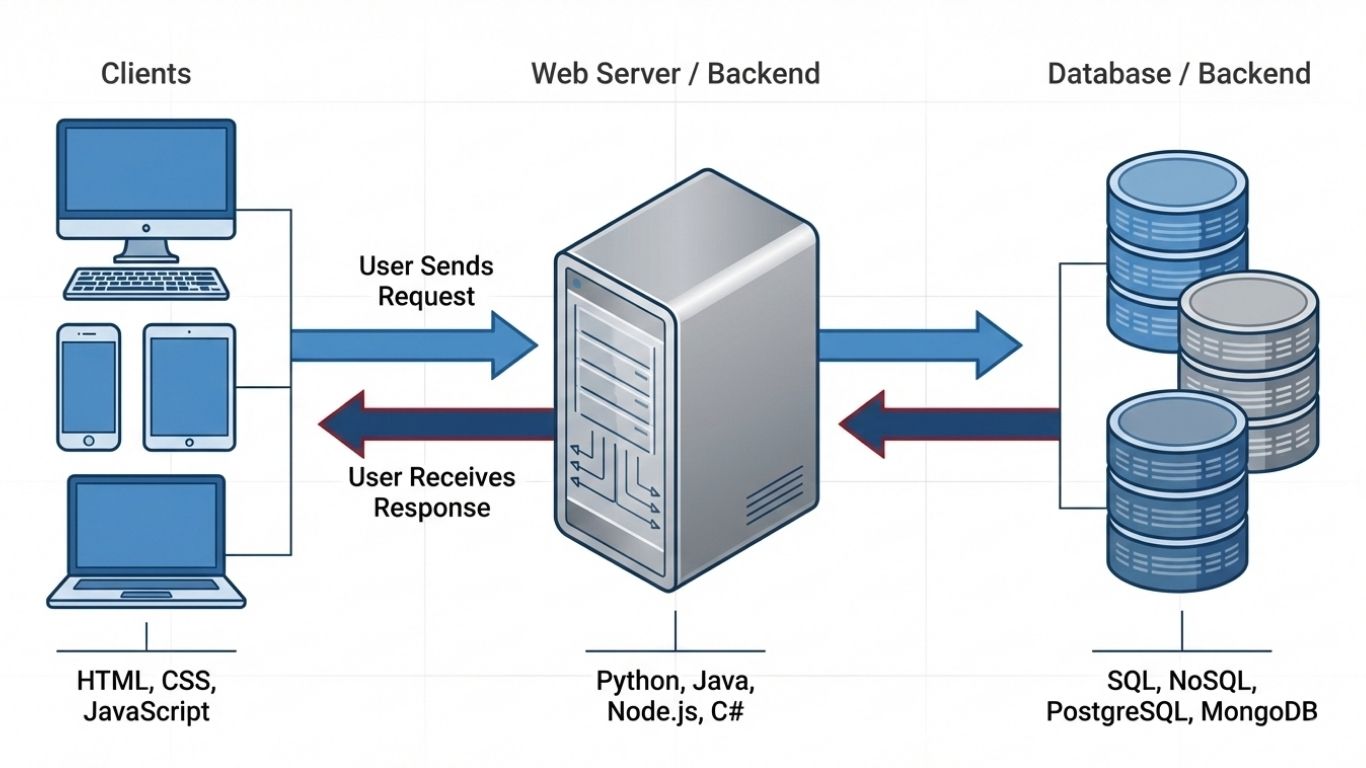
The backend operates as the invisible engine of modern web applications. When you click a button on a website or submit a form, your browser sends an HTTP request across the internet to a server.
That server’s backend code receives your request, validates it, queries a database if needed, and sends a response back to your browser.
The Role of Backend in User Experience
Backend development determines whether applications load quickly, handle traffic spikes gracefully, and protect user data effectively. Without robust backend systems, even the most beautiful frontend interface becomes useless.
Understanding the Client-Server Architecture
The Client-Server Model Explained
Backend development operates within the client-server model. In this fundamental architecture, a client (typically a web browser) initiates communication with a server (a powerful computer hosted remotely) by sending requests.
The server receives these requests, processes them, executes necessary operations, and transmits responses back to the client.
The Request-Response Cycle
The request-response cycle forms the backbone of web interaction. When you load a website, your browser sends an HTTP request containing:
- The method (GET, POST, PUT, DELETE)
- The target URL specifying which resource to access
- Headers with metadata about the request
- A message body with additional data (for POST/PUT requests)
The server’s backend code intercepts this request at a routing layer, which directs it to the appropriate handler function. That handler executes business logic, queries databases, and constructs an HTTP response.
Why This Architecture Matters
Each page load, form submission, and real-time update involves the client-server request-response pattern. Backend developers build the server-side code that makes this pattern work reliably and efficiently at scale.
How Backend Development Differs from Frontend Development
Frontend Development: The User Interface Layer
Frontend and backend development represent complementary yet distinct specializations. Frontend development focuses on the client side, using HTML, CSS, and JavaScript to build visual interfaces and interactive elements.
Frontend developers prioritize responsiveness across devices, visual design coherence, and intuitive user interactions.
Backend Development: The Logic and Data Layer
Backend development concerns itself with everything beneath the surface. Backend developers:
- Build server infrastructure and deployment pipelines
- Design database schemas and optimize query performance
- Write APIs that enable frontend communication
- Implement authentication and authorization systems
- Enforce security protocols and data encryption
- Craft algorithms that process and transform user data
The Collaboration Between Frontend and Backend
Both roles require strong programming capabilities, but they apply these skills to different problems. A backend developer writing Python code for user registration must understand password hashing algorithms, database constraints, and API response formatting.
A frontend developer building the same registration form must understand form validation, error message display, and asynchronous network requests.
According to Stack Overflow’s 2024 developer survey, backend development ranks among the top three most sought-after tech roles, with organizations prioritizing experienced backend engineers for their ability to design scalable, secure systems.
The Core Components of Backend Systems
Servers: The Foundation of Backend Infrastructure
Servers form the foundation of backend infrastructure. A server is essentially a computer optimized for:
- Running applications continuously without downtime
- Processing requests from thousands of concurrent users
- Delivering consistent performance under load
- Hosting application code and serving it to clients
Backend developers may work with physical servers in on-premises data centers or cloud-hosted virtual servers from providers like AWS, Azure, and Google Cloud.
Popular server software includes Apache and NGINX, both open-source web servers that receive HTTP requests and route them to application code.
Databases: Persistent Data Storage
Databases store the persistent information that applications require. When you create an account, update your profile, or place an order, that data is stored in a database rather than computer memory.
Backend developers design database schemas, write queries to retrieve and update information, and optimize database performance. The choice between SQL and NoSQL databases significantly impacts system architecture and scalability characteristics.
Application Logic: The Business Rules Engine
Application logic encompasses the code that implements business rules and data processing workflows. This is where backend developers write algorithms to:
- Validate user input against business rules
- Perform calculations on financial or scientific data
- Make decisions based on data conditions
- Transform information into suitable formats
- Implement recommendation engines and personalization
Application logic interprets what the business actually needs to accomplish and translates those requirements into functioning code.
Databases in Backend Development: SQL vs. NoSQL
Understanding SQL Databases
Backend developers must understand database fundamentals because virtually every non-trivial application requires persistent data storage. The choice between SQL and NoSQL databases represents one of the most important architectural decisions.
SQL databases organize data into structured tables with rows and columns, similar to spreadsheets with defined relationships. SQL databases enforce ACID properties (Atomicity, Consistency, Isolation, Durability), which guarantee that transactions either complete entirely or fail completely.
The Power of Relational Databases
The relational model excels at complex queries joining data across multiple tables and generating detailed reports. A backend developer can write SQL queries to find all customers who purchased items in a specific category within a date range and calculate their average spending, all in a single query.
SQL databases like MySQL, PostgreSQL, and Oracle power the majority of web applications because their reliability and mature ecosystems are well proven at scale.
Understanding NoSQL Databases
NoSQL databases take a different approach, storing data in flexible, schema-less formats such as:
- Documents (MongoDB) for JSON-like flexible structures
- Key-value pairs (Redis) for caching and session storage
- Wide-column stores (Cassandra) for massive distributed datasets
- Graph databases (Neo4j) for relationship-heavy data
NoSQL databases sacrifice some consistency guarantees to achieve horizontal scalability, meaning they can distribute data across many servers and handle massive datasets.
Companies like Netflix, Amazon, and Google rely on NoSQL databases because they need to serve enormous amounts of data across geographically distributed servers with minimal latency.
Decision Framework: SQL or NoSQL?
When to choose SQL databases:
- Structured data with defined relationships between entities
- Strong consistency requirements where data accuracy is critical
- Complex reporting needs that involve joining multiple tables
- Applications like banking, e-commerce, or inventory systems
When to choose NoSQL databases:
- Unstructured or semi-structured data that doesn’t fit rigid schemas
- Horizontal scalability across many servers is essential
- Schema flexibility matters because data structure evolves rapidly
- Applications handling massive datasets or extremely high traffic
APIs: The Communication Layer Between Systems
What Are APIs and Why They Matter
Application Programming Interfaces (APIs) enable communication between the frontend application running in a user’s browser and the backend server, as well as between different backend services.
Backend developers spend significant time designing, building, and maintaining APIs because these interfaces define how different parts of a system talk to each other.
REST APIs: The Industry Standard
REST (Representational State Transfer) APIs have dominated backend development for the past decade. REST APIs use HTTP methods to define operations:
- GET retrieves data without modifying anything
- POST creates new records in the database
- PUT updates existing data with new values
- DELETE removes data from the system
Each API endpoint represents a specific resource or collection of resources. For example, a social media API might expose /users/123 to retrieve user information, /posts/456/comments to retrieve comments, and /messages to send new messages.
The Limitations of REST
REST APIs are straightforward to understand and implement, making them widely adopted. However, they have drawbacks:
- Over-fetching: If a frontend application needs only certain fields from a user object but the endpoint returns the entire user record including password hashes and private information, the frontend receives unnecessary data.
- Under-fetching: If the frontend needs related data like all a user’s posts and comments, it must make multiple API calls, slowing down the application.
GraphQL: The Flexible Alternative
GraphQL offers an alternative approach. Instead of multiple endpoints returning fixed data structures, GraphQL exposes a single endpoint where clients specify exactly which fields and related data they need in their query.
This eliminates both over-fetching and under-fetching, reducing network traffic and improving performance, particularly for mobile applications operating over slow connections.
GraphQL also includes a strongly typed schema that serves as definitive documentation and enables powerful developer tools with autocomplete and validation.
Authentication and Authorization: Securing Backend Systems
Understanding Authentication vs. Authorization
Backend developers must implement security mechanisms that verify user identity and control actions. Authentication confirms that a user is who they claim to be, while authorization determines what resources and operations that user can access.
These are fundamentally different security concerns that work together.
OAuth: Third-Party Authentication Framework
OAuth is an authorization framework that enables users to grant third-party applications access to their accounts without sharing passwords.
When you log into a website using your Google account, you are experiencing OAuth in action. Your browser redirects to Google’s authentication servers, you enter your password into Google’s interface, and Google returns an authorization token to the website.
JWT: Stateless Token-Based Authentication
JWT (JSON Web Tokens) is a token format used to transmit information securely between systems. A JWT contains three parts:
- Header describing the token type and algorithm
- Payload containing claims about the user (ID, permissions, expiration)
- Signature proving the token was issued by a trusted server
Unlike session-based authentication where the server stores information about logged-in users, JWT enables stateless authentication. The server simply verifies that the token’s signature is valid and reads the user information from the token itself.
Modern Authentication Workflows
Many modern applications combine both technologies. The OAuth flow handles initial authentication and authorization, verifying the user’s identity with a trusted identity provider. The authorization server then issues a JWT as the access token.
Subsequent API requests include the JWT in an Authorization header, allowing the backend to verify identity and permissions without requiring a centralized session store.
Backend Programming Languages: Choosing the Right Tool
Python: Rapid Development and AI Integration

Python continues to dominate backend development due to its readable syntax, rapid development capabilities, and exceptional ecosystem. Python’s simplicity allows developers to express complex logic with minimal code.
Django, a full-featured Python framework, comes with built-in authentication, database management, and admin interfaces. Flask offers a lighter-weight alternative for building APIs and microservices.
Python has become the default choice for data science, machine learning, and artificial intelligence integration, making it invaluable for building modern backends that incorporate predictive models and intelligent features.
JavaScript/Node.js: Full-Stack Consistency
JavaScript via Node.js enables developers to use the same language on both frontend and backend, creating cohesive full-stack development teams.
Node.js uses an event-driven, non-blocking I/O architecture, making it exceptionally performant for applications handling real-time communication, streaming data, or thousands of concurrent connections.
Express.js provides a minimal framework for building APIs quickly, while NestJS offers a more opinionated, enterprise-ready approach with strong typing through TypeScript integration.
Java: The Enterprise Standard
Java with Spring Boot represents the enterprise backend standard. Java’s strong type system catches errors at compile time, its mature ecosystem includes solutions for almost any architectural problem, and its extensive optimization means Java code often outperforms dynamically typed languages at scale.
Large financial institutions, e-commerce platforms, and cloud infrastructure providers rely heavily on Java backends for mission-critical systems.
Go: Cloud-Native Performance
Go (Golang), created at Google, has become increasingly popular for building cloud-native applications and high-performance microservices. Go compiles to native machine code, resulting in executable binaries that start instantly and consume minimal memory.
Go’s first-class support for concurrency through goroutines and channels makes writing highly concurrent applications natural and efficient. Go is the language of choice for Kubernetes, Docker, and numerous cloud infrastructure tools.
PHP: Content Management Dominance
PHP remains widespread despite its reputation among some developers. While newer languages may be more elegant, PHP powers WordPress and countless content management systems that run significant portions of the web.
For content-heavy websites and rapid development of backend functionality that integrates with WordPress plugins, PHP continues to be a pragmatic choice.
Ruby: Developer Happiness Focus
Ruby emphasizes developer happiness and rapid prototyping. Ruby on Rails pioneered the “convention over configuration” philosophy, where frameworks provide sensible defaults so developers can build applications without excessive boilerplate configuration.
Ruby and Rails appeal to startups and organizations prioritizing speed to market over raw performance.
C#/.NET: Microsoft Ecosystem Power
C# with .NET Core provides a Microsoft-ecosystem alternative combining enterprise reliability with modern language features. C# shares similarities with Java but includes additional features like LINQ for data querying and async/await syntax.
.NET Core runs cross-platform, enabling C# developers to deploy to Windows, Linux, and cloud platforms.
Language Selection Criteria
Selecting a backend language depends on:
- Project requirements (performance, scalability, real-time features)
- Team expertise (existing knowledge and learning curve)
- Business context (startup speed vs. enterprise reliability)
- Ecosystem maturity (available libraries, frameworks, tools)
The Essential Skills of a Backend Developer
Core Technical Competencies
Becoming proficient in backend development requires technical mastery, architectural understanding, security awareness, and collaboration skills.
Programming language mastery forms the foundation. Backend developers must achieve fluency in at least one language, understanding not just syntax but memory management, concurrency models, error handling strategies, and performance characteristics.
Database and Data Management Skills
Database competency extends beyond writing queries. Backend developers must understand:
- Data modeling and entity relationship design
- Normalization principles for reducing data redundancy
- Indexing strategies for query performance
- Query optimization and execution plan analysis
- Transaction behavior and isolation levels
- Consistency models and replication strategies
A poorly designed database schema or inefficient queries can create performance bottlenecks that no amount of server resources can overcome.
API Design and Integration
API design represents another crucial skill. Backend developers should understand REST principles, GraphQL concepts, versioning strategies, and how to design APIs that are intuitive for frontend developers and external consumers.
Well-designed APIs reduce integration friction and enable faster feature development across teams.
Security Implementation and Best Practices
Security awareness is non-negotiable. Backend developers must understand:
- Authentication and authorization mechanisms (OAuth, JWT, session management)
- Common vulnerabilities like SQL injection and cross-site scripting
- Encryption for sensitive data (at rest and in transit)
- Defensive programming practices and input validation
- The OWASP Top 10 list of critical web security risks
System Design and Architecture
System design and architecture knowledge distinguishes senior backend developers from junior developers. Understanding how to design scalable systems, choose between monolithic and microservices architectures, implement caching strategies, and design for reliability enables developers to make architectural decisions that impact application success.
Version Control and Collaboration
Version control with Git is essential for collaborative development. Backend developers commit code changes, review other developers’ code, manage branches, and resolve merge conflicts.
Proficiency with Git and platforms like GitHub, GitLab, or Bitbucket enables teams to work efficiently and maintain code history.
Testing and Quality Assurance
Testing and debugging skills ensure code quality. Backend developers write:
- Unit tests verifying individual components work correctly
- Integration tests checking that components work together
- System tests validating end-to-end functionality
- Load tests ensuring performance under high traffic
Cloud Platform Expertise
Cloud platform knowledge has become increasingly important. Most modern applications run on AWS, Azure, or Google Cloud rather than on-premises servers.
Backend developers should understand cloud services like computing instances, managed databases, storage systems, and how to design applications for cloud platforms.
DevOps and Deployment
DevOps practices increasingly blur the line between development and operations. Backend developers use:
- Docker for containerization
- Kubernetes for orchestration
- CI/CD tools like Jenkins or GitHub Actions for automation
Essential Soft Skills
Soft skills round out the backend developer toolkit:
- Problem-solving enables debugging complex issues and designing solutions
- Communication facilitates collaboration with frontend developers and stakeholders
- Time management helps juggle multiple priorities and meet deadlines
- Adaptability allows staying current with rapidly evolving technologies
Architectural Patterns: Monolithic vs. Microservices
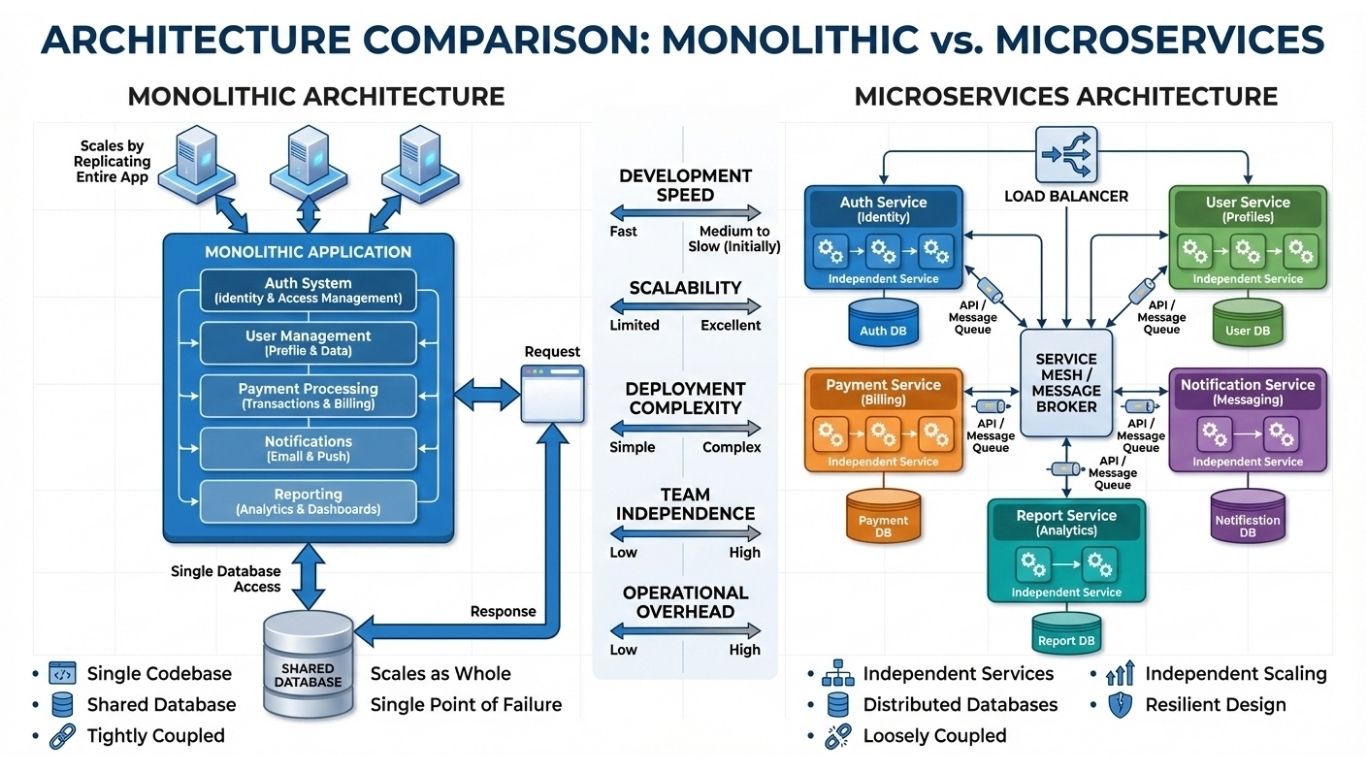
Understanding Monolithic Architecture
As applications grow in complexity, backend developers must choose between architectural approaches that fundamentally impact how systems are built, deployed, and scaled. These decisions affect everything from development team structure to IT infrastructure costs.
The monolithic architecture involves building an entire application as a single codebase and deployable unit. All features, from user authentication to payment processing to notifications, run in the same application instance.
Advantages of Monolithic Applications
Monolithic applications offer several benefits:
- Simpler initial development because everything is in one place
- Easier debugging because code exists in one location
- Straightforward end-to-end testing with a single deployment
- Lower operational complexity for small teams
Many successful applications started as monoliths.
Limitations of Monolithic Architecture
However, monolithic applications become challenging to scale. When traffic increases, developers must replicate the entire application across multiple servers. They cannot scale only the payment processing component that experiences high load.
Additionally, a single bug in one feature can crash the entire application, potentially taking down all functionality for all users. Deploying updates requires restarting the entire application, causing temporary unavailability.
Understanding Microservices Architecture
Microservices architecture decomposes applications into small, independent services. User authentication runs in one service, payment processing runs in another service, notifications run in yet another service.
Each service maintains its own database, handles its own deployment, and scales independently. Services communicate through APIs or message queues.
Microservices Advantages
Benefits of microservices include:
- Teams can develop services independently using different programming languages and technologies appropriate for each problem domain
- Services scale independently, allowing teams to add capacity only where needed
- One service’s failure does not necessarily bring down other services
- Deploying updates to one service does not require restarting other services
- Teams can work in parallel without blocking each other
Microservices Complexity Challenges
Microservices introduce significant complexity. Developers must manage communication between services, ensure data consistency across services that do not share databases, and debug issues that span multiple services.
The infrastructure for deploying and monitoring dozens of microservices requires significant DevOps investment. Teams need strong discipline to prevent microservices from becoming a distributed mess of tightly coupled services.
Choosing the Right Architecture
Most applications start as monoliths because the simplicity enables faster initial development. As they grow in complexity and scale requirements, teams migrate to microservices.
However, microservices are not universally appropriate for every use case.
Learning Backend Development: Realistic Timeline and Pathways
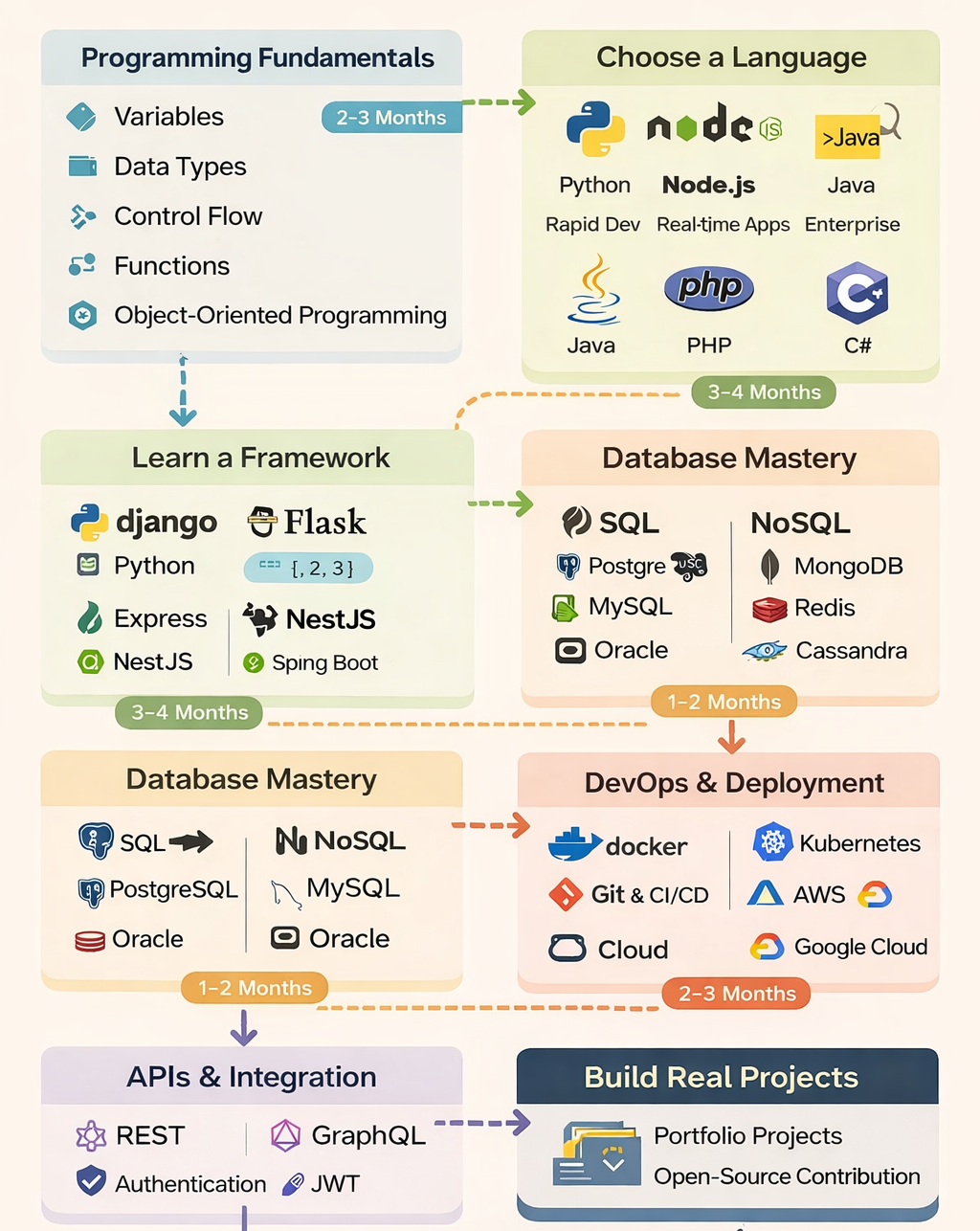
Learning Timeline for Complete Beginners
The journey to becoming a job-ready backend developer varies significantly depending on starting point and available study time.
For complete beginners with no programming experience, achieving job-ready proficiency typically requires six to twelve months of consistent learning.
The first one to three months should focus on foundational programming concepts: variables, data types, control flow, functions, and object-oriented principles. Then, three to six months should be dedicated to learning a chosen backend language and its frameworks.
Accelerated Timelines for Experienced Developers
Individuals with programming experience from other domains can accelerate significantly. A frontend developer transitioning to backend might achieve job readiness in four to nine months.
They already understand fundamental programming concepts, HTTP requests, asynchronous coding, and debugging. They need to focus primarily on backend-specific technologies: databases, server-side frameworks, API design, and deployment systems.
Experienced software developers transitioning from other programming languages can become job-ready in three to seven months. They understand system design, testing, version control, and engineering best practices.
Key Timeline Factors
Critical factors affecting learning speed:
- Dedication level: Twenty hours per week enables six to twelve months to proficiency; ten hours per week extends timelines to eighteen to twenty-four months
- Consistency over intensity: Steady daily or weekly practice proves more effective than sporadic marathon study sessions
- Prior experience: Programming background accelerates learning compared to complete beginners
- Learning pathway: Bootcamps, university degrees, and self-directed learning each have different timeframes
- Quality of practice: Building real projects accelerates learning faster than passive tutorial following
Comparing Learning Pathways
University Computer Science Degrees (Four Years):
Provide comprehensive foundational knowledge and recognized credentials but require significant time and financial investment. Best for those seeking deep theoretical understanding and traditional career paths.
Coding Bootcamps (Three to Six Months):
Accelerate learning through intensive, structured programs but cost thousands of dollars and require full-time commitment. Best for career changers who can dedicate intensive focus. Many successful developers transition through bootcamp programs to quickly enter the industry.
Self-Directed Learning (Variable Timeline):
Offers maximum flexibility and minimal cost but requires exceptional discipline and self-motivation. Best for those with strong self-learning capabilities and ability to structure their own curriculum.
The Importance of Project-Based Learning
Regardless of pathway, project-based learning accelerates development more effectively than passive consumption of tutorials. Building real applications that solve actual problems creates portfolio pieces and develops problem-solving skills that employers value.
Career Outlook and Compensation for Backend Developers
Strong Job Market Growth
Backend development offers excellent career prospects, with employment of web developers and digital designers projected to grow 7 percent from 2024 to 2034, much faster than the average for all occupations. This translates to approximately 14,500 job openings annually throughout the decade.
The demand for backend developers continues to exceed supply, particularly for experienced engineers who can design scalable, secure systems for modern applications.
Competitive Compensation Ranges
The average salary for backend developers in the United States is $116,985 per year, with compensation varying significantly based on experience, location, and specialization. Entry-level backend developers typically earn between $75,000 and $90,000 annually, while senior developers with extensive experience command salaries exceeding $160,000.
Geographic location remains a significant factor in compensation. Backend developers working in tech hubs like San Francisco, New York, and Seattle earn substantially more than those in other regions. However, the rise of remote work and distributed teams has enabled developers to access higher-paying positions regardless of physical location.
Premium Specializations Drive Higher Earnings
Backend developers with expertise in high-demand areas earn significantly above average. Specializations in distributed systems, security architecture, machine learning infrastructure, blockchain technologies, and cloud-native architectures command premium compensation packages, often exceeding $200,000 for principal engineers and architects.
The Impact of Artificial Intelligence on Backend Development
AI’s Role in Code Generation
Artificial intelligence and machine learning are fundamentally changing how backend development is practiced, not by replacing backend developers but by automating routine tasks and shifting focus toward higher-level concerns.
According to GitHub’s 2024 reports, forty-one percent of code written globally is now generated by AI systems. However, only thirty percent of AI-generated code is accepted without modification.
The Reality of AI-Assisted Development
This single statistic reveals the evolving reality of backend development: AI can generate functional code incredibly quickly, but human expertise is required to ensure that code is secure, scalable, aligned with business requirements, and integrated appropriately into existing systems.
AI tools like GitHub Copilot excel at generating boilerplate code, API scaffolding, and database schema definitions. Backend developers can prompt an AI system to “create a REST API for user management with JWT authentication” and receive working code in seconds.
The Irreplaceable Human Element
However, developers must then review that code for:
- Security vulnerabilities like SQL injection or authentication bypass
- Performance implications and scalability bottlenecks
- Architectural consistency with existing system design
- Business logic correctness and edge case handling
Tasks that once consumed hours now take minutes, but skilled human judgment remains irreplaceable.
Evolution of Junior Developer Roles
Junior developers’ roles are evolving. The entry-level tasks that traditionally served as learning opportunities (writing CRUD operations, implementing basic authentication, creating simple APIs) are now quickly generated by AI.
Successful junior developers are those who understand systems deeply, can audit AI-generated code effectively, and know when that code is insufficient. Rather than signaling the end of junior developer roles, this shift demands that junior developers develop stronger foundational knowledge.
How Backend Developers Must Adapt
Critical skills for the AI era:
- Prompt engineering: Ability to specify requirements to AI systems clearly and precisely becomes as important as writing code manually
- Code review expertise: Spending more time auditing AI output than writing original code requires strong analytical skills
- System architecture: AI cannot understand business context, make tradeoffs between competing requirements, or make strategic decisions
- Security validation: Ensuring AI-generated code meets security standards requires deep security knowledge
- Algorithm design: Complex algorithmic thinking remains purely human domain
Productivity Gains, Not Job Elimination
The productivity gains are significant. Developers report saving thirty to sixty percent of their time on coding, testing, and documentation.
This productivity improvement does not eliminate jobs but rather:
- Enables smaller teams to accomplish more
- Shifts work toward higher-value activities
- Creates new roles like AI pipeline auditors who validate AI-generated code
- Increases demand for senior developers who can architect complex systems
Getting Started in Backend Development
Choosing Your First Programming Language
The path to becoming a backend developer begins with choosing a programming language that aligns with your interests and the types of applications you want to build.
Python offers the gentlest learning curve and rapid development capabilities, making it ideal for beginners. JavaScript via Node.js appeals to developers interested in full-stack development. Java appeals to those targeting enterprise applications.
After selecting a language, learn its syntax and fundamental concepts thoroughly before moving to frameworks.
Building Foundational Knowledge
Next, build understanding of how the internet and web applications work. Learn:
- HTTP protocol fundamentals (request methods, status codes, headers)
- DNS and how domain names resolve to IP addresses
- TCP/IP and how data travels across networks
- Database concepts (relational vs. non-relational, ACID properties)
These foundational knowledge areas enable comprehension of backend systems at a deeper level than memorizing syntax.
Mastering a Backend Framework
Then, learn a backend framework appropriate for your chosen language. Whether Django for Python, Spring Boot for Java, or Express.js for Node.js, frameworks provide structure and handle common tasks.
Focus on building real applications rather than following tutorials passively. Create a personal project, build an API for a mobile app, or contribute to an open-source project. Project-based learning accelerates development and creates portfolio pieces.
Prioritizing Understanding Over Speed
Throughout this journey, prioritize understanding over speed. Backend development requires deep knowledge of how systems work together.
A developer who thoroughly understands databases, APIs, and system design will learn new languages and frameworks quickly. A developer who memorizes syntax without understanding fundamentals will struggle every time circumstances require problem-solving.
Building a Professional Portfolio
Finally, build a portfolio demonstrating your capabilities to prospective employers. Include projects that:
- Solve real problems rather than tutorial-following exercises
- Showcase different aspects of backend development (database design, API implementation, authentication systems)
- Include documentation explaining your architectural choices and what you learned
- Demonstrate best practices like testing, error handling, and security implementation
The Path Forward
Backend development powers the digital world, handling everything from processing financial transactions to delivering personalized content to billions of people globally. Backend developers build the infrastructure that makes user-facing applications possible.
The field offers excellent compensation, strong job security, and intellectually stimulating work solving complex technical problems. Whether you are a career changer exploring technology, a student considering specialization paths, or a frontend developer expanding into full-stack capabilities, backend development offers a rewarding path to build resilient, scalable systems that millions depend on daily.
Read more:
– PHP Development Services: Unlocking Scalable and Cost-Effective Web Solutions
– Top Website Development Company: Your Guide to Choosing the Best Partner
– Top Web Development Companies in Singapore in 2026: Expert Guide