

Nearly 80% of companies using generative AI report no material bottom-line impact. McKinsey calls this the “Gen AI Paradox”: massive adoption investment paired with minimal measurable return.
This is not a technology failure.
It is a strategy failure that repeats across industries, geographies, and organization sizes.
The problem of AI enterprise solutions failure has become systemic, and most diagnoses treat all organizations as if they face identical challenges. They do not.
This article is not about whether AI works. The technology demonstrably works. It is about why it fails for specific types of organizations, why most failure diagnoses are wrong, and what different types of organizations should do instead.
By the end, you will understand four concepts that most organizations confuse, four distinct failure types that require different remedies, and specific actionable directions based on your organization’s tier.
Before Talking About Failure
Most confusion around enterprise AI solutions stems from four concepts being used loosely and interchangeably. Each must be defined precisely before any meaningful failure analysis can begin.
What “Enterprise” Actually Means and Why the Word Creates Systematic Confusion
The word “enterprise” has no single standard definition in business or technology discourse. IBM defines enterprise-scale AI as systems capable of operating effectively in complex organizational environments that are scalable, reliable, and sustainable. Google Cloud describes it as artificial intelligence applied to a large organization’s needs, improving functions with machine learning at scale.
In practice, the word is applied identically to a 40-person agency and a 50,000-person conglomerate. This creates systematic misreading of all failure statistics.

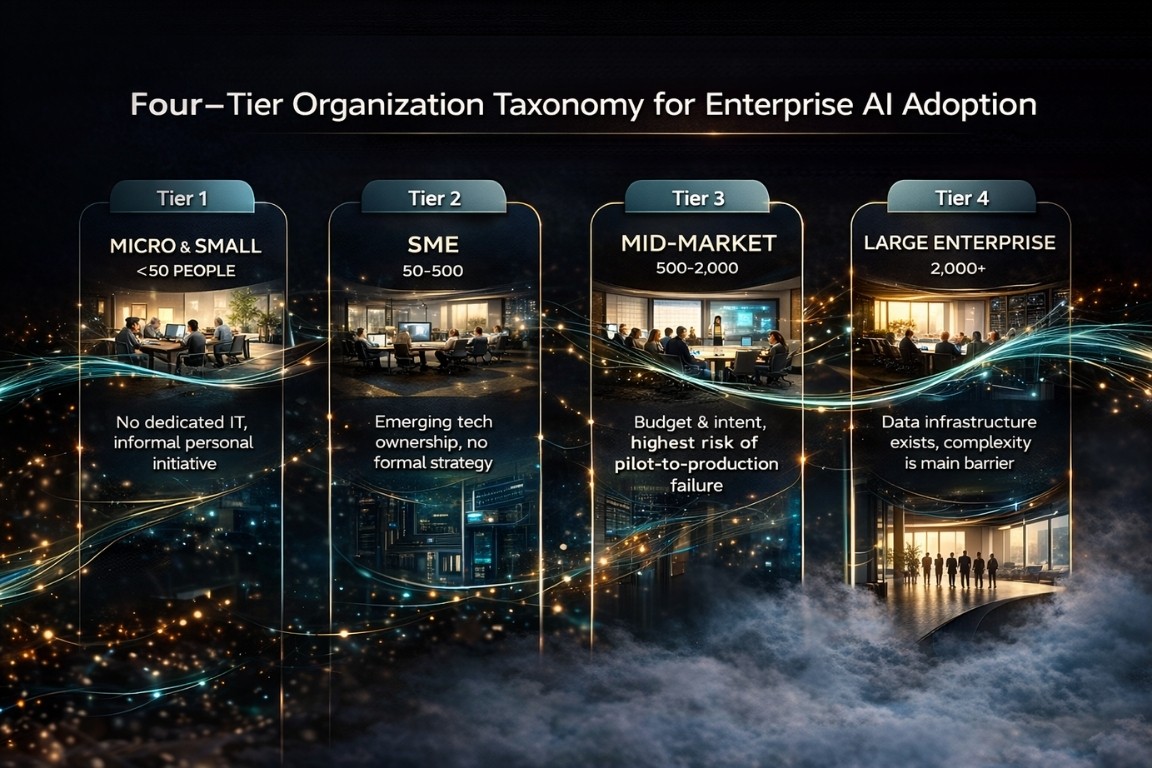
A clear four-tier taxonomy allows any organization to self-identify:
- Tier 1, Micro and Small (under 50 people): No dedicated IT team, tool decisions made by individuals, AI adoption is entirely informal and driven by personal initiative rather than organizational strategy
- Tier 2, SME (50 to 500 people): Emerging tech ownership, no formal AI strategy, some employees using AI independently while leadership remains uncertain about direction
- Tier 3, Mid-market (500 to 2,000 people): Has budget and intent, beginning formal AI deployment, at highest risk of pilot-to-production failure where promising proofs of concept never achieve operational scale
- Tier 4, Large Enterprise (2,000 or more people): Has data infrastructure and governance frameworks, but organizational complexity becomes the primary barrier to implementation
McKinsey, MIT NANDA, and Gartner reports predominantly survey Tier 3 and Tier 4 organizations. Their findings should not be imported directly into Tier 1 and Tier 2 contexts without translation.
The same statistic, 70% failure rate, means something fundamentally different depending on which tier is being measured.
What “AI Solutions” Actually Means
When a company says “we use AI,” this statement can mean four fundamentally different deployments with different cost structures, risk profiles, integration requirements, and timelines to value.
- Type 1, Horizontal AI tools: General-purpose consumer tools such as ChatGPT, Claude, Copilot, and Gemini. Wide adoption but shallow integration, no company data connection by default. These tools create fragmented, invisible usage patterns that organizations cannot govern or optimize
- Type 2, Vertical AI solutions: Industry-specific tools built for legal, medical, logistics, or financial domains. Faster ROI when correctly matched to a real workflow problem, but require careful alignment between vendor capabilities and actual operational needs
- Type 3, Custom AI projects: Systems built or commissioned for a company’s unique operational problem. Highest complexity, highest risk, highest potential return. Requires significant data preparation that most organizations underestimate by a factor of three to five
- Type 4, Agentic AI systems: AI that autonomously executes multi-step workflows without human instruction at each step. Still early-stage for most organizations and not yet accessible at scale for most Tier 1 through Tier 3 organizations
Global generative AI spending reached $37 billion USD in 2025, with the majority flowing to the application layer, meaning end-user products, not infrastructure.
Most organizations are investing in Type 1 horizontal tools while expecting Type 3 or Type 4 outcomes.
What “Success” Means in Enterprise AI

49% of organizations struggle to estimate and prove value from AI projects, more than those citing lack of technical talent or poor data quality. This measurement crisis exists because “success” has three distinct layers, and most organizations celebrate Layer 1 while expecting Layer 3.
- Layer 1, Individual-level success: An employee completes a task faster or with less effort. Highly visible personally, nearly impossible to aggregate into organizational value without structure. A marketing manager writing emails 30% faster says nothing about campaign effectiveness, customer acquisition cost, or revenue impact
- Layer 2, Operational success: A specific workflow shows measurable improvement such as reduced processing time, lower error rate, or documented cost savings in a defined business process. This is the layer where most AI initiatives stop
- Layer 3, Strategic and financial success: AI creates direct bottom-line impact through revenue growth, significant cost reduction, or measurable competitive advantage. McKinsey reports that 56% of businesses have adopted AI in at least one function, but only 23% report significant bottom-line impact
Most organizations invest expecting Layer 3 results while measuring only Layer 1 outcomes. An executive sees individual productivity gains, authorizes broader investment, then is surprised when no one can demonstrate organizational value.
What “Failure” Means in Enterprise AI
This is the most critical definitional section. AI enterprise solutions failure can be notably seen in four distinct failure types occurring at different stages of the deployment lifecycle, requiring different diagnoses and different remedies.
- Failure Type 1, Never Started: The organization knows it needs AI but cannot identify where to begin. Most prevalent in Tier 1 and Tier 2 organizations where informal AI usage exists but no strategic direction has been established
- Failure Type 2, Pilot Purgatory: Pilots show isolated positive results but never graduate to full production. The company cycles through proof-of-concept projects indefinitely. Most prevalent in Tier 2 and Tier 3 organizations
- Failure Type 3, Deployed But Not Adopted: The system is built and deployed but employees avoid it, use it inconsistently, or abandon it after initial exposure. This is a people and process failure, not a technology failure
- Failure Type 4, No Measurable Impact: The system is actively used, but no one can demonstrate that it created business value. The ROI question goes permanently unanswered
The statistics support this typology:
- 70 to 85% of AI initiatives fail to meet initial expectations
- In 2025, 42% of companies abandoned most AI projects, up sharply from 17% in 2024
- Only 26% of organizations successfully move from proof-of-concept to production
- MIT NANDA 2025 documents the progression precisely: 60% of organizations evaluate enterprise AI, 20% reach pilot stage, and only 5% reach production with measurable financial impact
- Gartner 2025 reports that 30% of generative AI projects are abandoned after proof of concept
Micro and SME Organizations: Failure Before the Project Begins
For organizations in Tier 1 and Tier 2, the dominant failure type is not failed projects. It is the absence of projects entirely. The real problem is invisible: employees are already using AI individually, in ways the organization has not authorized, does not see, and cannot capture value from.
By August 2025, small businesses reached 8.8% formal AI adoption, up from 6.3% in 2024, narrowing the gap with large businesses at 10.5%. But formal adoption numbers mask significantly higher informal usage. Workers are screenshotting corporate data to upload to ChatGPT, copy-pasting between personal AI tools and work systems, and maintaining shadow workflows because company systems do not accommodate their tools.
Research indicates that 98% of small businesses now use some form of AI, yet 62% do not clearly understand the benefits.
Think of it this way: employees have already built and furnished a house that leadership does not know exists. The question is not whether to build. It is whether to acknowledge what has already been built and decide what to do with it.
Three barriers are unique to this tier:
- Awareness: Most small businesses do not clearly understand the benefits of AI, which prevents informed strategic decisions about where and how to apply it
- Tool fragmentation: Different employees use different tools without any shared standard, making collective organizational benefit structurally impossible even when individual productivity improves
- Data access: Employees using general-purpose AI tools have no secure connection to company data, meaning results are generic rather than contextually relevant
The solution path for this tier:
- Visibility audit: Before purchasing any tool or building any policy, map how employees currently use AI individually, which tools, which tasks, which departments. You cannot govern what you cannot see
- Identify one high-friction workflow: Select a single, contained business process with clear measurable inputs and outputs where improvement would be directly felt. Do not attempt organization-wide transformation
- Enable rather than replace: Identify which AI tools employees already use effectively and augment those with better data access and clearer guidelines. Work with existing behavior rather than against it
- Establish a minimal AI policy: Define which tools are approved, how company data may be used with AI, and what the output standards are. Clarity enables adoption. Ambiguity creates risk
Mid-Market Organizations: Failure After a Successful Pilot
This tier’s defining failure mode is Failure Type 2: Pilot Purgatory. These organizations have budget, intent, and technical capacity to attempt serious AI deployment. They run pilots that show genuine value. Yet the projects never reach production at scale.
Research indicates that 56% of organizations take 6 to 18 months to move a generative AI project from intake to production. Nearly two-thirds of organizations struggle to transition pilots into full production environments. A Citrix-cited CIO summarized it precisely: “We have seen dozens of demos this year. Maybe one or two are genuinely useful. The rest are science projects.”
Five structural failure causes are specific to this tier:
- The problem inversion error: Organizations decide they need AI because competitors are using it, then search for a problem to attach the solution to. This backward sequence guarantees misalignment. One retail client wanted a predictive analytics engine but went silent when asked what it should predict. The real need was predicting regional shipping delays, not general prediction capability
- Data unreadiness: Most mid-market organizations have data that is siloed across departments, inconsistent in format, and incomplete in coverage. An AI model trained on bad data makes bad decisions. Allocate 30 to 40% of the pilot timeline to data preparation alone
- The integration trap: AI deployed as a separate system, disconnected from the workflows where decisions are made, will be accurate but useless. One quality control AI reached 99% defect detection accuracy but delivered findings via PDF with a five-minute delay. By the time the factory floor manager received it, the faulty batch was already packaged. The technology worked. The architecture failed
- The UX and adoption gap: AI interfaces designed for data scientists rather than daily users will be abandoned by daily users. Investing in interface design is not optional. It determines whether the technology is actually used
- Perfection paralysis: Waiting for 100% accuracy before deployment means never deploying. An 85% accurate AI that automates 50% of a tedious manual task is already a significant operational win
The solution path for this tier:
- Score all candidate AI use cases on two dimensions: business impact and technical feasibility. Only pursue use cases that score strongly on both
- Conduct a data audit before any model development begins. Identify which data is clean, accessible, and complete. This step alone prevents the majority of pilot failures
- Build a cross-functional team that includes a business problem owner, a data engineer, a systems integration developer, and an end-user representative from the affected department
- Set a 60-day measurable result target for the pilot. If results cannot be defined and measured within 60 days, the problem scope is too broad
- Use a phased production rollout. Organizations using phased rollouts report 35% fewer critical implementation issues compared to full simultaneous deployment
Large Enterprise Organizations: Failure at the Architecture Level
Large enterprises have the most resources, the most data, and the most technical capacity, yet they have the lowest rate of moving from AI pilot to production with measurable financial impact. MIT NANDA 2025 documents this precisely: 60% of large organizations evaluate enterprise AI, 20% reach pilot stage, and only 5% achieve production deployment with documented financial results.
The reason is not people or process. At this tier, the root failure is architectural.
The standard enterprise AI architecture follows what analysts describe as the “third-party overlay model”: an external AI platform extracts data from multiple operational systems and centralizes it in a data lake or repository. In practice, this systematically destroys the most valuable property of enterprise data, which is its business context. When data is extracted from an ERP (Enterprise Resource Planning) or CRM (Customer Relationship Management) platform, it loses its business hierarchies, transactional dependencies, and time-dependent logic. Rebuilding this context in a separate layer is extremely expensive and, in most cases, impossible to maintain as underlying systems change.
The answer is not a better data lake. It is a different architecture: zero-copy models and data fabric approaches where AI analyzes information within the systems where it already lives, preserving semantic integrity. Instead of dismantling a house to study its structure, you install sensors that report on each room without disturbing the architecture.
Two additional failure forces are specific to this tier:
- Governance and compliance gaps: Security models, access controls, and compliance rules must exist within the environment where AI operates, not added as an external layer afterward. Research indicates that 64% of enterprises lack the architecture required for reliable AI operations
- Organizational inertia: 87% of large enterprise leaders report internal resistance as a key barrier to AI adoption. Middle managers can passively undermine integration without appearing obstructionist. The Chief AI Officer (CAIO) role, now present in 26% of large organizations, often lacks the cross-functional mandate and budget authority needed to overcome this
While large enterprises wait for the perfect agentic AI architecture, their own employees are already achieving transformation results with $20-per-month ChatGPT subscriptions. The worker-led AI transformation is not a future event. It is happening now, in the shadow of corporate policy.
The four-part solution path for this tier:
- Activate intelligence within existing systems rather than building AI on top of them. This preserves context and reduces integration complexity
- Give employees secure access to company data through their preferred AI tools rather than forcing adoption of an approved tool they will not use
- Implement governance as an enabler: secure the environment where AI operates, not the specific tools. Governance that enables work is adopted. Governance that prevents work is circumvented
- Scale what already works: when an individual worker creates measurable value with AI, make that workflow shareable, documented, and institutionally sanctioned
Identify Where You Are
Before any AI investment decision, an organization should be able to answer four questions clearly. If any answer is unclear, that unclear answer is the starting point, not a technology evaluation:
- Is there a specific person in your organization responsible for AI decisions, with defined authority and accountability?
- Are your employees already using AI tools without company guidance or policy? If yes, how many, doing what?
- Have you completed a formal AI pilot? If yes, did it reach production? If not, at which stage did it stop?
- Can you name one specific business process where AI would solve a problem that you can measure before and after?
Three universal principles apply across all four tiers:
- Every successful AI story begins with a specific, painful business problem, not a decision to adopt AI. The technology is the instrument. The problem is the entry point. Organizations that start with “we need AI” rather than “we need to solve X” have already failed
- In every tier, individual workers are already ahead of their organization’s policy. This is not a governance failure to be corrected. It is a signal to be read. The employees who have figured out how to use AI effectively are your best source of information about what actually works
- The four failure types are not verdicts. They are diagnostic coordinates. Failure Type 1 requires visibility. Failure Type 2 requires integration focus. Failure Type 3 requires adoption design. Failure Type 4 requires measurement frameworks
The divide is not between organizations that have AI and organizations that do not. It is between organizations that have correctly diagnosed their specific failure mode and those still applying someone else’s solution to their own problem.
Enterprise AI solutions do not fail because the technology is inadequate. They fail because the diagnosis was wrong, the architecture was misaligned, and the measurement framework measured the wrong things at the wrong level.
Read more:
– Mobile App Development Costs in 2026: What You Are Actually Paying For
– The Website Development Process in the Age of AI: Can ChatGPT Build Your Website?
– How to Train an AI Model: What Actually Happens Behind the Algorithms