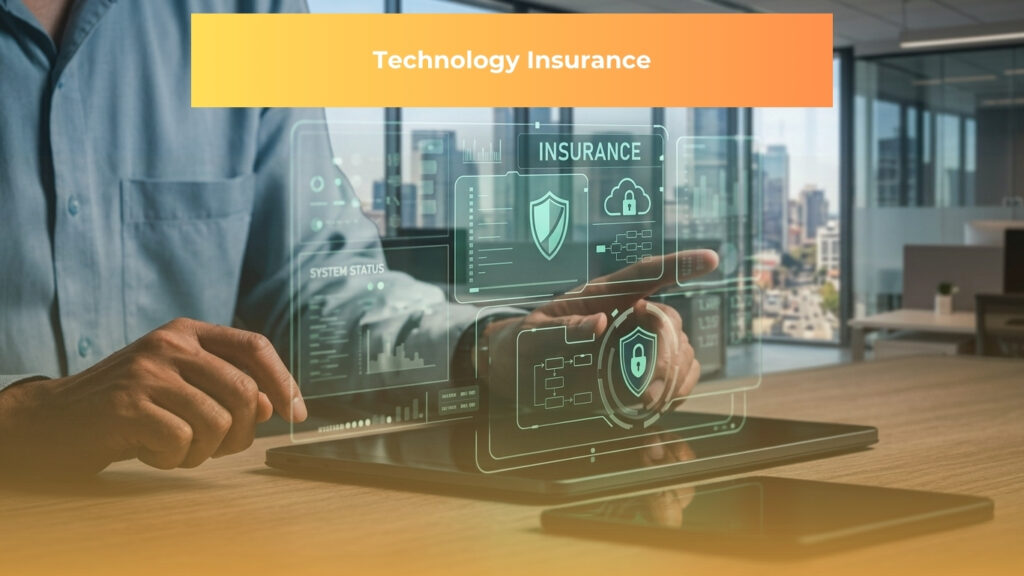
Technology insurance is the category of business insurance designed to protect organizations from financial losses caused by technology-related risks. Whether you operate a software firm, manage IT infrastructure for a healthcare provider, or run an e-commerce platform, understanding this coverage is a practical business requirement.
What Is Technology Insurance
Technology insurance is a specialized category of business insurance designed to protect organizations from financial losses caused by technology-related risks. These risks include equipment failure, software errors, data loss, IT service disruptions, system integration errors, and hardware failures that affect day-to-day business operations.

Technology insurance is not a single policy. It is a bundle of coverages tailored to the specific technology systems a business relies on. A logistics company managing warehouse automation systems will have different coverage needs than a software developer providing client-facing applications. Both fall under the umbrella of technology insurance, but the composition of their policies will differ substantially.
Standard commercial insurance does not fill this gap. General business policies are built around physical property and general liability. They do not cover software failures, digital service disruptions, or technology professional liability. A business that assumes its general commercial policy covers a software outage or data corruption event will find itself unprotected when a claim arises.
Technology insurance addresses the specific exposures that technology companies and IT-dependent organizations face, exposures that fall entirely outside conventional business coverage. Any organization that builds, sells, manages, or depends on technology systems needs to evaluate technology insurance as a distinct line of coverage.
What Technology Insurance Covers
Technology insurance covers several distinct risk categories. Each coverage type addresses a different class of loss, and understanding each one separately is necessary before assessing which combination your business requires.
Technology Errors and Omissions (E&O) is the most common and foundational coverage type for technology businesses. E&O, which stands for Errors and Omissions, protects against claims that a technology product or service failed to perform as agreed, caused system downtime, or resulted in financial loss for a client.

For example, if a software provider delivers a system integration that causes a client’s order management platform to fail, the client may pursue legal action for lost revenue. Technology E&O covers defense costs and resulting damages in that scenario. Progressive Commercial confirms that technology E&O is the starting point for any technology business evaluating its coverage needs.
Cyber Liability Insurance covers losses arising from cyberattacks and data breaches. This includes:
- Legal fees and regulatory fines
- Customer notification costs
- Data restoration expenses
Cyber liability and technology E&O are related but distinct. E&O covers professional failures, meaning situations where your product or service did not perform as promised. Cyber liability covers external threats, meaning unauthorized access, ransomware attacks, or data theft by third parties. A business can experience both types of loss in a single incident, which is why many insurers offer them as a coordinated package.
Business Interruption Insurance compensates for lost income during periods when a covered event forces the business to pause or limit operations. If a server failure or covered cyberattack forces a company to suspend services for several days, this coverage replaces the revenue that would have been earned during that period.
Network Security and Data Privacy Liability covers third-party claims that arise from a security failure in the insured’s network. If a flaw in your network security leads to the exposure of a client’s customer data, that client may bring a claim against your organization. This coverage addresses that specific liability.
Directors and Officers (D&O) Insurance covers defense costs and damages from lawsuits brought against a company’s board members or senior officers, including those triggered by cyber-related incidents. D&O stands for Directors and Officers. Investors and partners in the technology sector frequently require this coverage before entering agreements, because a major technology failure or data breach can directly affect shareholder value and trigger fiduciary claims.
Property and Equipment Coverage covers physical hardware, servers, and office equipment against theft, fire, and accidental damage. This coverage applies to any organization that owns or leases physical technology assets, including on-premise servers, networking hardware, and workstations.
Many insurers bundle several of these coverages through a Business Owners Policy, commonly abbreviated as BOP. A BOP combines general liability and commercial property protection into a single policy. Technology-focused insurers often extend it to include E&O and cyber liability, giving small to mid-size technology businesses a coordinated baseline of protection. Stanton Insurance notes that a well-structured technology BOP eliminates the coverage gaps that arise when businesses piece together unrelated policies from separate providers.
Which Technology Insurance Does Your Business Actually Need
Selecting the right technology insurance requires a structured assessment of your organization’s specific risk profile. The following steps guide that process from asset inventory through to policy review.
Step 1: Identify your technology assets
Begin by listing the servers, software systems, network equipment, and client-facing digital services your organization depends on. This inventory is the foundation for every coverage decision that follows. Assets that are not declared cannot be covered.
Step 2: Assess your risk level
Consider the volume of sensitive data you handle, the number of clients depending on your systems, and the regulatory environment your industry operates in. Companies handling medical records or financial data carry higher risk profiles and require broader coverage. The insurance.org business insurance resource confirms that industry type and data sensitivity are among the primary factors insurers use to assess technology risk.
Step 3: Match coverage to risk
A software developer serving a small number of clients may need technology E&O and a basic BOP. A healthcare IT provider managing patient records needs technology E&O, cyber liability, and D&O coverage at minimum. Embroker’s analysis of technology company insurance requirements indicates that underinsurance is a more common problem than overinsurance in the technology sector, particularly among early-stage companies.
Step 4: Read exclusion clauses
Technology insurance does not cover all risks. Exclusions commonly include:
- Acts of war
- Intentional misconduct
- Pre-existing system vulnerabilities
Not understanding exclusions is one of the most common and costly mistakes businesses make.
A policy that appears comprehensive may contain an exclusion that voids coverage in the precise scenario your business is most likely to face.
Review exclusion language carefully and consult a licensed broker if any clause is unclear.
Step 5: Combine insurance with a Disaster Recovery Plan
A Disaster Recovery Plan, abbreviated as DRP, is a documented strategy that outlines how a business will restore critical systems after an incident. Many insurers require a DRP before issuing a technology insurance policy. Technology insurance and a DRP are complementary, not interchangeable. Insurance covers financial loss; a DRP covers operational recovery.
According to PJT Agency, businesses that pair robust coverage with a tested DRP recover from technology incidents significantly faster and with lower total cost than those relying on insurance alone. Coverage limits should be reviewed and updated whenever significant IT assets are acquired or upgraded.
How Blockchain Technology Is Transforming Insurance
Blockchain technology is reshaping how insurers detect fraud, process claims, and share data across complex multi-party networks.
Blockchain is a Distributed Ledger Technology, abbreviated as DLT. It is a digital record system that is not stored in one central location but is replicated across a network of computers called nodes. Every record added to this ledger is permanent and cannot be altered without detection. This property is called immutability. Unlike a traditional database that a single administrator can edit or delete, a blockchain record is fixed once written and visible to all authorized participants simultaneously.

The insurance industry has historically suffered from three structural problems:
- Slow claims processing
- High rates of fraud
- Inefficient data sharing between insurers, reinsurers, brokers, and regulators
Blockchain addresses each of these problems directly.
Fraud prevention is one of the most immediate applications. Because records on a blockchain cannot be modified retroactively, false claims and duplicate submissions are detectable in real time. Industry estimates cited by Codewave indicate that blockchain-enabled fraud detection systems could reduce fraudulent claims by up to 75%. Fraudulent claims typically rely on the inability of different parties to cross-reference records quickly. A shared, immutable ledger removes that gap entirely.
Smart contracts accelerate claims processing significantly. A smart contract is a self-executing agreement coded onto a blockchain. When a predefined condition is met, the contract executes automatically without human intervention. In parametric insurance, for example, a crop insurance policy can be programmed to pay out automatically when rainfall data falls below a certain threshold, reducing claim processing time from weeks to hours. ScienceSoft’s insurance blockchain analysis confirms that parametric smart contracts are among the most mature and widely deployed applications of blockchain in the insurance sector.
Data transparency benefits reinsurance operations directly. Reinsurance involves insurers transferring portions of their risk portfolios to other insurers. Blockchain gives all authorized parties a shared, real-time view of premiums, claims, and exposure data, eliminating the need for manual reconciliation across complex reinsurance arrangements.
The market data reflects accelerating adoption:
- The global blockchain in insurance market was valued at approximately USD 1.86 billion in 2024
- It is projected to grow to USD 59.90 billion by 2032
- This represents a compound annual growth rate (CAGR) of 53.7%, according to Fortune Business Insights
- As of 2025, 58% of insurers plan to increase their blockchain investment
The Bank Underground analysis of blockchain integration in insurance further notes that regulatory frameworks for blockchain-based insurance products are maturing across major markets, reducing one of the primary barriers to adoption.
How to Choose a Technology Insurance Company
Choosing the right technology insurance company is a structured decision, not a price comparison. The insurer’s expertise, coverage architecture, claims capability, and financial stability all directly affect whether your policy will perform when you need it.
First, verify that the insurer specializes in technology sector coverage. General business insurers may not understand the specific risk profile of software companies, IT consultants, or data infrastructure providers. A generalist insurer may offer a policy that appears adequate but contains exclusions or definitions that do not align with how technology businesses actually operate. Stanton Insurance notes that technology-specialized insurers are better equipped to underwrite nuanced risks such as cloud dependency failures or third-party API errors.
Second, confirm that the provider offers all the coverage types your business needs, either under one policy or as a coordinated bundle. Switching between multiple insurers for different coverages creates gaps in protection and complicates the claims process when multiple coverage types are triggered by a single incident.
Third, review the insurer’s claims team capabilities. Technology claims, particularly E&O and data breach claims, are complex and often involve forensic investigation, legal coordination, and regulatory reporting. Look for providers with dedicated claims specialists in technology liability rather than generalist adjusters unfamiliar with the technical dimensions of a software failure or network breach.
Fourth, confirm the provider’s financial stability rating from recognized rating agencies such as AM Best, Standard and Poor’s, or Moody’s. A low-cost policy from a financially weak provider offers no real protection.
Fifth, understand the contractual requirements your clients and partners place on you. Many enterprise clients, government agencies, and investors specify minimum coverage types and limits in their contracts with technology vendors. Both Liberty Mutual’s technology insurance guidance and Founder Shield’s analysis of technology insurance trends confirm that contractual insurance requirements have become more stringent as technology procurement has grown more sophisticated.
Confirm your policy meets these requirements before signing any client agreement, because a coverage gap discovered after contract execution can expose your organization to immediate breach of contract liability.
Frequently Asked Questions
1. Is technology insurance different from cyber insurance?
Yes. Technology insurance is the broader category and covers equipment failures, software errors, and professional liability arising from technology products or services. Cyber insurance is a specific coverage type within that category, focused on losses from external cyberattacks and data breaches.
2. Can a business carry both technology E&O and cyber liability insurance?
Yes, and this combination is strongly recommended for any organization operating critical IT systems or handling sensitive client data. Many insurers offer both as a coordinated package, which ensures that a single incident triggering both types of loss is handled under a unified claims process.
3. Do insurers require a Disaster Recovery Plan before issuing a technology insurance policy?
Many do. A Disaster Recovery Plan demonstrates that the business has documented procedures for restoring systems after an incident. Insurers view businesses with a DRP as lower risk, and some will not issue a policy or will exclude certain claims without one in place.
4. Does technology insurance cover all IT equipment?
Coverage depends on the specific terms of the policy. Not all equipment or software is automatically included. Each policy must be reviewed for its inclusions, exclusions, and asset definitions, and declared assets should be updated whenever the organization acquires or retires significant hardware or software.
5. How is the coverage limit determined?
Coverage limits are calculated based on:
- The declared value of insured technology assets
- The risk level of the business’s operations
- Contractual obligations with clients
- The organization’s claims history
Businesses in high-risk sectors such as healthcare IT or financial technology typically carry higher limits to meet both regulatory requirements and client contract terms.
6. Who needs technology insurance?
Any business that provides technology products, IT services, software, managed services, data storage, or digital infrastructure should carry technology insurance. This includes startups, mid-size IT firms, and enterprise technology departments that manage systems on which other parts of the business depend.
Read more:
– Top Object-Oriented (OOP) Programming Languages to Learn
– Outsourced IT Services: Which Solutions Does Your Business Actually Need?
– AI Enterprise Solutions Failure: Why Organizations Invest More and Get Less