What Is a Retail Mobile Application?
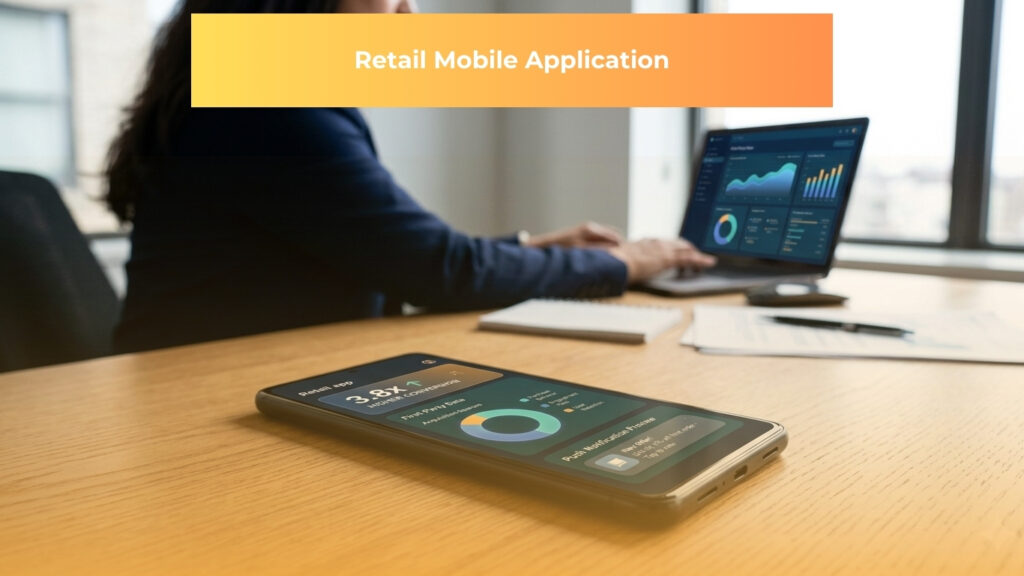
A retail mobile application is a dedicated software program designed specifically for smartphones and tablets that allows customers to browse products, make purchases, access loyalty programs, and interact with a retail brand directly from their mobile device. Unlike mobile websites that require a browser to access, retail mobile applications are downloaded and installed on the customer’s device, creating a persistent presence that enables richer functionality and more personalized experiences.
Retail App vs. Mobile Website
A mobile website is essentially a responsive version of your desktop website that adapts its layout to smaller screens, accessible through any web browser without requiring installation.
Retail mobile applications, by contrast, live on the customer’s device as a dedicated icon on their home screen, creating a psychological presence that reinforces brand loyalty with every glance at their phone.
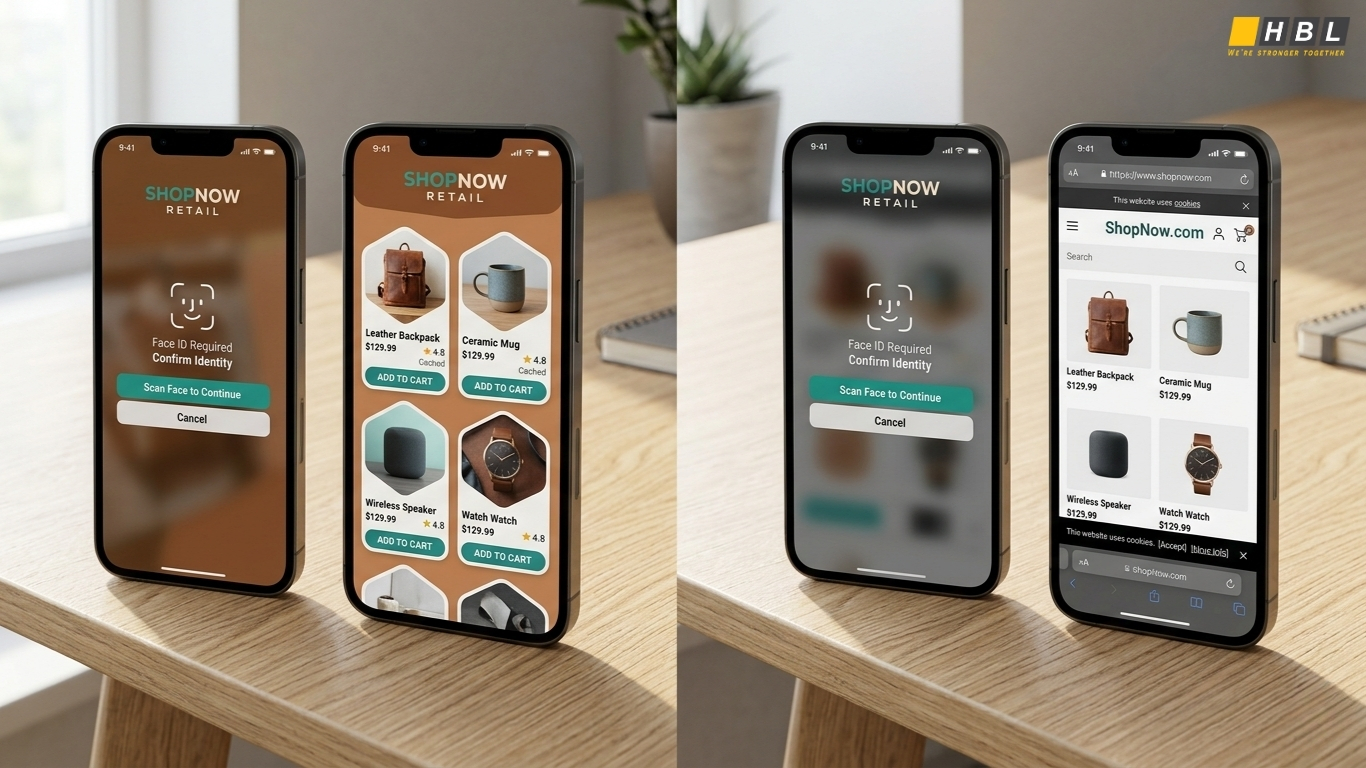
From a functionality standpoint, retail mobile applications can access device capabilities that mobile websites simply cannot:
- Biometric authentication for frictionless checkout
- Camera integration for augmented reality try-on features
- Offline browsing of cached content
- Precise geolocation for location-based marketing
Perhaps most importantly, retail mobile applications generate rich first-party data about customer behavior, preferences, and engagement patterns that feeds directly into your marketing and merchandising strategies, while mobile website data is increasingly limited by privacy regulations and browser restrictions on third-party tracking.
Retail Apps vs. Marketplace Platforms
Marketplace platforms such as Amazon, Shopee, Lazada, and eBay offer retailers immediate access to massive audiences and established infrastructure for payments, logistics, and customer service. For many retailers, especially smaller businesses or those just entering e-commerce, marketplace platforms provide an attractive shortcut to digital sales without the upfront investment of a dedicated application.
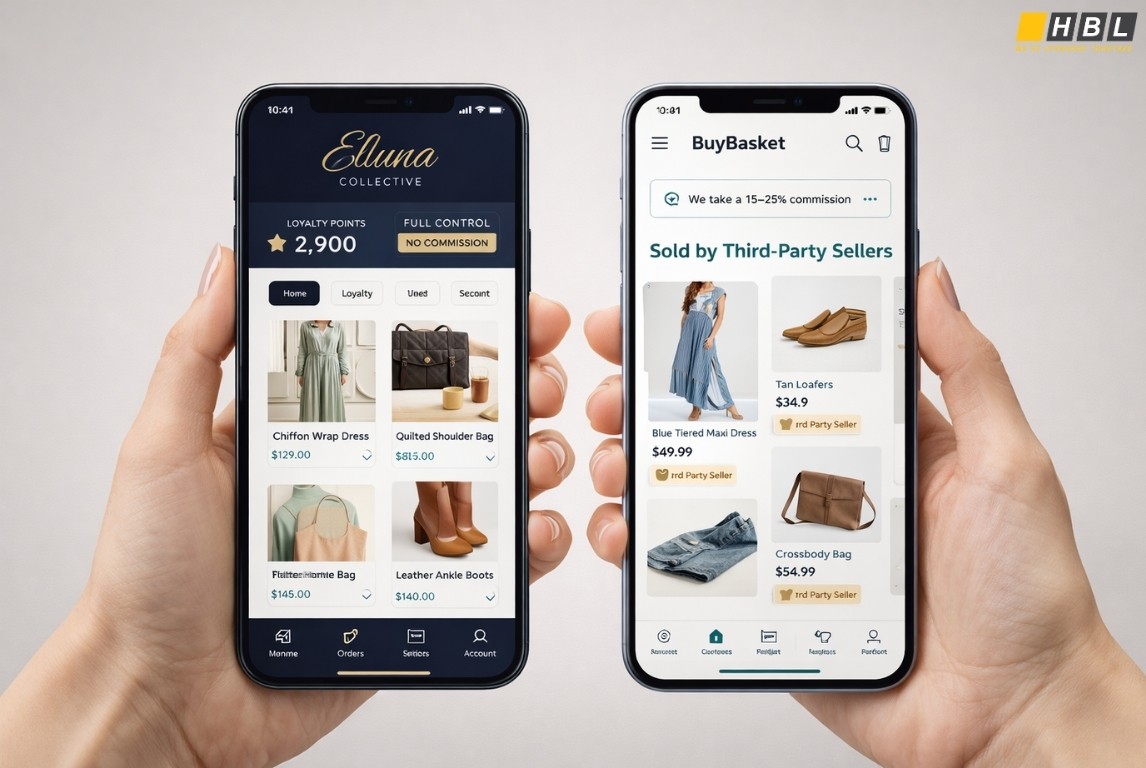
However, selling through marketplace platforms comes with significant tradeoffs:
- Commission fees typically range from 8% to 15% or more, permanently eroding margins
- The marketplace owns the customer relationship and controls all data
- Brand differentiation is difficult in a price-driven environment
- Algorithm or policy changes can impact visibility and sales overnight
Retail mobile applications invert this relationship entirely, giving retailers complete control over branding, customer data, and the shopping experience while eliminating commission fees on direct sales.
Where Retail Apps Fit in the M-Commerce Landscape
Mobile commerce, often abbreviated as m-commerce, represents the subset of e-commerce transactions conducted through mobile devices. Within this landscape, retail mobile applications occupy a premium position at the top of the conversion funnel. Mobile apps drive significantly higher conversion rates than mobile websites, often 3 to 4 times higher, because they reduce friction at every stage of the purchase journey.
M-commerce now accounts for the majority of global e-commerce traffic, with mobile devices driving over 60% of online sales. Retailers who have invested in retail mobile applications are positioned to capture this shift and build lasting relationships with mobile-first consumers, while those relying solely on mobile websites or marketplace platforms risk becoming intermediaries in their own industry.
The M-Commerce Opportunity
The urgency around retail mobile applications stems from a convergence of market forces reshaping the competitive landscape for retailers of all sizes. Mobile commerce has moved from a secondary channel to the primary battleground for customer attention and wallet share.
Simultaneously, the digital marketing ecosystem is undergoing a fundamental transformation. Third-party cookies, which have powered digital advertising and retargeting for over two decades, are being deprecated across major browsers. Apple’s privacy changes have already made cross-app tracking significantly more difficult, and Google’s Chrome browser is following suit.
First-party data — information collected directly from customers through owned channels — is becoming the most valuable marketing asset a retailer can possess. According to a collaborative study by Google and Boston Consulting Group, key marketing activities leveraging first-party data resulted in:
- A 2.9x increase in revenue
- A 1.5x decrease in costs
compared to those that do not leverage such data. Retail mobile applications are uniquely positioned to collect this first-party data through direct customer interactions, purchase histories, browsing behaviors, and engagement patterns.
Types of Retail Mobile Applications
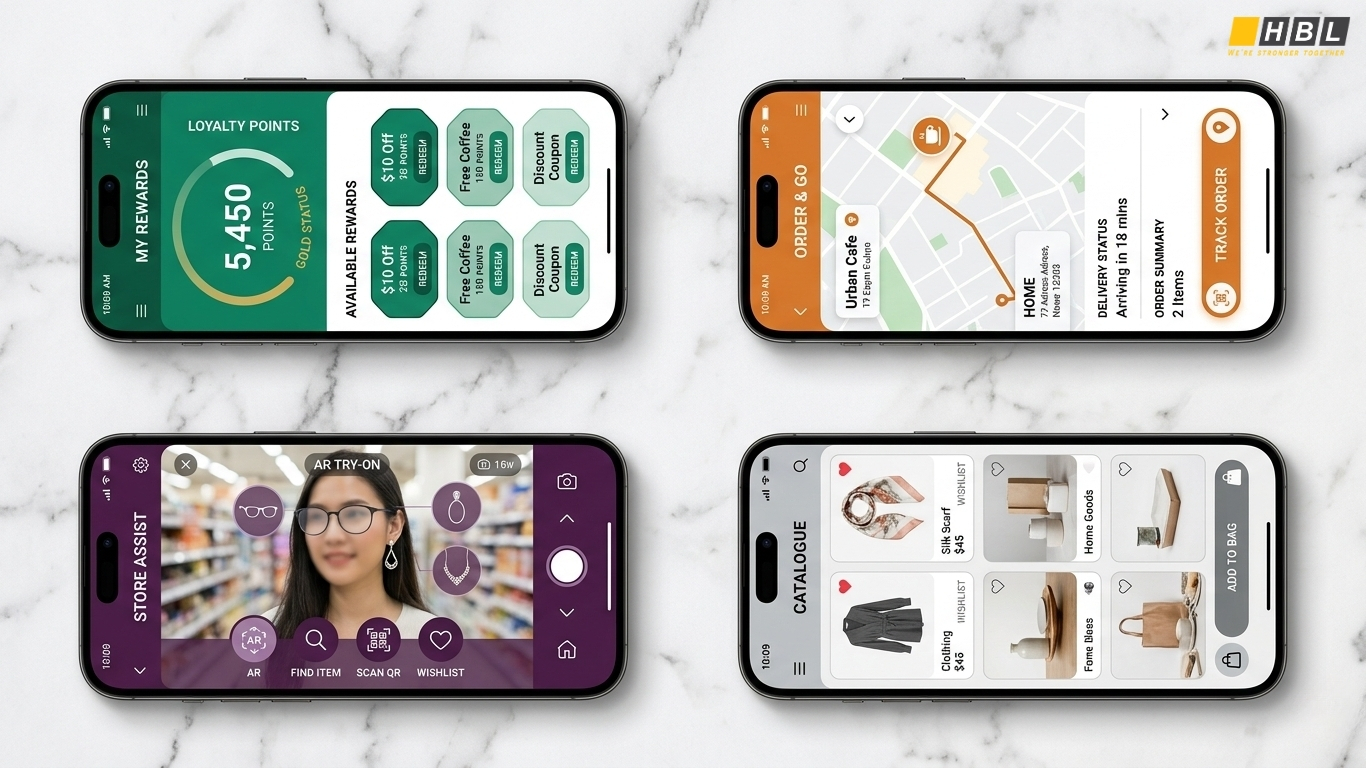
Retail mobile applications are not monolithic. They vary significantly in scope, functionality, and strategic purpose. The appropriate choice depends on purchase frequency, average order value, customer demographics, and competitive positioning.
Full-Featured Retail Apps (Super App Model)
Full-featured retail applications represent the most comprehensive approach to mobile engagement, combining product browsing, purchasing, loyalty programs, customer service, store locators, inventory checking, and personalized recommendations in a single platform. Major retailers like Walmart, Target, and Amazon have embraced this model, creating super apps that serve as comprehensive shopping companions rather than simple transaction tools.
The super app model works best for large retailers with diverse product assortments, significant customer bases, and the resources to maintain sophisticated mobile platforms. The investment required is substantial, but the potential returns in customer loyalty and data collection are correspondingly large.
Loyalty and Rewards-Only Apps
Loyalty-focused retail mobile applications concentrate on one specific function: rewarding repeat customers and building long-term relationships. These apps typically feature points tracking, rewards redemption, exclusive offers, and member benefits, but may not include full e-commerce functionality. The Starbucks mobile app exemplifies this model, having evolved from a simple loyalty card replacement into one of the most successful retail apps in existence.
This model suits retailers with high purchase frequency and strong customer affinity, including coffee shops, quick-service restaurants, convenience stores, and specialty retailers. Development costs are lower than full-featured apps, making this an attractive entry point for retailers testing the mobile app waters.
Order-Ahead and Delivery Apps
Order-ahead and delivery-focused retail mobile applications solve a specific pain point: the time and friction involved in traditional shopping experiences. These apps allow customers to browse products, place orders, and schedule pickup or delivery without entering a physical store or waiting in line.
Food and beverage retailers were early adopters of this model, but it has expanded to grocery stores, pharmacies, and specialty retailers. The COVID-19 pandemic dramatically accelerated adoption of order-ahead behaviors across all demographics, normalizing what was previously considered a niche convenience.
Booking and Appointment Apps
Service-oriented retailers require mobile applications tailored to scheduling and appointment management rather than product transactions. Booking apps allow customers to view availability, schedule services, receive reminders, manage appointments, and prepay or add deposits. Salons, spas, fitness studios, automotive service centers, and healthcare providers increasingly rely on these applications to streamline scheduling and reduce no-shows.
Automated reminders significantly decrease no-show rates, protecting revenue that would otherwise be lost. For service retailers, the mobile app becomes an essential operational tool rather than merely a marketing channel.
In-Store Companion Apps
In-store companion retail mobile applications enhance the physical shopping experience rather than replacing it. These apps bridge digital and physical retail through:
- Scan-and-go checkout that allows customers to scan items as they shop and pay without traditional checkout lines
- Augmented reality features that let customers visualize products in their homes or on their bodies before purchasing
- Detailed product information accessed by scanning barcodes in the aisle
Home improvement stores, furniture retailers, beauty retailers, and fashion brands have found particular success with augmented reality try-on features.
Catalog and Wishlist Apps
Catalog and wishlist retail mobile applications focus on product discovery and aspiration rather than immediate transaction. While they include purchasing capability, the emphasis is on longer shopping journeys, particularly for higher-consideration purchases that customers research over time.
This model fits retailers selling high-value or emotionally significant products including jewelry, luxury fashion, home furnishings, and specialty electronics. Wishlist data provides invaluable insight into customer intent and price sensitivity, allowing retailers to craft targeted promotions that convert interest into purchase without eroding margins unnecessarily.
Which Retailers Actually Need a Mobile App?
Not every retailer should build a dedicated mobile application. Building and maintaining a quality retail mobile application requires significant investment, ongoing commitment, and a clear strategy for driving downloads and engagement.
When Building Your Own App Makes Business Sense
Several conditions signal that investing in a retail mobile application makes strategic sense.
First, customer interaction frequency matters enormously. Retailers whose customers shop weekly or more frequently benefit most from dedicated apps because the convenience value justifies the installation friction. Daily or near-daily interactions create habit formation that makes the app icon on the home screen a natural part of customer routines.
Second, data ownership considerations are increasingly critical. Retailers who rely heavily on personalized marketing, targeted promotions, or customer segmentation need first-party data sources that are becoming essential as third-party tracking capabilities diminish.
Third, business model type influences app value. Direct-to-consumer brands, subscription services, and retailers with strong loyalty programs derive more value from owned mobile channels than intermediaries or commodity sellers competing primarily on price.
High-Frequency vs. Low-Frequency Retail
Purchase frequency is perhaps the single most important factor in evaluating whether a retail mobile application makes sense. High-frequency retail categories, including groceries, coffee and quick-service food, convenience items, and everyday essentials, naturally lend themselves to mobile app engagement. The app becomes a tool customers use regularly, making push notifications and personalized offers highly relevant.
Low-frequency retail categories, including furniture, luxury goods, specialty appliances, and seasonal items, present different challenges. Customers may only shop these categories a few times per year, making installation motivation difficult. However, low-frequency retailers can still benefit from mobile applications by focusing on specific use cases: catalog browsing and wishlist functionality, augmented reality features, or service and support features that extend the customer relationship.
Industry-by-Industry Breakdown
Food and beverage retailers represent some of the strongest candidates for retail mobile applications. High purchase frequency, time sensitivity, and the convenience value of mobile ordering create compelling customer motivations. Starbucks reports that mobile orders represent a significant and growing portion of total transactions.
Fashion and apparel retailers occupy a middle ground where purchase frequency varies widely by customer segment. Fast fashion retailers with frequent new arrivals can build strong app engagement through early access to new collections and personalized recommendations. Luxury and occasion-wear retailers may find more value in catalog and wishlist functionality.
Beauty and pharmacy retailers have found particular success with loyalty-focused applications. Sephora’s Beauty Insider program has become a model for how specialty retailers can build customer relationships through personalized recommendations, birthday rewards, and exclusive early access to new products. Pharmacy retailers benefit from prescription management features that provide ongoing utility beyond retail transactions.
Electronics retailers face similar dynamics: replacement purchases are infrequent, but enthusiasts who follow new product releases may engage regularly through content and community features.
When a Third-Party Platform or Mini App Is the Better Choice
For many retailers, especially smaller businesses and those in earlier stages of development, alternatives to dedicated retail mobile applications may provide better return on investment.
Mini apps and mini programs embedded within super apps like WeChat, Zalo, or Grab represent an increasingly attractive middle ground. These lightweight applications live inside larger platforms that customers already have installed, eliminating download friction while providing many benefits of dedicated apps. Mini apps work particularly well for retailers in markets where super apps dominate digital life, or for businesses testing mobile functionality before committing to full app development.
What Benefits Can Mobile Applications Offer to Retailers?
Understanding these benefits in specific, quantified terms helps retailers build business cases for app investment and set appropriate expectations for return on investment.
Direct Sales Channel With Higher Conversion Rates
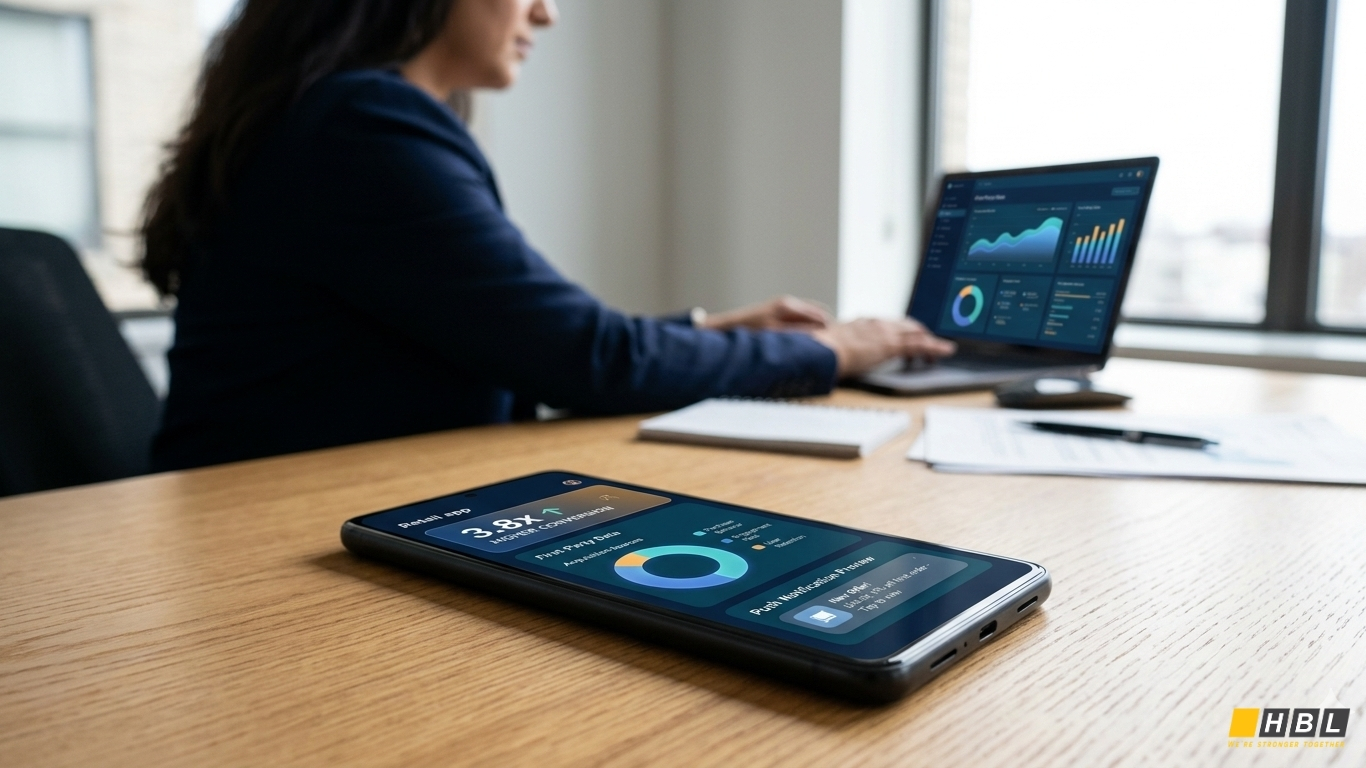
The most immediate and measurable benefit of retail mobile applications is their superior conversion performance. Mobile apps consistently achieve conversion rates 3 to 4 times higher than mobile websites for the same retailers. This dramatic difference stems from several factors:
- App users have already demonstrated brand commitment by downloading
- Stored payment information enables one-click checkout
- The interface is optimized specifically for the mobile context
Research from JMango360 indicates that mobile apps drive 7 times higher revenue per user compared to mobile websites, reflecting not just higher conversion rates but also larger basket sizes, more frequent purchases, and better response to promotional offers.
First-Party Customer Data and Behavioral Insights
In an era of increasing privacy regulations and third-party cookie deprecation, first-party data has become one of the most valuable assets a retailer can possess. Retail mobile applications serve as rich sources of this data, capturing detailed information about customer browsing patterns, purchase histories, feature usage, and engagement timing.
According to the Commerce Media Brand Summit analysis, leveraging first-party data in key marketing activities resulted in a 2.9x increase in revenue and a 1.5x decrease in costs compared to approaches that do not utilize such data.
Push Notifications as a Low-Cost Marketing Channel
Push notifications represent one of the most cost-effective marketing channels available to retailers. Unlike email, which risks being filtered to spam or promotions folders, push notifications appear directly on the device screen, capturing immediate attention at a fraction of a cent per send.
The key to push notification success lies in relevance and restraint. Retailers must provide genuine value through their notifications:
- Personalized offers based on browsing or purchase history
- Timely alerts about price drops on wishlisted items
- Order status updates
- Exclusive app-only promotions
Loyalty Programs That Drive Repeat Purchase
Retail mobile applications provide the ideal platform for loyalty programs that genuinely influence customer behavior. Digital loyalty programs eliminate the friction of physical cards, enable instant point updates and reward visibility, and allow sophisticated tier structures that would be impossible with analog systems.
According to data from Nudge and other loyalty platform providers, well-designed loyalty programs can increase repeat purchase rates by 20% to 40% among participating customers. Mobile apps amplify these effects by making loyalty participation seamless: points update in real-time, rewards are easily redeemed through the same interface, and progress toward goals is constantly visible.
In-App Advertising and Personalized Offers
In-app offers can be tailored to individual preferences, purchase histories, browsing behaviors, and even current location. This precision reduces promotional waste while improving customer experience by presenting relevant offers rather than generic noise.
For large retailers, in-app advertising also represents a potential revenue stream through featured placement of products or partner promotions. Retail media networks have emerged as significant profit centers for major retailers, with eMarketer reporting substantial year-over-year growth in US retail media ad spending.
Reduced Dependency on Third-Party Marketplaces
Retailers who have built significant marketplace presence often find themselves trapped by the economics and policies of platforms they do not control. Commission fees permanently erode margins, competitive visibility requires ongoing advertising spend, and policy changes can suddenly impact sales and operations.
Building a strong retail mobile application creates an alternative channel that escapes these constraints: sales through your own app incur no commission fees, customer data belongs entirely to you, and promotional strategies are entirely within your control. The goal is not necessarily to abandon marketplaces, which provide valuable customer acquisition, but to build a balanced channel strategy where owned mobile channels grow to represent a meaningful portion of sales and customer relationships.
What Drives Customers to Download and Keep Using Retail Apps?
Understanding customer motivation is essential for retailers who want their mobile applications to succeed beyond initial download numbers. Many retailers successfully generate app downloads through welcome vouchers or promotional campaigns, only to see engagement plummet after the initial incentive is redeemed.
The Four Core Customer Incentives
Research into mobile app adoption and engagement reveals four primary incentive categories that motivate customers to download and continue using retail applications.
- Convenience incentives center on time savings and friction reduction: mobile ordering, saved payment methods, easy reordering of previous purchases, and streamlined checkout appeal to customers seeking efficiency in their busy lives.
- Economic incentives include discounts, loyalty rewards, app-exclusive prices, and cashback offers that provide direct financial benefit for app usage. Retailers must be careful not to train customers to only purchase when promotions are available.
- Exclusivity incentives involve early access to new products, members-only items, limited edition releases, and VIP experiences that make app users feel special and privileged. This appeals to customers who value status and being ahead of trends.
- Experience incentives encompass features that make shopping more enjoyable or interesting, such as augmented reality try-on, interactive content, personalized recommendations, and community features.
Industry-Specific Incentive Patterns
Food and beverage retailers, including grocery stores and quick-service restaurants, find that convenience incentives drive the strongest engagement. Mobile ordering, curbside pickup, and easy reordering of regular purchases address the time-pressed nature of daily food shopping.
Fashion and beauty retailers often find success with exclusivity and experience incentives. Early access to new collections, app-only colorways, and personalized styling recommendations create differentiated experiences that make the app valuable beyond simple transactions.
Electronics retailers typically find that experience incentives around product information, comparison tools, and augmented reality features create the strongest engagement.
The Retention Problem
Many retailers face a retention gap between initial download and ongoing engagement. The common pattern plays out predictably: a welcome voucher drives downloads, customers redeem the offer, and then engagement drops sharply as the incentive disappears.
Solving the retention problem requires designing app experiences that provide continuing value beyond initial incentives. The most successful retail apps integrate deeply into customer routines, becoming tools users reach for naturally. Progressive engagement features that unlock additional benefits over time create ongoing reasons for continued use. Most importantly, the app experience must genuinely improve on alternatives: if mobile web or in-store shopping offers comparable convenience without the app, customers will naturally gravitate toward the easier option.
How to Research Your Own Customers’ Incentives
Rather than assuming what features will drive engagement, retailers should conduct direct research with their specific customer base. A practical approach involves three complementary methods:
- Analyze existing customer behavior: look at purchase frequency, channel preferences, and response to promotions to identify patterns that suggest which incentive types might resonate most
- Conduct direct customer research through surveys, interviews, or focus groups asking what would motivate them to download and regularly use a retail app
- Test hypotheses through minimum viable features before committing to full app development, using mobile website implementations to gauge actual customer response
Real-World Examples of Retail Mobile Apps Done Right
Starbucks: Gamification and Loyalty as the Core Product
Starbucks has built one of the most successful retail mobile applications in existence by making the app central to the customer experience rather than an optional add-on. Stars accumulate with each purchase, progress bars visualize advancement toward rewards, and tiered status levels create aspiration and exclusivity. Mobile orders now represent a substantial portion of total transactions, reducing in-store congestion while increasing average order values.
The key lesson from Starbucks is the power of deep integration between app functionality and core business operations. Rather than treating the app as a separate marketing channel, Starbucks designed the app to enhance and extend the core experience of buying coffee, creating a virtuous cycle of engagement that competitors struggle to match.
Walmart: From Coupon Clipper to Full Commerce Platform
Walmart’s mobile application evolution illustrates how a retailer can transform an app from a simple promotional tool into a comprehensive shopping platform. Initially positioned primarily around savings and store navigation, the Walmart app has expanded to encompass full e-commerce functionality, grocery ordering with pickup and delivery, pharmacy services, and even financial services.
Customers can research products at home, check in-store availability, navigate efficiently within stores, and complete purchases through multiple channels, all through a single app experience. The lesson is that for large retailers, app ambition should match business scope: partial functionality creates frustration, while comprehensive tools become indispensable.
Foot Locker FLX: Redesigning Loyalty Around Real Value
Foot Locker’s FLX program demonstrates how specialty retailers can differentiate through loyalty innovation. Rather than the generic points-percentage model that dominates retail loyalty programs, FLX built a program around sneaker enthusiast culture with early access to limited releases, exclusive colorways, and community features that resonate deeply with their customer base.
The lesson for specialty retailers is clear: design app and loyalty features around specific customer passions rather than assuming generic retail approaches will transfer effectively. Generic loyalty programs may drive some incremental behavior, but programs built around authentic understanding of what customers genuinely value create much stronger and more durable engagement.
Tesco Clubcard: From Physical Card to Fully Digital App
Tesco’s transformation of its Clubcard loyalty program from physical cards to a comprehensive mobile application showcases how established retailers can digitize existing customer relationships to drive engagement and data collection. Customers who previously carried physical cards now engage with Tesco through their phones multiple times per shopping trip, creating vastly more touchpoints for communication and data collection.
The lesson for established retailers is to leverage existing loyalty investments as the foundation for mobile app strategy. The transition from physical to digital loyalty enables sophisticated features that were impossible with analog systems: instant offer redemption, personalized recommendations based on complete purchase history, and push notifications that drive store visits during typically quiet periods.
Retail Mobile Application Development
The path from deciding to build a retail mobile application to launching a successful product involves multiple decisions and tradeoffs. Understanding the development landscape helps retailers make informed choices that match their budgets, timelines, and strategic objectives.
Native App vs. Cross-Platform
Native applications are built separately for iOS and Android using platform-specific programming languages, enabling optimal performance and full access to device capabilities. Cross-platform applications use shared code that runs on both platforms, reducing development time and cost but potentially sacrificing some performance or platform-specific features.
For most retail applications, cross-platform development has matured sufficiently to deliver excellent user experiences at significantly lower cost than dual native development. Frameworks like React Native and Flutter enable near-native performance while allowing code sharing between platforms. Applications requiring cutting-edge features like advanced augmented reality may benefit from native development to ensure optimal performance.
Build In-House vs. Agency vs. SaaS Platform
Retailers have three primary options for developing their mobile applications:
- In-house development provides maximum control and customization but requires ongoing investment in mobile developers, designers, and product managers. This approach makes sense for larger retailers with substantial digital teams.
- Agency development offers professional execution without the fixed cost of an internal team. Ongoing maintenance will require continued agency engagement or eventual internal capability transfer.
- SaaS platforms offer pre-built retail app templates with core functionality like product catalogs, shopping carts, and basic loyalty features. While less flexible than custom development, SaaS approaches dramatically reduce time to market and total cost of ownership.
How Much Does a Retail App Cost to Build?
Development costs vary enormously based on approach and requirements:
- SaaS-based retail applications: $5,000 to $50,000 for setup and customization, plus $100 to $1,000 or more in monthly platform fees
- Agency-developed applications: $50,000 to $250,000 or more, depending on feature complexity and design sophistication
- In-house development: primarily ongoing personnel expenses, typically $300,000 to $600,000 annually in total team compensation
Beyond initial development, retailers must budget for ongoing maintenance, updates, and feature enhancements. Industry standards suggest annual maintenance costs of 15% to 25% of initial development cost, covering bug fixes, platform updates, security patches, and minor improvements.
Common Mistakes Retailers Make With Mobile Apps
Building an App Without a User Acquisition Strategy
Many retailers invest heavily in app development but fail to plan for user acquisition, resulting in well-built applications that few customers ever download or use. The assumption that customers will automatically seek out and download retailer apps is fundamentally flawed in an environment where the average smartphone user already has dozens of apps competing for attention.
Effective user acquisition strategies typically combine multiple channels: in-store promotion through signage and staff encouragement, email campaigns to existing customers highlighting app benefits, social media promotion demonstrating app features, and potentially paid advertising. Budget for acquisition marketing should be incorporated into overall app investment planning, typically representing 20% to 40% of development costs in the first year.
Treating the App as a Mobile Version of the Website
A common mistake is developing mobile applications that simply replicate website functionality without leveraging the unique capabilities and contexts of mobile devices. Customers who download a dedicated app expect experiences that exceed what mobile websites can provide. Apps should be designed from the ground up for mobile contexts, taking advantage of device capabilities like cameras, location services, and biometric authentication.
Mobile app design should emphasize speed, simplicity, and contextually relevant features. This approach often leads to simpler, more focused apps that deliver superior experiences precisely because of their narrower feature scope.
Ignoring Post-Launch Engagement and Retention
The third major mistake involves treating app launch as a conclusion rather than a beginning. Without sustained attention, app usage inevitably declines as initial enthusiasm fades. Successful retail apps require continuous investment in features, content, and communication that keep users engaged over time.
Post-launch investment should include:
- Regular feature updates that respond to user feedback and competitive developments
- Content refreshment that provides reasons to open the app regularly
- Push notification strategies that drive engagement without creating annoyance
- Performance optimization that maintains speed and reliability as user bases grow
Retailers should plan for post-launch investment equal to or exceeding initial development costs in the first two to three years after launch.
About HBLAB
Retail and mobile application development are core strengths at HBLAB. This is where our ten years of proven experience was built. We have designed and delivered nearly every type of retail mobile application described in this guide. These include loyalty-only apps, order-ahead platforms, full-featured retail super apps, and in-store companion tools.
We have over 700 IT professionals. Thirty percent of them hold senior-level expertise. With more than ten years of experience in custom digital solutions, HBLAB offers deep technical knowledge and strong retail domain expertise that generic development agencies cannot match.
Our teams have supported retail clients in various sectors. We understand not only the technical code but also the business logic, customer incentives, and conversion strategies that make these applications successful.

We are CMMI Level 3 certified. Whether you are considering your first mobile app investment or expanding an existing platform, we provide flexible engagement models. These models give you full control over the project without increasing your budget.
If you are serious about building a retail mobile application that delivers real business results, we would like to show you practical examples from our work.
CONTACT US FOR A FREE CONSULTATION
Is a Retail Mobile App Right for Your Business?
The decision to invest in a retail mobile application requires careful evaluation of your specific business context, customer base, and strategic objectives. The following three-question framework provides a practical starting point.
1. First, do your customers shop frequently enough to justify app installation?
If typical customers interact with your brand weekly or more often, the convenience value of a dedicated app may justify installation effort. Monthly or quarterly interactions make download motivation more challenging but not impossible if the app provides sufficient value during each engagement.
2. Second, would first-party customer data meaningfully improve your marketing and merchandising?
If personalization, targeted offers, and customer insights drive competitive advantage in your category, building owned data collection capabilities through a mobile app provides strategic value beyond immediate transaction benefits.
3. Third, can you commit to ongoing investment in app development and marketing?
Mobile apps require continuous attention to remain relevant and competitive. If your organization cannot commit resources beyond initial launch, alternative approaches like marketplace presence or mobile website optimization may deliver better return on limited resources.
If your answers suggest that a retail mobile application aligns with your business context, the next step is developing a comprehensive strategy that encompasses development approach, feature prioritization, user acquisition, and ongoing operations.
Start with clear objectives and realistic budgets, learn from the examples of successful retailers who have navigated this path before, and plan for the long-term commitment that mobile app success requires.
READ MORE:
– Best Inventory Management Software for Retail Stores: 5 Pitfalls to avoid & Implementation Tips
– Hybrid Cloud Networking Explained: Architecture, Benefits, and How It Actually Works
– Vietnam AI Engineers: Why the World’s Sharpest Tech Companies Are Paying Attention