You have decided that your business needs a website, or perhaps you are planning to redesign an existing one. The decision itself feels straightforward enough, but what follows can quickly become overwhelming if you are unfamiliar with the technical landscape.
The website development process involves multiple stages, each with its own set of decisions, deliverables, and team members. Understanding this process is essential whether you are a business owner hiring an agency, a project manager coordinating internal teams, or a startup founder working with freelancers.
The website development process refers to the complete lifecycle of building a website, from the initial idea through launch and ongoing maintenance. It includes discovery and planning, design, content creation, coding, testing, and deployment. Each stage builds on the previous one, and skipping steps often leads to costly rework or a final product that fails to meet business objectives. Business owners who understand this workflow can ask better questions, set realistic expectations, and make informed decisions that keep their projects on track.
This article explains the website design and development process in detail, breaking down each stage into actionable components. You will learn who should be involved at each step, what deliverables to expect, and how AI is now transforming traditional workflows.
Whether you follow the classic seven stage model or a condensed five stages of website development approach, the fundamental principles remain consistent across methodologies.
The 7 Stages of the Website Development Process
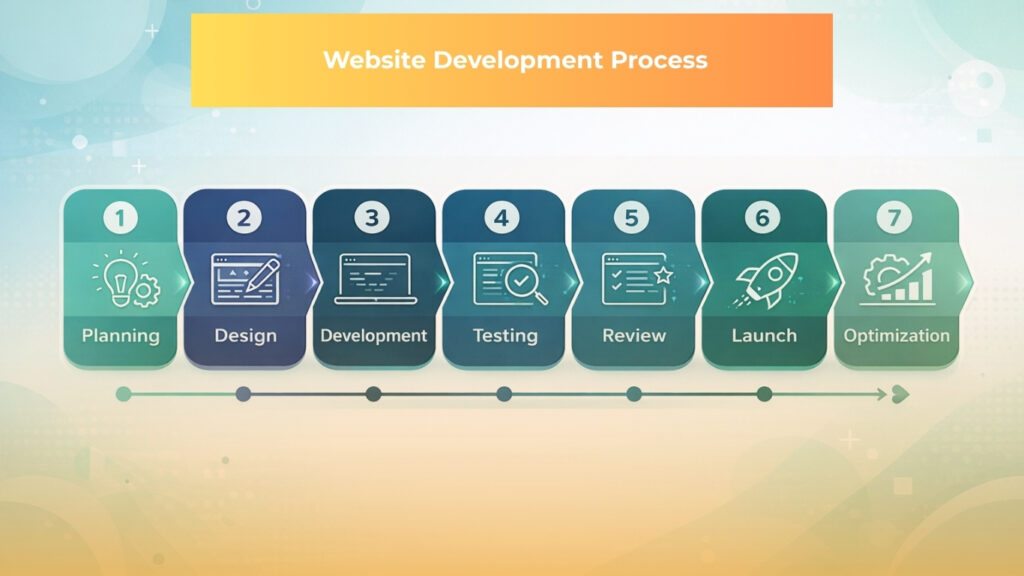
The website development process unfolds across seven distinct stages. Each stage has a specific purpose, requires input from particular team members, and produces tangible outputs that inform the next phase.
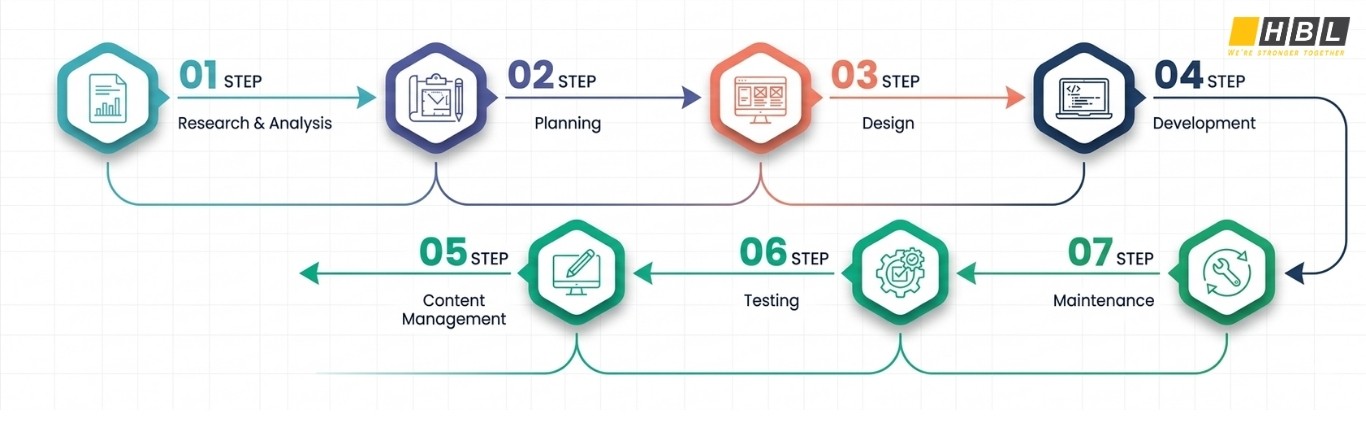
The stages are: discovery and goal setting, planning with sitemaps and wireframes, UI/UX design, content creation, front-end and back-end development, testing and quality assurance, and launch with post-launch maintenance. Some teams consolidate these into five stages by combining related activities, but the underlying work remains the same.
Stage 1: Discovery and Goal Setting
Discovery and goal setting is the foundation of the entire website development process. This stage determines why you are building a website, who it serves, and what success looks like. Without clear goals, teams often build features that do not align with business needs, wasting both time and budget.
Discovery typically involves stakeholder interviews, competitor analysis, user research, and technical requirements gathering. The output is a project brief or requirements document that guides all subsequent decisions.
The primary participants are business stakeholders, product managers, and often a business analyst or project manager. Stakeholders provide business context including target audiences, revenue goals, and brand requirements. Product managers translate these needs into functional requirements. Technical leads may also participate to assess feasibility and identify constraints early.
Key activities during discovery include:
- Defining the target audience through user personas
- Establishing key performance indicators (KPIs)
- Analyzing competitor websites
- Documenting must-have versus nice-to-have features
- Identifying technical constraints such as integrations, compliance needs, or platform limitations
Deliverables include a project charter, user personas, a competitive analysis report, and a preliminary feature list.
Stage 2: Planning
Planning transforms discovery insights into a structural blueprint for the website. This stage answers how the website will be organized and how users will navigate through it. Poor planning leads to confused navigation, redundant content, and expensive changes during development.
Information architects, UX designers, and project managers lead this stage. Information architects design the sitemap, which is a hierarchical diagram showing every page on the website and how they relate to each other. It functions like a table of contents for the entire site. UX designers create wireframes, which are low-fidelity sketches showing where navigation, content areas, images, and interactive elements will appear on each page.
Wireframes do not include colors, fonts, or final imagery. They focus entirely on layout and user flow. Stakeholders review wireframes to confirm that the planned structure supports business goals before any time is invested in visual design.
Stage 3: UI/UX Design
UI/UX design is where the website begins to look like a finished product. UI, or User Interface design, focuses on visual elements such as colors, typography, buttons, and imagery. UX, or User Experience design, focuses on how users move through the site and complete tasks. Both disciplines work together to create designs that are visually appealing and easy to use.
UI designers, UX designers, and creative directors are the primary contributors. UI designers apply brand guidelines to create high-fidelity mockups showing exactly how each page will appear. UX designers conduct usability testing on prototypes, gathering feedback that informs design iterations. Front-end developers may review designs early to flag any elements that would be technically challenging to implement.
The design process typically begins with style tiles or mood boards establishing color palettes, typography, and aesthetic direction. Once approved, designers create high-fidelity mockups for key pages using tools like Figma or Adobe XD. Deliverables include final mockups, a style guide documenting colors and fonts, and all design assets ready for development.
Stage 4: Content Creation
Content creation fills the designed structure with the text, images, and media that users will consume. This stage is often underestimated, yet content quality directly impacts user engagement, search engine rankings, and conversion rates.
Content writers, copywriters, SEO specialists, and multimedia producers collaborate here. Content writers produce the main body text, ensuring clarity and consistency with brand voice. Copywriters focus on conversion-driven text such as calls to action. SEO specialists research keywords and optimize content to improve search visibility.
Content creation typically runs parallel to design rather than waiting for designs to finish. This parallel workflow allows writers to understand the space available for text while designers see how actual content fits their layouts. Key deliverables include all page copy, meta descriptions and title tags, optimized images and videos, and any downloadable resources.
Stage 5: Front-End and Back-End Development
Development transforms designs and content into a functioning website. This stage is where code meets creativity, and the website design and development process converges as developers implement visual designs and build the technical infrastructure powering the site.
Understanding Front-End vs. Back-End
Front-end development creates everything users see and interact with in their browsers. Front-end developers use HTML (HyperText Markup Language) to structure content, CSS (Cascading Style Sheets) to control visual appearance, and JavaScript to enable dynamic behavior such as form validation and animations. Think of front-end development as building a restaurant’s dining room where customers experience the service directly.
Back-end development powers the behind-the-scenes functionality users never see but constantly rely upon. Back-end developers build server-side logic, databases, and APIs (Application Programming Interfaces) that connect the front-end to data sources and external services. They work with languages such as Python, PHP, Ruby, or Node.js, and database systems like MySQL or MongoDB. Continuing the restaurant analogy, back-end development is the kitchen where ingredients are stored and orders are processed without customers ever seeing the work.

Development teams include front-end developers, back-end developers, and a technical lead or solutions architect. Technical leads make architectural decisions, conduct code reviews, and ensure the solution is scalable and maintainable. Deliverables include the complete codebase, database structure, and documentation for future maintenance.
Stage 6: Testing and Quality Assurance
Testing and quality assurance (QA) verify that the website works correctly before users ever see it. This stage identifies bugs, compatibility issues, and usability problems that could harm the user experience or business reputation. Thorough testing prevents launch failures and reduces post-launch emergency fixes.
QA engineers, testers, and developers all participate. QA engineers design test plans that systematically check every feature and user flow. Developers fix identified bugs and may also write automated tests. Stakeholders conduct user acceptance testing (UAT), confirming the delivered website meets requirements before launch approval.
Testing covers multiple dimensions:
- Functional testing: verifies each feature works as specified
- Compatibility testing: confirms the site works across browsers, operating systems, and devices
- Performance testing: measures load times and identifies bottlenecks
- Security testing: identifies vulnerabilities that could be exploited
- Accessibility testing: confirms users with disabilities can navigate and use the site effectively
Stage 7: Launch, Deployment, and Post-Launch Maintenance
Launch marks the transition from development project to live product. This stage deploys the website to production servers where real users access it. Post-launch maintenance ensures the website remains functional, secure, and effective over time.
DevOps engineers, system administrators, and developers handle the technical aspects of launch. DevOps engineers configure production servers, set up monitoring and alerting, and manage the deployment process. Project managers coordinate timing with marketing teams and stakeholders to align launch with business goals.
The launch process includes a final content and functionality review, configuration of the production environment, DNS (Domain Name System) changes to point the domain to the new site, and active monitoring immediately after go-live. Successful websites treat launch as a milestone rather than an endpoint, continuing to evolve based on user feedback and analytics.
How AI Is Transforming the Website Development Process
Artificial intelligence is reshaping every stage of the website development process, from initial planning through post-launch optimization. AI tools accelerate repetitive tasks, generate initial drafts that humans refine, and analyze data at scales impossible for manual review. While AI cannot replace human creativity and strategic thinking, it significantly amplifies what development teams can accomplish.
AI Across the Seven Stages
During discovery and goal setting, AI assists with market research and competitive analysis. Tools can analyze competitor websites, extract messaging patterns, and identify market gaps. AI-powered survey analysis processes open-ended responses faster than manual review, revealing user preferences and pain points quickly.

In the planning stage, AI can generate initial sitemaps and suggest information architecture patterns based on industry best practices. UX designers use AI to analyze behavior data from existing websites, informing wireframe decisions with evidence rather than assumptions.
UI/UX design has seen dramatic AI integration. Artificial Design Intelligence (ADI) tools can generate complete design concepts from brand guidelines and content inputs. Platforms like Wix ADI create functional website designs automatically. Tools like Midjourney and Adobe Firefly generate custom imagery and design assets from text descriptions. AI excels at generating options while humans curate, refine, and ensure designs communicate the intended brand message.
Content creation benefits substantially from AI assistance. Large language models like ChatGPT and Claude generate initial content drafts, product descriptions, and blog posts that human writers then edit and enhance. AI tools optimize content for search engines by suggesting keyword placements and readability improvements. The human role shifts from producing first drafts to strategic planning, fact-checking, and maintaining brand voice consistency.
In development, GitHub Copilot and similar tools suggest code completions and generate entire functions from comments, significantly reducing repetitive work. AI assistants help developers find bugs by analyzing error messages and suggesting fixes. Developers remain essential for architecture decisions, complex logic, and ensuring AI-generated code follows best practices and security standards.
Testing and QA leverage AI for comprehensive coverage. AI testing tools automatically generate test cases, explore edge cases humans might miss, and detect patterns in bug reports that reveal systemic issues. Visual regression tools use AI to detect subtle differences between expected and actual screenshots.
Post-launch maintenance benefits from AI-powered analytics and monitoring. AI analyzes user behavior to identify friction points and recommend optimizations. Security tools detect anomalous traffic patterns indicating attacks. Chatbots handle routine customer inquiries, improving response time while reducing support costs.
Can ChatGPT Actually Create a Website?
ChatGPT can generate HTML, CSS, and JavaScript code for simple websites, and it can write content and suggest structures. However, it cannot replace the full website development process.
ChatGPT lacks understanding of your specific business context, cannot conduct meaningful user research, produces code that requires human review for security and best practices, and cannot test or deploy websites. It serves best as a powerful assistant that accelerates portions of the workflow while skilled professionals maintain overall direction and quality control.
Our Case Study
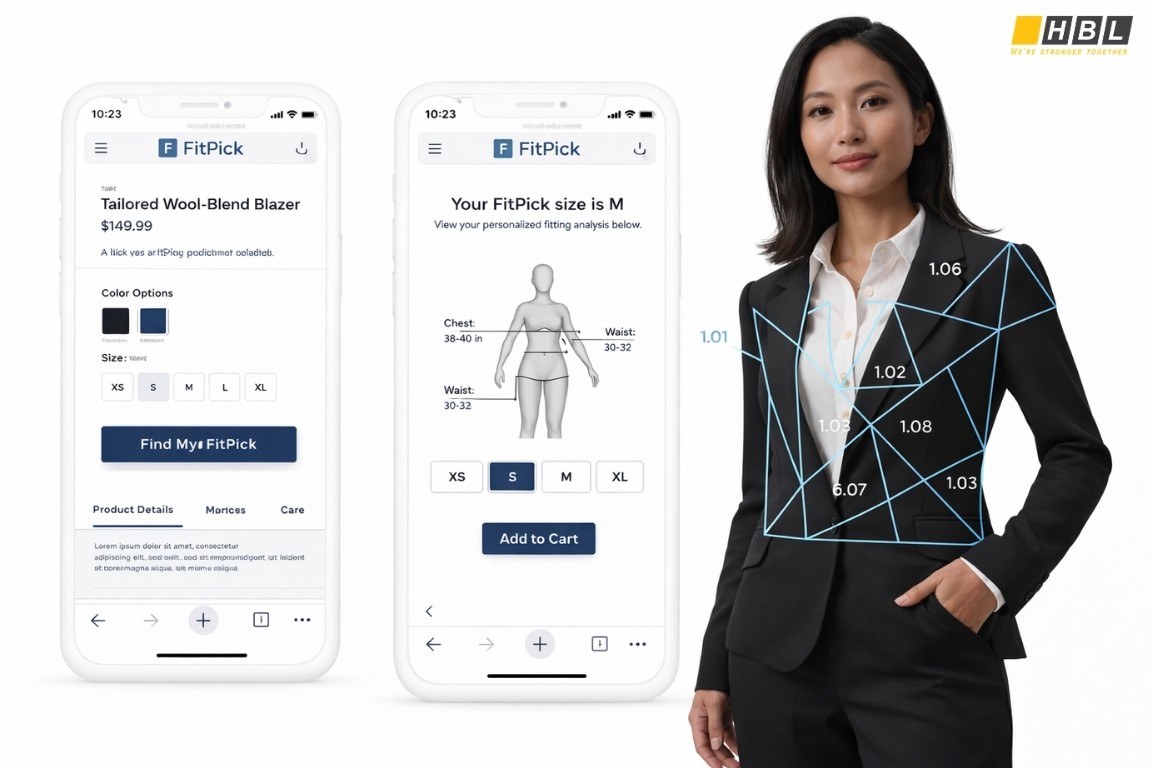
AI-Assisted Clothing Size Measurement for a Fashion E-Commerce Platform
A fashion manufacturing and distribution company faced a persistent challenge directly impacting their bottom line. Survey data revealed a high customer churn rate linked to size uncertainty when purchasing clothes online. Customers expressed frustration with standard size guides that provided only general measurements. They wanted detailed part measurements for specific garments, information that would help them assess fit before purchasing.

The company partnered with HBLAB to develop an AI-powered solution that would display clothing dimensions directly from product photographs. The development team proposed three different technology solutions and tested each to identify which would deliver the highest accuracy across the widest range of products.
The Technical Approach
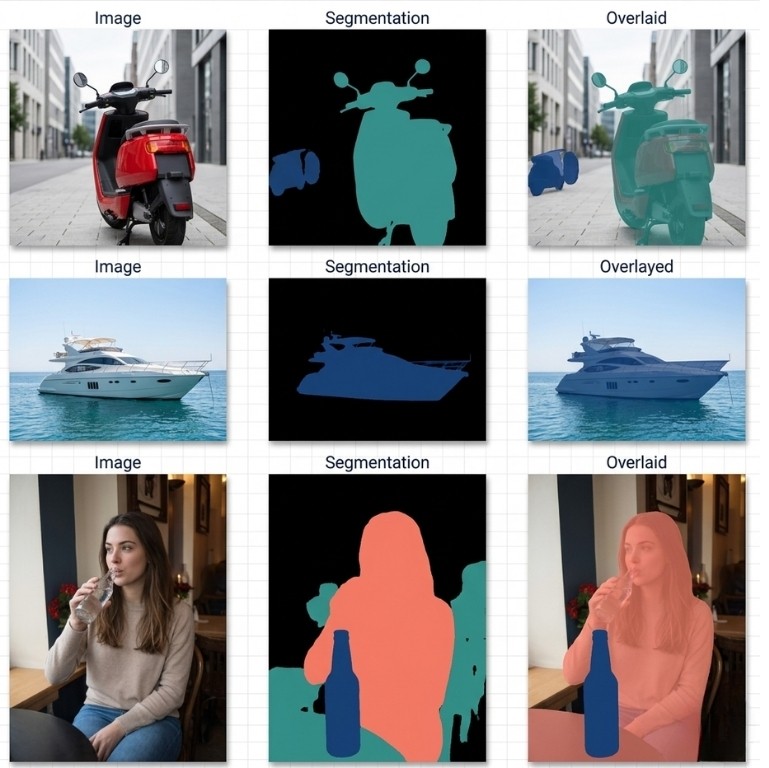
After comparative testing, the team selected DeepLab V3, a deep learning image segmentation model developed by Google, for its superior accuracy and adaptability. Image segmentation is the process of dividing an image into multiple segments, essentially teaching a computer to recognize which pixels belong to the garment and which belong to the background.
DeepLab V3 uses deep neural networks, computing systems inspired by the structure of the human brain, to identify object boundaries at the pixel level. Once the garment is isolated in the image, heuristic algorithms, which are practical problem-solving approaches, calculate dimensions based on standard reference points. The result is a system that can measure clothing parts from a single photograph without any manual input.
The project required just one AI engineer working over a two-month timeline: one month for solution testing and one month for development.
Technologies employed included image processing libraries, heuristic algorithms for measurement calculation, and the DeepLab V3 model.
This lean team and timeline demonstrate how focused AI integration can address specific business problems without requiring large-scale transformation initiatives.
The solution deployed live on the client’s website with a measurement tolerance as low as 30 pixels, providing the detailed size information customers had been requesting. The business impact was direct and measurable: the closing rate increased by 8 percent after implementation.
This case illustrates how the website development process, when paired strategically with AI capabilities, can solve real commercial problems that directly affect revenue.
The key was identifying a specific user pain point, evaluating multiple technical approaches, and implementing a focused solution that addressed the root cause of customer hesitation.
About HBLAB

Building a website is one thing. Building it right, on time, and with the technology to grow alongside your business is another. That is where HBLAB comes in.
With 10+ years of custom software development experience and a team of 700+ IT professionals, HBLAB has helped businesses across Asia Pacific and beyond turn complex digital challenges into clean, functional, and intelligent web solutions. AI has been part of the HBLAB toolkit since 2017, long before it became an industry buzzword, which means clients benefit from practical AI expertise rather than experimentation.
The AI-assisted size measurement solution featured in this article is a real example of how HBLAB works: identify the problem, test multiple approaches, and deliver something that measurably moves the needle.
HBLAB is CMMI Level 3 certified, offers flexible engagement models to fit your team structure, and delivers up to 30% cost efficiency compared to local development rates, without cutting corners on quality or security.
CONTACT US FOR A FREE CONSULTATION
People Also Ask
1. What are the 5 stages of website development?
Teams that follow a condensed model typically group the seven stages into five: discovery and planning, design, content and development, testing and QA, and launch with maintenance. The core work remains the same regardless of how the stages are labeled.
2. What are the 7 steps in creating a website?
Define your goals, map the site structure, design the user interface, create your content, build the front-end and back-end, test across devices and browsers, then launch and monitor performance.
3. What are the 7 steps in the design process?
Within the design phase specifically, the seven steps are: gather requirements, create mood boards, establish a style guide, design wireframes, build high-fidelity mockups, develop interactive prototypes, and conduct usability testing before handing off to developers.
Read more:
– Cybersecurity Standards: Top 5 Frameworks Every Organisation Needs to Know
– Software Development Life Cycle Phases: Step-by-Step Guide
– Technology Strategy for Non-Technical Executives: What It Is and How It Works