What Is a Hybrid Cloud?
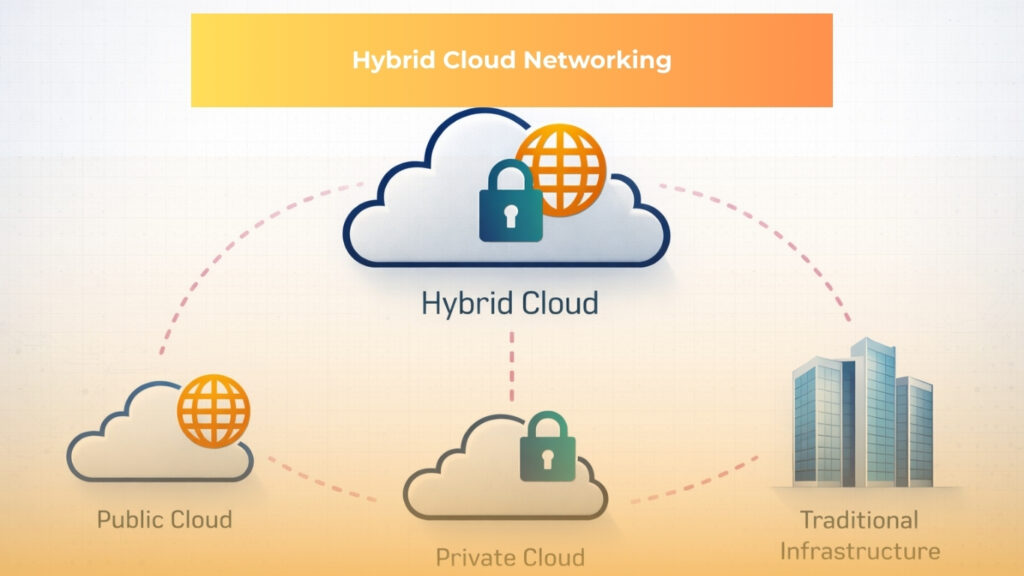
A hybrid cloud is a computing environment that combines an organization’s on-premises infrastructure or private cloud with one or more public cloud services, connected in a way that allows data and applications to move freely between them. Rather than committing entirely to a single infrastructure model, organizations use a hybrid cloud to place each workload where it is best suited: sensitive data or regulated applications stay within a private environment, while compute-intensive or variable workloads take advantage of the scalability that public cloud providers offer.
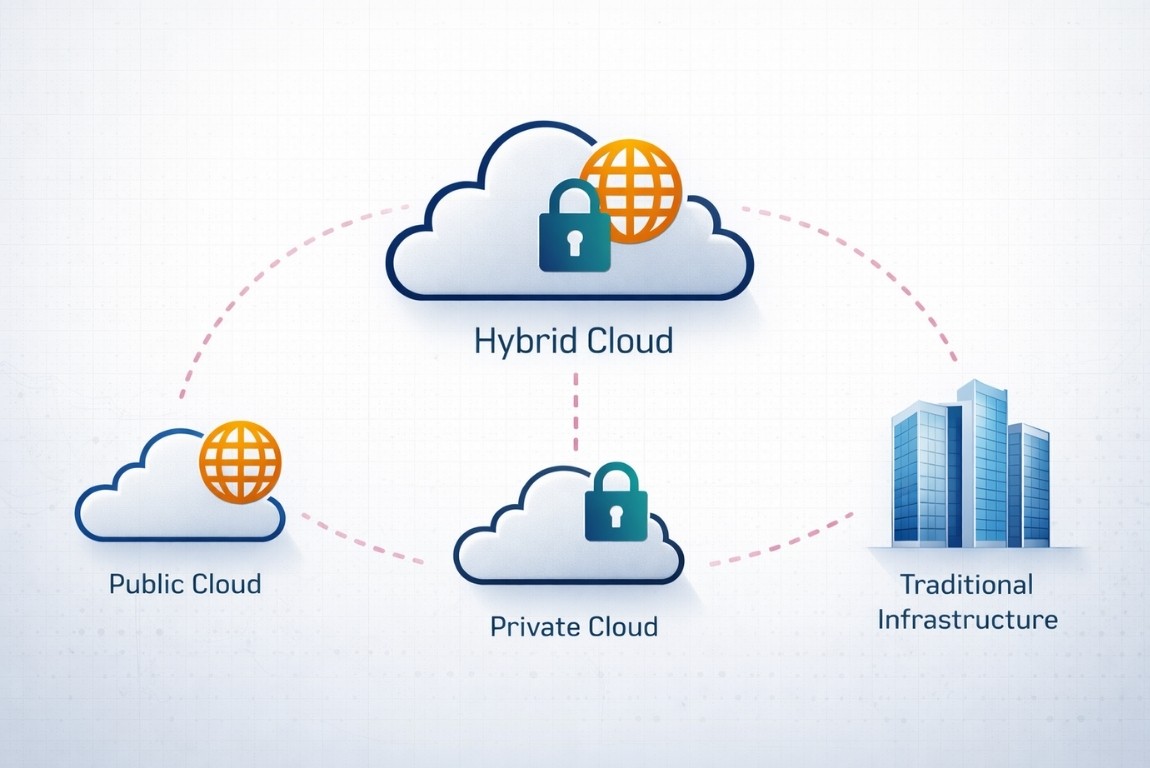
Think of a hybrid cloud the way you might think of a business that owns a small private office for confidential client meetings but rents additional conference space from a shared facility when demand spikes. The private office offers control and security. The rented space offers capacity on demand. Together, they form a single, flexible operation. A hybrid cloud works on exactly the same principle.
Public cloud environments are operated by third-party providers, the most prominent being Amazon Web Services (AWS), Microsoft Azure, and Google Cloud Platform (GCP). These platforms offer computing power, storage, and services over the internet on a pay-as-you-go basis. Private clouds, by contrast, are dedicated environments operated either on-premises within an organization’s own data center or hosted by a single-tenant provider. The key distinction is exclusivity: a private cloud’s resources are not shared with other organizations. A hybrid cloud brings both environments together under a unified operational framework.
Types of Cloud Computing
Understanding hybrid cloud networking requires a clear picture of the four primary cloud deployment models that exist in enterprise computing today.
Public cloud refers to computing resources delivered over the internet by a third-party provider and shared across many organizations simultaneously. Resources are allocated dynamically, and the provider is responsible for all infrastructure management. This model offers significant cost advantages and near-unlimited scalability, but organizations have limited control over the underlying infrastructure and must trust the provider’s security posture.
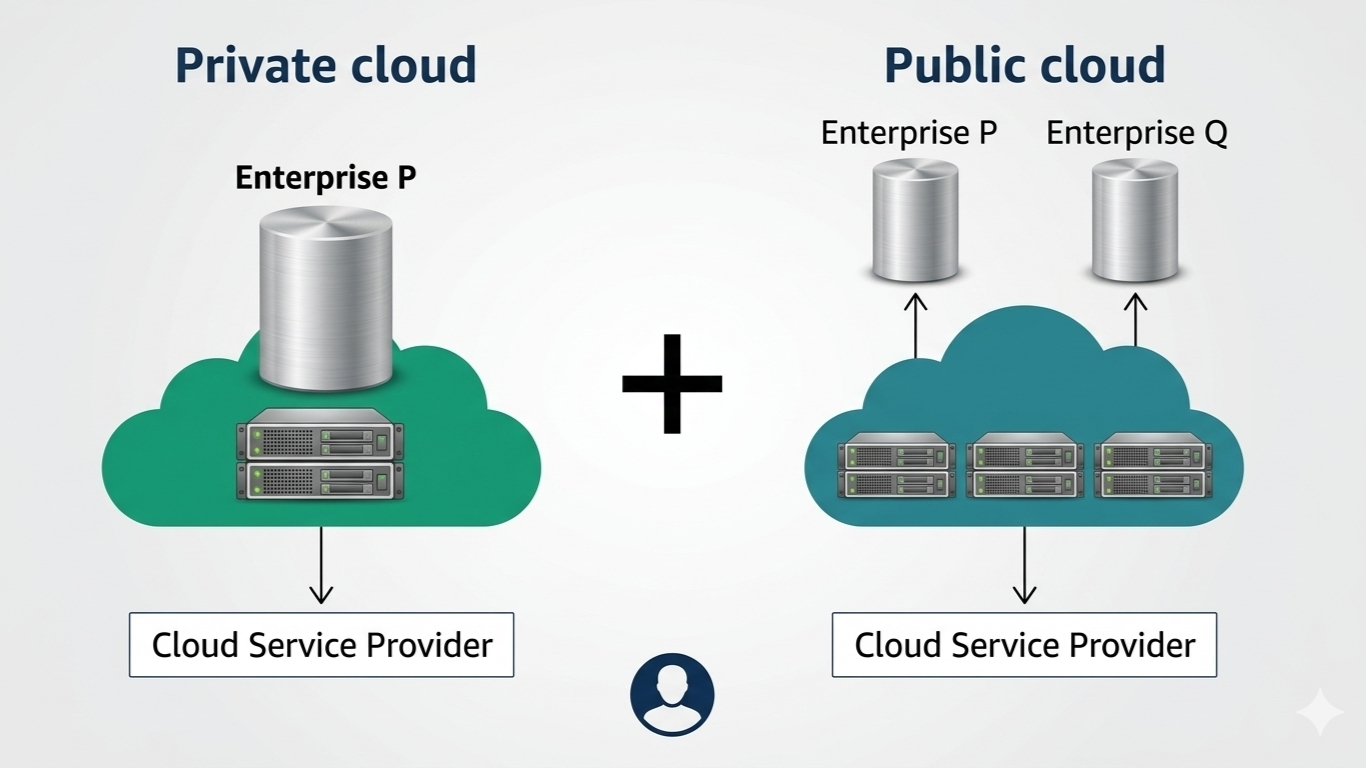
- Private cloud is a dedicated cloud environment used exclusively by a single organization. It may be hosted in the organization’s own data center or managed by a third party on dedicated hardware. Private cloud environments offer greater control, customization, and security, making them well-suited for workloads governed by strict regulatory requirements, such as patient health records in healthcare or financial transaction data in banking.
- Hybrid cloud combines private and public environments into a coordinated system. Workloads and data can move between the two according to business rules, cost thresholds, compliance requirements, or capacity needs. This is the model that hybrid cloud networking is designed to support and sustain.
- Multi-cloud refers to the use of cloud services from multiple public cloud providers simultaneously, without necessarily integrating any on-premises or private cloud infrastructure. An organization using AWS for data storage and Azure for machine learning workloads, while keeping no on-premises infrastructure in the picture, is operating in a multi-cloud model.
What Is Hybrid Cloud Networking?
Hybrid cloud networking is the practice of integrating on-premises infrastructure with public or private cloud environments into a single, cohesive system, enabling secure data and application portability across those environments. It is not simply the act of using both a private and a public cloud. Hybrid cloud networking is the discipline of building, managing, and securing the connections between them so they behave as one unified network rather than two separate systems stitched together at the edges.
This distinction matters. An organization might have a private data center and an AWS account without those two environments being genuinely integrated. Workloads might run in one or the other, but data does not flow securely between them, policies are not shared, and management is entirely separate. Hybrid cloud networking is what transforms that fragmented arrangement into a coherent infrastructure architecture.
How Exactly Do Hybrid Cloud Networks Connect?
The connectivity methods that make hybrid cloud networking possible fall into three primary categories.
The first is the Virtual Private Network (VPN), a technology that creates an encrypted tunnel over the public internet, allowing traffic to pass between an on-premises network and a cloud environment as if the two were part of the same private network. VPNs are cost-effective and straightforward to configure, which makes them a common starting point. However, because they rely on the public internet, they are subject to variable latency and bandwidth constraints.
The second method is dedicated private connectivity. Services such as AWS Direct Connect and Microsoft Azure ExpressRoute establish direct physical links between an organization’s data center and the cloud provider’s network, bypassing the public internet entirely. These connections offer predictable, low-latency performance and higher bandwidth than a typical VPN, making them appropriate for workloads that require consistent throughput, such as large-scale data replication or real-time analytics.
The third method is Software-Defined Wide Area Network (SD-WAN), a networking approach that uses software to control the routing of traffic across a wide area network (WAN) rather than relying on fixed hardware configurations. In a hybrid cloud networking context, SD-WAN can intelligently route traffic between on-premises sites and cloud environments, choosing the optimal path based on real-time conditions such as congestion, latency, or cost.
Multiprotocol Label Switching (MPLS) is another connectivity technology commonly found in enterprise hybrid cloud networking deployments. MPLS is a method of directing data from one network node to the next based on short path labels rather than long network addresses, which speeds up and simplifies traffic flow along predetermined paths. MPLS connections are highly reliable and offer quality-of-service guarantees, though they are typically more expensive than internet-based alternatives.
Application Programming Interfaces (APIs) also play a connectivity role. An API is a set of protocols that allows different software systems to communicate with one another. In hybrid cloud networking, APIs enable cloud management platforms, orchestration tools, and on-premises systems to exchange data, issue commands, and share state information across environment boundaries.
What Is Hybrid Cloud Network Architecture?
Hybrid cloud network architecture refers to the structural design that governs how the components of a hybrid cloud environment are arranged, interconnected, and managed. Architecture in this context is not a single fixed blueprint. It describes the combination of network topologies, connectivity technologies, security controls, and management frameworks that together define how data flows through the system.
Hub-and-Spoke vs. Mesh
Two broad architectural patterns are most common in hybrid cloud networking deployments.
The hub-and-spoke architecture places a central network hub, typically a virtual network or a transit gateway in the cloud, at the center of all connectivity. On-premises environments, branch offices, and cloud virtual networks all connect to this central hub rather than directly to one another. Traffic between any two spokes passes through the hub, which simplifies policy enforcement and monitoring because all traffic flows through a single controlled point. The analogy here is a bicycle wheel: all the spokes connect to a central hub, and that hub mediates all communication between them.
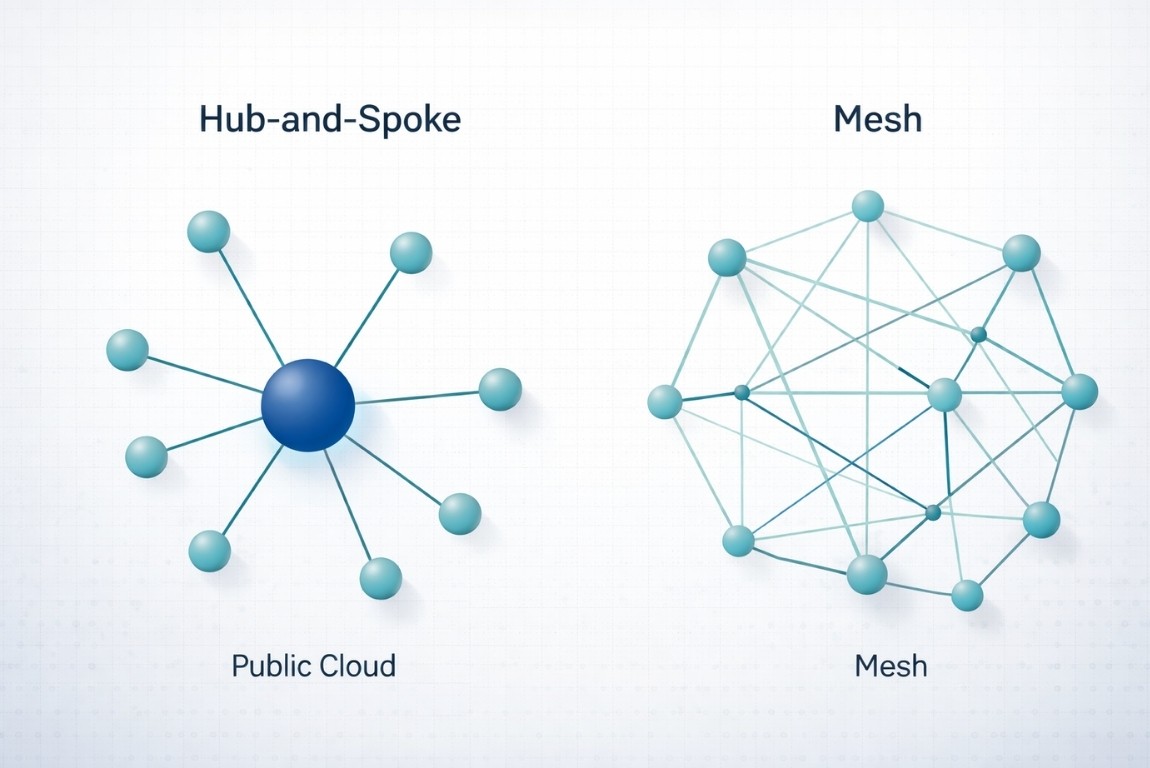
The mesh architecture creates direct connections between multiple network segments without routing all traffic through a central point. In a full mesh, every node is directly connected to every other node. In a partial mesh, key nodes are directly connected while others use intermediate paths. Mesh architectures are more resilient because the failure of any single link does not disrupt connectivity between all nodes, but they are also more complex to configure and monitor.
Core Technical Components
Beyond topology, hybrid cloud network architecture encompasses several key technical components:
- Software-Defined Networking (SDN): A method of managing network traffic through software-based controllers rather than dedicated hardware. SDN separates the control plane, which decides where traffic should go, from the data plane, which physically moves the traffic. This separation enables network administrators to configure and adjust routing policies programmatically across an entire hybrid environment from a centralized interface.
- Network virtualization: Abstracts physical network resources into logical units, allowing multiple virtual networks to run on the same underlying infrastructure. This enables organizations to create isolated network segments for different applications, teams, or regulatory domains without deploying separate physical hardware for each.
- Load balancing: Distributes incoming network traffic across multiple servers or cloud resources to ensure no single component becomes a bottleneck. In hybrid cloud networking, load balancers must operate across environment boundaries, directing traffic to on-premises resources or cloud instances depending on which is best positioned to handle the request at any given moment.
Security architecture within a hybrid cloud network typically incorporates encryption for data both in transit and at rest, Identity and Access Management (IAM) frameworks that define and enforce who can access which resources across the full environment, and network traffic monitoring systems that provide visibility into all flows crossing the boundary between private and public environments.
>> Explore AWS Identity and Access Management (IAM)
Benefits of Hybrid Cloud Networking
The primary advantage of hybrid cloud networking is flexibility: the ability to match each workload to the infrastructure that handles it most effectively, and to change that placement as conditions evolve.
Cloud Bursting and Scalability
Cloud bursting is one of the most cited benefits. Cloud bursting describes the practice of running an application primarily in a private environment but automatically expanding into a public cloud when demand exceeds the private environment’s capacity. A retail company, for example, might process most transactions on-premises throughout the year but burst into AWS during a peak sales period without any manual intervention or infrastructure procurement. Hybrid cloud networking provides the reliable, low-latency connectivity that makes cloud bursting seamless rather than disruptive.
Compliance and Data Sovereignty
Compliance and data sovereignty are equally significant drivers. Many industries operate under regulations that restrict where certain data may be stored or processed. Financial services firms subject to regulations such as the Gramm-Leach-Bliley Act, healthcare organizations subject to the Health Insurance Portability and Accountability Act (HIPAA), and European enterprises governed by the General Data Protection Regulation (GDPR) cannot simply move all workloads to a public cloud without careful controls. Hybrid cloud networking allows these organizations to retain regulated data in a private environment while still accessing public cloud capabilities for non-regulated workloads.
Disaster Recovery
Disaster recovery becomes more achievable and cost-effective with hybrid cloud networking in place. Organizations can replicate critical on-premises workloads to a cloud environment continuously, so that in the event of a local failure, operations can be restored from the cloud quickly. The cloud environment serves as a warm or hot standby without requiring the capital expenditure of a fully duplicated physical data center.
Cost Optimization and Vendor Independence
Cost optimization is another measurable benefit. On-premises infrastructure requires significant capital investment and carries fixed operational costs regardless of how heavily it is used. Public cloud resources are consumed and billed on demand. Hybrid cloud networking allows organizations to use on-premises capacity for predictable, stable workloads where fixed costs are efficient, while routing variable or unpredictable workloads to the cloud where the pay-per-use model is more economical.
By operating across both private and public environments, organizations are also not wholly dependent on any single cloud provider. If a provider’s pricing changes, its service quality degrades, or its product roadmap diverges from the organization’s needs, the organization retains the infrastructure and connectivity to migrate workloads without starting from scratch.
Challenges of Hybrid Cloud Networking
The same architectural complexity that gives hybrid cloud networking its power also introduces meaningful operational challenges. These challenges do not invalidate the model, but they must be understood and planned for by any organization considering a hybrid cloud strategy.
Management Complexity
Complexity in management is the most pervasive challenge. Operating a network that spans on-premises hardware, private cloud infrastructure, and one or more public cloud environments requires teams who understand all of those environments and the tools that connect them. Policies, access controls, routing configurations, and monitoring systems must be maintained consistently across all segments. A firewall rule applied to on-premises traffic but not reflected in cloud security groups can create a gap that neither team notices until a security incident exposes it.
Latency and Performance
Latency and performance variability present technical challenges that are difficult to eliminate entirely. Even the best-designed hybrid cloud network introduces some latency at the boundary between private and public environments. Applications that were designed to run entirely within a low-latency on-premises network may not perform as expected when parts of their processing chain move to the cloud. Careful application profiling and connectivity selection, including the use of dedicated connections rather than VPN over public internet, can mitigate this but cannot eliminate it.
Security Governance
Security governance across a hybrid network is substantially more complex than in a single-environment deployment. Data moving between environments must be encrypted in transit. Access credentials and identity policies must be consistent and enforced at every boundary. The attack surface is larger, because each connectivity technology introduces its own potential vulnerabilities. Misconfigurations are a particularly common risk: a cloud storage bucket inadvertently exposed to the public internet, or a VPN endpoint with overly permissive routing rules, can undermine the security of an otherwise well-designed architecture.
Legacy System Integration and Observability
Integrating legacy systems is a challenge that affects many enterprises. Applications built on older technologies may lack the APIs or communication protocols required to participate cleanly in a hybrid cloud network. Modernizing these applications requires time and investment, and the interim state, in which legacy and modern systems must coexist, requires careful architectural bridging.
Visibility and observability are harder to achieve in a hybrid cloud network than in a homogeneous environment. Traffic flows across multiple domains, each with its own logging formats, monitoring tools, and management interfaces. Assembling a unified view of network performance, security events, and application health across the entire hybrid environment typically requires specialized observability platforms and deliberate investment in tooling and process.
How Does Multi-Cloud Networking Differ from Hybrid Cloud Networking?
Multi-cloud networking and hybrid cloud networking are related concepts, and they are frequently used interchangeably, but they describe meaningfully different architectures.
Hybrid cloud networking, as defined throughout this article, specifically involves the integration of private infrastructure, whether on-premises or in a private cloud, with one or more public cloud environments. The defining characteristic is the presence of a private component connected to the public cloud.
Multi-cloud networking refers to the simultaneous use of multiple public cloud providers. An organization running workloads across AWS, Azure, and GCP simultaneously is operating a multi-cloud network. If that organization has no on-premises infrastructure and no private cloud, the architecture is multi-cloud but not hybrid.

The practical distinction matters because the challenges and technologies differ. Multi-cloud networking is primarily concerned with managing interoperability, data transfer costs, and consistent policy enforcement across multiple public cloud platforms. Hybrid cloud networking is additionally concerned with the bridging of fundamentally different infrastructure models, the private environment and the public cloud, which have different networking primitives, different security models, and different performance characteristics.
An organization can also operate both models simultaneously. A company with an on-premises data center connected to AWS and Azure, where workloads move between all three environments, is operating both a hybrid cloud and a multi-cloud architecture at the same time. This combined model is sometimes called hybrid multi-cloud networking, and it represents the most complex form of cloud networking in enterprise use today.
The connectivity technologies differ in emphasis as well. Hybrid cloud networking leans heavily on dedicated private connections such as AWS Direct Connect and Azure ExpressRoute to bridge the performance gap between on-premises infrastructure and the cloud. Multi-cloud networking often relies more on cloud-native transit services and software-defined networking to manage traffic between cloud providers without requiring physical connectivity into a private facility.
Real-World Use Cases
Hybrid cloud networking addresses a set of persistent, practical problems that organizations encounter as they attempt to modernize their infrastructure without abandoning systems that continue to work reliably.
Modernizing Legacy Applications
Modernizing legacy applications is one of the most common use cases. Many enterprises operate applications that were built decades ago and cannot be quickly migrated to a public cloud environment. Hybrid cloud networking allows organizations to keep these legacy applications running on-premises while connecting them to modern, cloud-based services such as analytics engines, API gateways, or machine learning platforms that extend their functionality without requiring a complete rewrite. A bank might, for example, keep its core transaction processing system on-premises while connecting it via a hybrid cloud network to a cloud-hosted fraud detection service that processes transaction data in real time.
Data Processing, Analytics, and Edge Computing
Data processing and analytics workloads benefit substantially from hybrid cloud networking. Organizations often generate large volumes of data on-premises through manufacturing equipment, point-of-sale systems, or sensor networks. A hybrid cloud network allows organizations to pre-process and filter data at the edge of their on-premises environment before sending only the relevant subset to the cloud for deeper analysis, a pattern commonly called edge computing. Edge computing pushes computation closer to the source of the data rather than centralizing it in a distant cloud data center, which reduces both latency and bandwidth costs.
AI and Machine Learning Workloads
Artificial Intelligence (AI) and Machine Learning (ML) workloads present a particularly well-suited use case for hybrid cloud networking. Training large AI models requires substantial compute resources, often more than most organizations maintain on-premises, making the public cloud an attractive environment for model training. However, the data used to train those models is frequently sensitive, regulated, or simply too large to transfer economically to the cloud. A hybrid cloud network enables organizations to move model training to the cloud while keeping the training data in a private environment, transmitting only the data required for each training run rather than replicating the entire dataset.
>> AI and Machine Learning Trends 2026
Disaster Recovery and Geographic Compliance
Rather than investing in a full secondary data center, which would sit idle most of the time, organizations can use a hybrid cloud network to replicate critical workloads and data to a cloud environment that activates only when needed. This dramatically reduces the cost of resilience while maintaining recovery time objectives.
Geographic compliance is a use case growing in importance as data sovereignty regulations proliferate. A multinational company that must ensure customer data from European users never leaves the European Union can use a hybrid cloud network to route European data to compliant private or regional cloud infrastructure, while routing data from other regions to public cloud environments where residency requirements are less restrictive.
Frequently Asked Questions
1. What are the 4 types of cloud networking?
The four types of cloud networking are public cloud, private cloud, hybrid cloud, and multi-cloud. Public cloud networking uses shared infrastructure delivered over the internet by a third-party provider. Private cloud networking uses dedicated infrastructure for a single organization. Hybrid cloud networking connects private and public cloud environments into a unified system. Multi-cloud networking distributes workloads across multiple public cloud providers simultaneously.
2. What is hybrid networking?
Hybrid networking is a broad term for any network architecture that combines two or more distinct infrastructure types, such as on-premises hardware and cloud resources, into a connected system. In modern enterprise usage, hybrid networking most commonly refers to hybrid cloud networking: the integration of private on-premises or private cloud infrastructure with one or more public cloud environments, connected through secure and managed network pathways.
3. What is an example of a hybrid network?
A retail organization that operates its inventory management system in an on-premises data center, connects that system to an AWS environment via a dedicated AWS Direct Connect link, and uses the cloud environment to run customer-facing web applications during peak sales periods is a concrete example of a hybrid network in operation. The on-premises system handles stable, predictable workloads. The cloud environment absorbs variable demand. The dedicated connection between them is what makes the arrangement a managed hybrid cloud network rather than two separate infrastructure deployments.
4. What are the disadvantages of hybrid cloud?
The primary disadvantages of hybrid cloud environments include:
- Increased architectural complexity, requiring teams with expertise across multiple technology domains
- Higher management overhead, because policies and security controls must be maintained consistently across all environments
- Potential latency at the boundary between private and public infrastructure
- Elevated security risk if connectivity configurations are not carefully designed and audited
- Integration difficulty when legacy on-premises systems lack the APIs or protocols needed to communicate cleanly with cloud services
5. What is a hybrid cloud?
A hybrid cloud is a computing environment that combines an organization’s private infrastructure, whether on-premises or in a private cloud, with one or more public cloud environments, connected in a way that enables data and workloads to move between them. The goal of a hybrid cloud is to allow organizations to place each workload in the environment best suited to its performance, security, compliance, and cost requirements, while managing all environments as part of a coherent whole.
What are the 7 types of networks?
The seven commonly recognized types of networks are:
- Personal Area Network (PAN): Covers a very short range, such as the area around an individual person and their devices
- Local Area Network (LAN): Connects devices within a single building or campus
- Metropolitan Area Network (MAN): Spans a city or regional area
- Wide Area Network (WAN): Covers large geographic distances and is the network type over which most cloud connectivity travels
- Campus Area Network (CAN): Links multiple LANs within a defined geographic campus
- Storage Area Network (SAN): A specialized high-speed network dedicated to connecting servers to storage devices
- Virtual Private Network (VPN): Creates an encrypted, private communication channel over a public or shared network
In hybrid cloud networking, WAN and VPN are the most directly relevant of these types, as they provide the connectivity infrastructure that links on-premises environments to cloud platforms.
See more:
– Website Development Process: A Complete Step-by-Step Guide
– Data Science vs. Computer Science: A Clear, Honest Comparison
– AI-Driven Business Transformation: What It Actually Means and How to Execute It