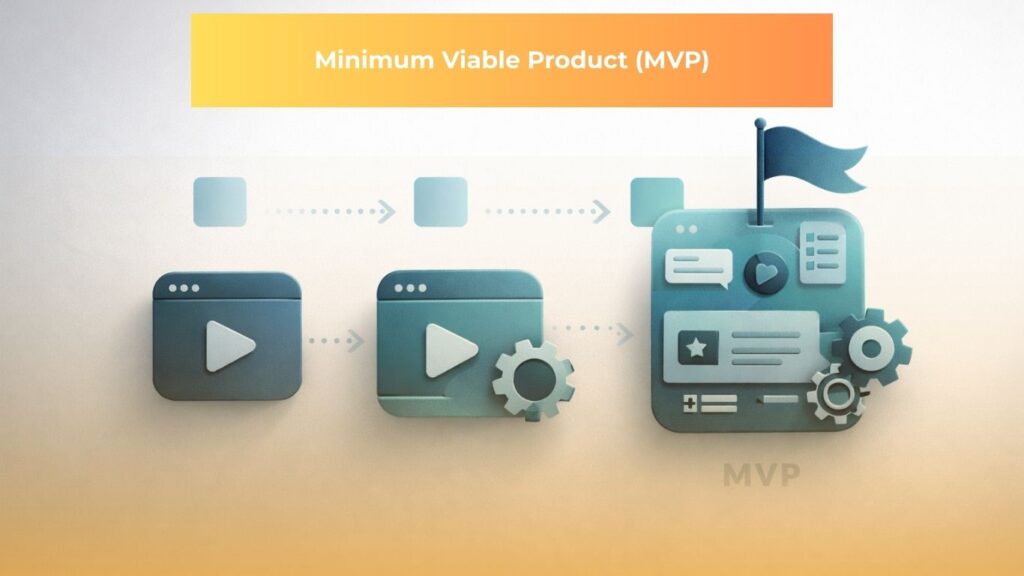
What Is a Minimum Viable Product (MVP)?
A minimum viable product (MVP) is the earliest functional version of a software product built with only the core features necessary to satisfy a defined group of early users and validate a central business hypothesis. It is a deployable, working product, not a sketch, not a wireframe, and not a proof of concept, designed to generate real-world feedback under real-world conditions.

The minimum viable product carries enough utility to attract genuine users while remaining lean enough to be built, shipped, and iterated upon at speed.
- The word “minimum” does not mean low quality or incomplete in any damaging sense; it means the smallest possible feature set that still delivers authentic value to a specific user group.
- “Viable” is the operative constraint: the product must function well enough to serve its intended purpose and produce credible data about whether users want it.
To What Extent Is It Considered a Minimum Viable Product?
The boundary between “minimum viable” and “dangerously incomplete” depends entirely on what the product must accomplish to generate trustworthy feedback.

A minimum viable product must cross two thresholds simultaneously:
- It must be functional enough for real users to engage with meaningfully
- It must expose the core assumption the team needs to test.
Anything below that threshold is a prototype.
Anything above it starts to resemble a finished product built before sufficient validation has occurred.
Real-World MVP Examples
Dropbox
Dropbox illustrates this principle precisely. Rather than building a fully functional cloud-syncing application before confirming demand, founder Drew Houston produced a short explainer video demonstrating how the product would work. That video was the MVP. It required no engineering infrastructure yet validated enormous demand, with sign-ups rising from 5,000 to 75,000 overnight. The minimum viable product here was not a piece of software at all; it was the smallest possible test of whether people wanted what Dropbox intended to build.
Airbnb
Airbnb followed similar logic when its founders photographed their own apartment, listed it manually on a simple webpage, and charged guests to stay. No automated booking system, no payment processing platform, no host onboarding flow. The MVP proved that strangers would pay to stay in someone else’s home and that hosts would accept them. Only after that validation did the founders justify investing in the infrastructure now worth hundreds of billions of dollars.
Zappos
Zappos built its earliest version the same way. Founder Nick Swinmurn photographed shoes in local stores, posted them online, and manually purchased and shipped each order that came in. The business hypothesis was that people would buy shoes online without trying them on first. The minimum viable product confirmed it without a single unit of inventory.
Why Do People Build a Minimum Viable Product?
The primary reason teams build a minimum viable product is risk reduction.
Software development is expensive, and the most common cause of product failure is not poor engineering but building something users do not actually want. Shipping an MVP before committing to full development puts the central business assumption in front of real users before sunk costs make a change of direction financially or psychologically difficult.
Speed to market is the second major driver.
A team that spends eighteen months building a feature-complete product before launch gives competitors twelve additional months to establish themselves in the same space. The minimum viable product compresses that timeline dramatically, allowing a team to occupy a market position, begin accumulating user data, and start iterating while a slower competitor is still in planning.
Early market presence builds brand recognition and shapes how users conceptualise a product category. That is a structural advantage no amount of later engineering can fully replicate.
Cost efficiency compounds these advantages.
Building only what is necessary to validate an idea means paying for only the engineering, design, and infrastructure that serves a defined learning objective. Every additional feature built before validation is a financial bet placed without evidence. If the product hypothesis proves wrong, a team that shipped an MVP loses weeks of work; a team that built a full product loses months or years.
Perhaps the most strategically powerful benefit is the feedback loop the MVP creates.
Real users interacting with a real product surface problems, preferences, and behaviours that no amount of internal discussion or market research can replicate. That feedback drives the pivot-or-persevere decision: should the team continue in the current direction, modify the product’s positioning or feature set, or redirect resources entirely? Without an MVP, that decision is made on instinct. With one, it is made on evidence.
Common Pitfalls When Building an MVP
Most failed minimum viable product launches can be traced to a small set of well-documented mistakes:
- Building too much before launch. Scope creep at the MVP stage delays launch, increases cost, and generates data that is harder to interpret because too many variables changed at once.
- Ignoring user feedback after launch. Shipping an MVP and then continuing to build from the original roadmap without incorporating feedback defeats the entire purpose of the exercise.
- Treating the MVP as the final product. Users notice when a product stagnates after its first release, and trust erodes quickly.
- Confusing an MVP with a proof of concept. A proof of concept tests technical feasibility internally. A minimum viable product tests market demand externally with real users. They serve different functions and must not be substituted for one another.
- Neglecting the “viable” threshold. An MVP that crashes, confuses users, or fails to solve the core problem generates noise rather than signal. The product must function well enough to produce a genuine behavioural response.
How to Build a Good MVP
A Step-by-Step Methodology
Building a credible minimum viable product follows a structured process grounded in user research, disciplined prioritisation, and systematic measurement.
Step 1: Identify the core user problem
Before any feature is scoped, the team must articulate the specific pain point the product addresses for a specific user segment. Vague problem statements produce bloated MVPs. A sharply defined problem, such as “freelance graphic designers cannot invoice clients without switching between three separate tools,” produces a product focused enough to test a real hypothesis. User interviews, jobs-to-be-done analysis, and existing behavioural data are the right inputs at this stage.
Step 2: Define success metrics
The minimum viable product must have a measurable outcome attached before the first line of code is written. Success metrics might include a target activation rate, a retention threshold over the first two weeks, a specific number of completed core actions, or a net promoter score range. Without pre-defined success criteria, post-launch evaluation becomes subjective and the pivot-or-persevere decision loses its analytical foundation.
Step 3: Map and narrow the feature set.
Once the problem and success metrics are defined, the team should list all features that could plausibly address the problem and apply a strict filter. Atlassian recommends scoring candidate features against user impact and delivery effort, prioritising only those in the high-impact, manageable-effort quadrant. Everything else becomes a backlog candidate for post-validation sprints.
Step 4: Build for the right fidelity level.
Not every MVP requires production-grade code. As the Dropbox and Airbnb examples demonstrate, appropriate fidelity depends on what must be tested. If the hypothesis is about demand, a video or landing page may be sufficient. If the hypothesis is about usability or retention, a fully functional product deployed to a small cohort is required. Matching fidelity to the test question prevents both over-investment and under-investment.
Step 5: Establish a feedback collection process.
The minimum viable product generates value only when the team has a plan for capturing and interpreting what users do.
This includes:
- In-product analytics tracking the specific actions corresponding to success metrics
- Direct user interviews conducted within the first two weeks of launch
- A mechanism for users to report friction, whether a feedback widget, a monitored support channel, or scheduled usability sessions
Post-launch, the team reviews this data against pre-defined success criteria and produces a documented decision: continue, adjust, or pivot.
Step 6: Iterate
The minimum viable product is not a one-time event; it is the beginning of a continuous loop. Each subsequent release is evaluated against new success metrics defined before it launches. The product grows from a base of confirmed user value rather than accumulated assumptions, which is the structural difference between a Lean development process and a traditional waterfall approach.
Teams that maintain this discipline produce products whose feature sets are justified by evidence at every stage, reducing the risk of investing in functionality that users will never prioritise.
FAQ
1. What is MVP in Agile?
In Agile development, the minimum viable product functions as the first meaningful increment of value in a continuous delivery cycle. Agile teams use sprints to build, test, and release incrementally, and the MVP represents the earliest sprint output that justifies real-user exposure. It anchors backlog prioritisation: everything beyond the MVP becomes a candidate for the next iteration, ranked by user feedback rather than internal assumption.
2. What is MVP, MMP, and MMF?
Distinguishing an MVP from related concepts prevents teams from misdirecting effort:
- MVP (Minimum Viable Product): A strategic learning vehicle; the earliest functional release designed to validate a core hypothesis with real users.
- MMP (Minimum Marketable Product): Goes one step further, adding polish, onboarding flows, and basic support infrastructure on top of a validated MVP core. It is the first commercially releasable version.
- MMF (Minimum Marketable Feature): A single discrete feature that delivers standalone user value and can be released independently without waiting for a broader product build.
3. What does MVP mean in maintenance management software?
In that context, the minimum viable product typically refers to the core asset-tracking and work-order functionality a platform must include to replace a manual process or a spreadsheet. Features like preventive maintenance scheduling, reporting analytics, or mobile technician apps are post-validation additions. The MVP version proves the software can manage work orders reliably and that maintenance teams will adopt it, before the vendor invests in a broader feature suite.
READ MORE: