Enterprises faced long delivery cycles, high development costs, and a growing backlog of legacy-system work. Low-code platforms emerged to close the gap between slow custom coding and modern business demands.
OutSystems Platform is a low-code development platform built to rapidly create enterprise web and mobile applications. Its drag-and-drop IDE, pre-built templates, and cloud-native architecture allow businesses to build production-ready apps significantly faster than traditional methods.
What Problems Do Low-Code Platforms Like OutSystems Solve?
Low-code platforms address core enterprise pain points: developer shortages, slow release cycles, and mounting technical debt.
Traditional development demands specialist coding skills many organisations simply do not have. Low-code allows a lean developer team to deliver more by replacing manual hand-coding with visual models and shared component libraries. Delivery timelines shrink from months to weeks.
Cost control is another critical advantage. Instead of paying to custom-build every feature, enterprises reuse components and automate routine development tasks. Platforms like OutSystems also modernise legacy systems without requiring a full rewrite, generating standard code such as C#, SQL, and JavaScript under the hood to bridge old and new infrastructure.
What Kinds of Teams and Enterprises Use OutSystems?
OutSystems Platform targets midsize and large organisations running heavy application portfolios and active digital transformation programmes.
Typical adopters include major banks, insurers, government agencies, healthcare providers, and global retailers that need to ship multiple applications quickly. These enterprises choose a platform approach rather than maintaining one-off codebases for every project. Understanding the right IT outsourcing model is often what helps these teams decide whether to build with an in-house team, a vendor partner, or a platform like OutSystems.
Founded in 2001 by Paulo Rosado in Portugal, OutSystems now serves clients across 20+ industries, including financial services, government, healthcare, retail, and logistics. Common applications include:
- Customer portals and digital banking apps
- Citizen-facing government services and online forms
- Field-service mobile tools and internal workflows
- Loan management and policy processing systems
When Is OutSystems the Wrong Choice?
OutSystems Platform is a powerful platform but not a universal fit.
- Cost is the first barrier. Entry-level licensing runs to tens of thousands of dollars per year, placing it out of reach for startups or small teams with limited budgets.
- Complexity is the second. Despite its low-code approach, mastering OutSystems takes meaningful time and investment. Organisations often run formal training programmes when onboarding new users.
- Technical fit is the third consideration. Applications requiring extreme algorithmic complexity or ultra-fine performance tuning, such as high-frequency trading engines or specialised simulations, sit outside low-code’s natural strengths. In those cases, traditional development or purpose-built frameworks are more appropriate.
Finally, enterprises with large, expert engineering teams already delivering custom solutions in-house may find that the productivity gains do not justify the upfront transition effort or the vendor dependency that comes with any platform.
What Is OutSystems?
OutSystems is a low-code development platform engineered specifically for enterprise applications. Its visual IDE, Service Studio, allows developers to model application logic by designing rather than writing code.
The platform supports full-stack development: user interfaces, data models, and business logic are all handled within a single visual environment. A built-in CI/CD pipeline and DevOps automation handle deployment, so apps move from prototype to production with one-click releases and automated testing.
Under the hood, OutSystems runs on .NET, with custom code written in C#. In practice, most developers never touch .NET directly. One OutSystems MVP notes that in routine platform use, you will “hardly ever need to code in .NET or Java.”
OutSystems is privately held, backed by investors including KKR and Goldman Sachs alongside its founders. Its cloud-native architecture supports deployment on AWS, Azure, or on-premises infrastructure, and its code generation approach avoids vendor lock-in by producing standard, portable C# and JavaScript output.
Recent platform releases include OutSystems Mentor (AI-assisted development) and the Agent Workbench (for building custom agentic AI applications), extending the platform’s capabilities well beyond traditional low-code assembly.
The Capabilities of the OutSystems Low-Code Platform
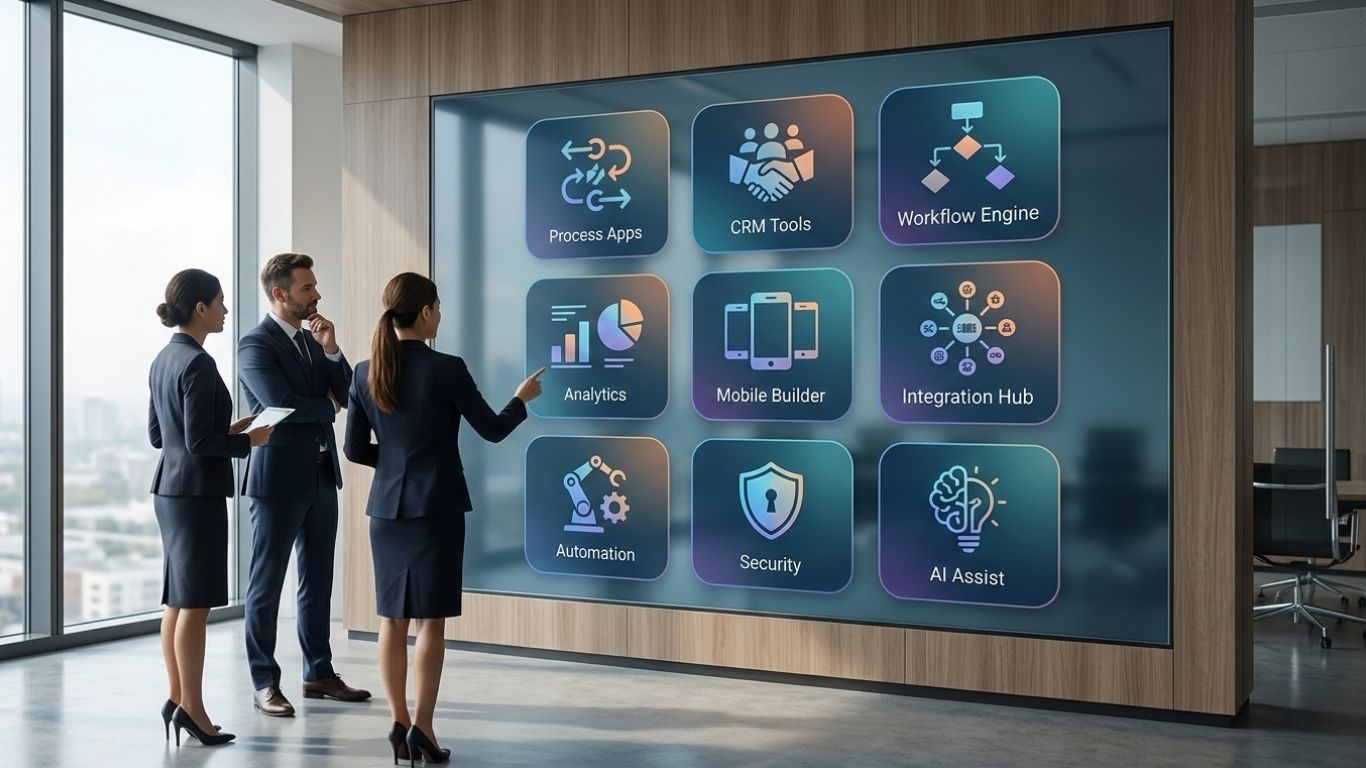
OutSystems covers the full application development lifecycle from a single visual environment.
- Visual Full-Stack Development Service Studio provides drag-and-drop tooling for UI design, data modelling, workflow logic, and API configuration. The IDE auto-generates responsive web and mobile front-ends alongside back-end services, removing the need to manage separate technology layers.
- AI-Assisted Development OutSystems Mentor provides in-IDE suggestions and error detection during development. The Agent Workbench enables teams to build AI-powered conversational assistants and automate repetitive development tasks, accelerating delivery on more complex projects.
- Integration Capabilities The platform ships with 400+ pre-built connectors for databases, ERP systems, SAP, Salesforce, Microsoft services, and cloud platforms. REST and SOAP API support allows connection to virtually any external system, with visual data mapping reducing integration effort significantly.
- Security and DevOps Built-in role-based access control and encryption are applied by default. AppShield, OutSystems’ static code analysis tool, scans continuously for vulnerabilities. Automated deployment, rollback, version control, and real-time performance monitoring are all included, enabling continuous delivery with minimal operations overhead.
- Hosted Platform Specifications The OutSystems Cloud is a fully managed PaaS running on AWS, with a 99.5% uptime SLA. OutSystems Platform handles infrastructure provisioning, scaling, patching, and maintenance. For organisations requiring more control, self-hosted deployment is supported on Azure or on-premises environments running Microsoft SQL Server and .NET.
- Mobile Push Notifications OutSystems supports OneSignal for cross-platform push messaging via an official plugin. Setup requires a developer to install the OneSignal plugin within the OutSystems mobile app module and supply the OneSignal App ID and API key. Once configured, push notifications are delivered to end users without writing any native mobile push code.
Use Cases Across Industries

- Banking and Insurance Banks use OutSystems Platform to build digital customer portals, KYC/AML processing workflows, and loan management systems. Insurers leverage it for policy processing and compliance automation, reducing the developer headcount needed to meet regulatory cycles.
- Government Agencies have deployed citizen-service websites, permit application portals, and internal case-management tools. OutSystems Platform handles real-time workflows including submissions, approvals, and document uploads without long IT project timelines.
- Healthcare Hospitals use OutSystems Platform for patient engagement portals, appointment scheduling, video consultation platforms, and electronic patient record systems. Its security architecture supports HIPAA-compliant deployments, and rapid iteration cycles allow quick responses to clinical workflow changes.
- Logistics and Manufacturing OutSystems Platform connects directly to sensors and legacy ERP systems to power warehouse inventory trackers, shipment dashboards, and IoT monitoring interfaces. A logistics company can build a custom inventory-tracking application in weeks rather than months.
- Retail and E-Commerce Retailers have built mobile shopping apps, customer loyalty portals, and in-store employee tools using OutSystems Platform. Its AI capabilities enable personalised product recommendations and real-time sales analytics dashboards.
OutSystems vs Other Low-Code Platforms
OutSystems platform competes directly with Microsoft Power Platform, Salesforce Lightning, Mendix, Appian, and ServiceNow in the enterprise low-code space.
By adoption volume, Microsoft Power Platform leads the market with over 56 million monthly active users across Power Apps and Power Automate. Gartner consistently lists OutSystems, Microsoft, Mendix, and Salesforce among enterprise low-code Leaders. The top Power Apps use cases across industries illustrate where Microsoft’s platform excels and where its constraints become apparent.
The platforms diverge meaningfully in focus and fit:
| Platform | Best For |
|---|---|
| OutSystems | Full-stack custom enterprise apps, cross-platform mobile |
| Microsoft Power Platform | Office/Dataverse-integrated forms and workflow automation |
| Mendix | Enterprise apps with an intuitive visual interface |
| Salesforce Lightning | CRM-native sales, service, and marketing automation |
| Appian | Business process management and workflow-heavy applications |
On development speed, OutSystems and Mendix excel for complex logic and custom UIs. Power Apps is faster for simple form-based projects. On scalability, OutSystems’ cloud-native design handles large enterprise workloads, though it rewards careful application architecture. On pricing, OutSystems uses fixed enterprise licensing (higher upfront, unlimited users), while Microsoft and Salesforce typically charge per user per month.
OutSystems vs Salesforce Low-Code Platform
OutSystems and Salesforce serve distinct needs. OutSystems Platform is a general-purpose, full-stack platform. Salesforce Lightning is optimised for extending the Salesforce CRM ecosystem.
Platform Focus OutSystems Platform builds any custom application: consumer-facing mobile apps, internal ERP portals, operational dashboards. Salesforce Lightning excels at customer-facing and sales or service applications that run on Salesforce data.
Developer Experience OutSystems Platform provides a standalone visual IDE with an embedded DevOps pipeline deployable across multiple clouds. Salesforce offers a web-based App Builder and Flow tools within its own environment. OutSystems is generally regarded as the stronger environment for professional development teams; Salesforce can be more cumbersome for custom logic, as it relies heavily on metadata-driven objects.
Customisation OutSystems Platform allows custom .NET code and integrates with virtually anything via REST services. Salesforce is more opinionated, primarily constraining developers to its own data model. Highly custom widgets or non-Salesforce data integrations require more effort on the Salesforce side.
Cost Structure Salesforce charges per-user licensing, which is economical at small scale but rises linearly with headcount. OutSystems charges larger fixed fees per environment, making it more predictable for unlimited-user enterprise deployments.
For organisations already invested in the Salesforce ecosystem, a Salesforce agency can help unlock its full CRM automation potential before the decision to switch or extend platforms is made. When to choose each platform comes down to this:
- Choose OutSystems Platform for broad, mission-critical application portfolios that extend beyond CRM, including public-facing apps and heavy data processing systems.
- Choose Salesforce Lightning if the primary goal is automating sales, service, or marketing processes within an existing Salesforce environment.
Is OutSystems Hard to Learn? Does It Require Coding Knowledge?
OutSystems Platform is easier to start with than traditional development, but it is still a professional platform with a real learning curve. Common tasks such as UI design and data modelling ramp up quickly. Advanced capabilities including custom integrations and performance tuning take considerably longer to master.
Coding is not a prerequisite for most OutSystems work. The platform abstracts nearly all underlying code, and an OutSystems MVP confirms that routine platform use rarely requires C# or .NET knowledge. That said, familiarity with programming concepts such as variables, data types, and security logic accelerates troubleshooting and platform extension. OutSystems provides extensive documentation, a large community forum, official training courses, and sample application templates.
How HBLAB Helps Enterprises Navigate Low-Code Platform Decisions
Choosing between OutSystems Platform, Salesforce, or a fully custom low-code platform is rarely a straightforward call. The right answer depends on your existing infrastructure, team capability, budget, and the complexity of what you are building.
HBLAB works with enterprise IT leaders to make that decision with clarity, and then delivers on it.
With over 10 years of experience in custom digital solutions and a team of 700+ IT professionals, HBLAB brings the technical breadth to work across platforms rather than advocate for just one.

Whether your organisation needs staff augmentation to accelerate an OutSystems low-code development platform project, CRM workflow expertise to extend Salesforce, or an independent custom low-code solution built entirely around your own processes, HBLAB structures the engagement to fit the problem.
30% senior-level employees with five or more years of experience means your project is handled by engineers who have navigated enterprise integration, security compliance, and large-scale deployment before.
HBLAB holds CMMI Level 3 certification, reflecting the process discipline that mission-critical application development demands.
For CTOs and IT directors weighing platform costs, HBLAB’s delivery model offers up to 30% cost efficiency compared to local market rates, with flexible engagement options including dedicated teams, offshore models, and Build-Operate-Transfer arrangements that keep full control with the client.
CONTACT US FOR A FREE CONSULTATION
People Also Ask
1. Is OutSystems a programming language?
No. OutSystems is a low-code development platform, not a programming language. It runs on .NET and generates C# and JavaScript under the hood, but developers work visually rather than writing code directly.
2. Is OutSystems a SaaS or PaaS?
OutSystems is a PaaS (Platform as a Service). It provides a managed cloud infrastructure for building, deploying, and running custom applications, not a ready-made software product for end users.
3. Is OutSystems a CRM?
No. OutSystems is a general-purpose application development platform. It can be used to build CRM-like tools or integrate with existing CRMs such as Salesforce, but it is not a CRM itself.
4. Which companies use OutSystems?
OutSystems counts major enterprises among its clients across banking, insurance, healthcare, and government. Notable adopters include Volkswagen, Logitech, Deloitte, and several large public-sector agencies across Europe and North America.
5. Is OutSystems hard to learn?
OutSystems platform has a manageable learning curve for developers, but it is not a beginner tool. Basic app building ramps up quickly; advanced features such as custom integrations and performance optimisation take considerably more time to master.
6. What are the big 3 coding languages?
By global usage, the three most dominant programming languages are Python, JavaScript, and Java, consistently ranking at the top across developer surveys including Stack Overflow’s annual report.
7. Which is the toughest coding language in the world?
Malbolge is widely regarded as the most deliberately difficult language ever created, designed to be nearly impossible to program in. Among mainstream languages, C and Assembly are considered the most demanding due to their low-level memory management requirements.
READ MORE:
>> Salesforce Agency: Intelligent CRM Automation
>> Low Code vs Traditional Development: Choosing the Right Approach for Your Project
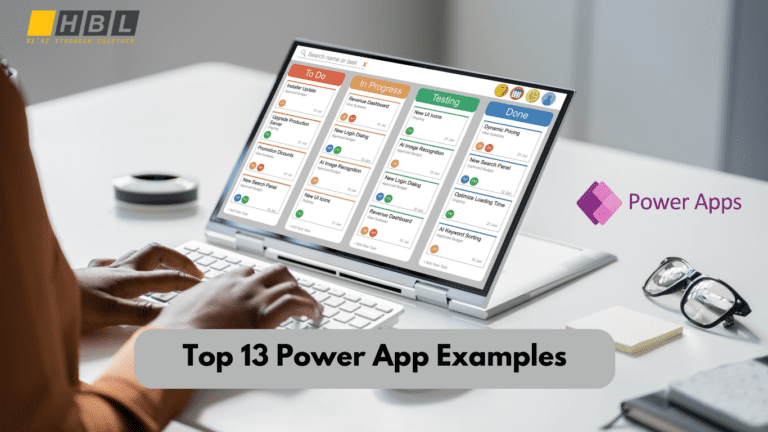
>> Top 13 Power Apps Examples & Use Cases in Real Life